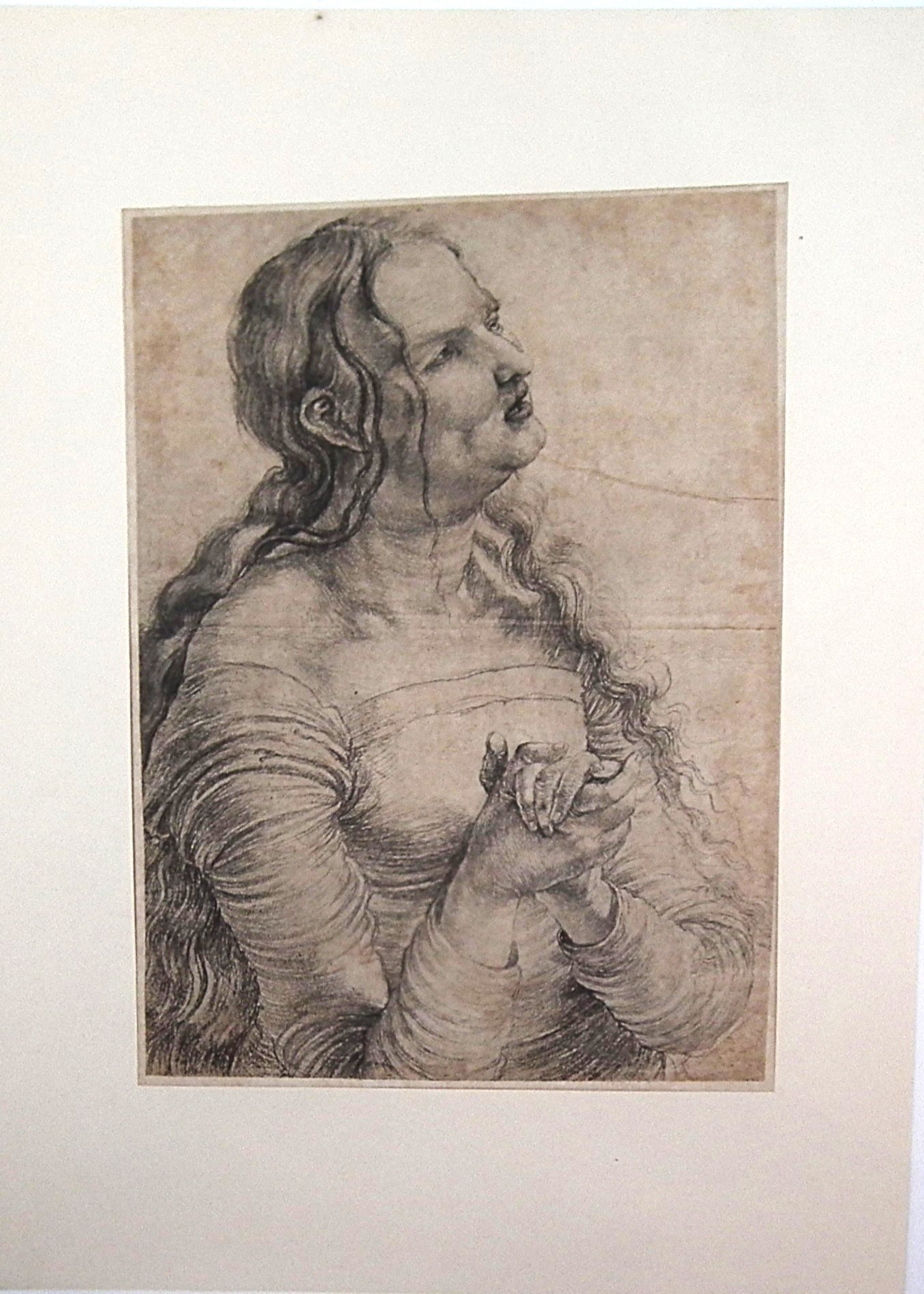
lithograph, paper, 42 x 32 cm in light of original passe - partout, (60 x 45 cm sheet ); dry seal of Museum Albertina, lithograph made in the 19th century by the museum office "Albertina Facsymile" in Vienna; unique print from the only unique edition of prints of the Dürer school published at the end of the 19th century.
Matthias Grünewald was a German painter, architect and engineer. Despite living at a time when the Renaissance was beginning to dominate European art, the artist remained faithful to Gothic traditions, but gave them a new, expressive form.
Grünewald worked closely with and Dürer on the Heller Altarpiece (also known as the Frankfurt Altarpiece), creating a unique work.
Dürer was the more famous artist of his time, but Grünewald also had his place in art history, especially with the Isenheim Altarpiece. Around 1512, he set to work on his masterpiece, a large altarpiece polyptych in the Saint Antoine hospital chapel of the Abbey of the Antonite Order in Isenheim (now Colmar), which he completed in 1516, when he found himself in the service of the Archbishop of Mainz, who was also the principal of Durer, Cranach and Holbein. The altarpiece is known for its exceptionally expressive depiction of suffering, which was characteristic of Grünewald. This artist, despite living at a time when the Renaissance was beginning to dominate European art, remained faithful to Gothic traditions, but gave them a new, expressive form.
"Study of a Woman" is a reference to one of the figures in the Isenheim Altarpiece. could be one of the figures accompanying Christ, which would be in keeping with the overall mood and theme of Grünewald's work.
Although he remained in the service of the Archbishop of Mainz, he turned with interest to the Reformation, which brought serious consequences. The artist, as a supporter of Protestantism, was forced to leave Mainz and live in Frankfurt, where he essentially stopped painting to toil in the paint trade and soap production. In 1527 he settled in Halle, where he took up hydraulic engineering and where he died the following year.
The Isenheim altarpiece is considered one of the most important works of religious art of the late Gothic period and is kept at the Musée d'Unterlinden in Colmar, France. Its dramatic and emotional depictions have had a major influence on later generations of artists and are still admired for their depth and expressive power.