


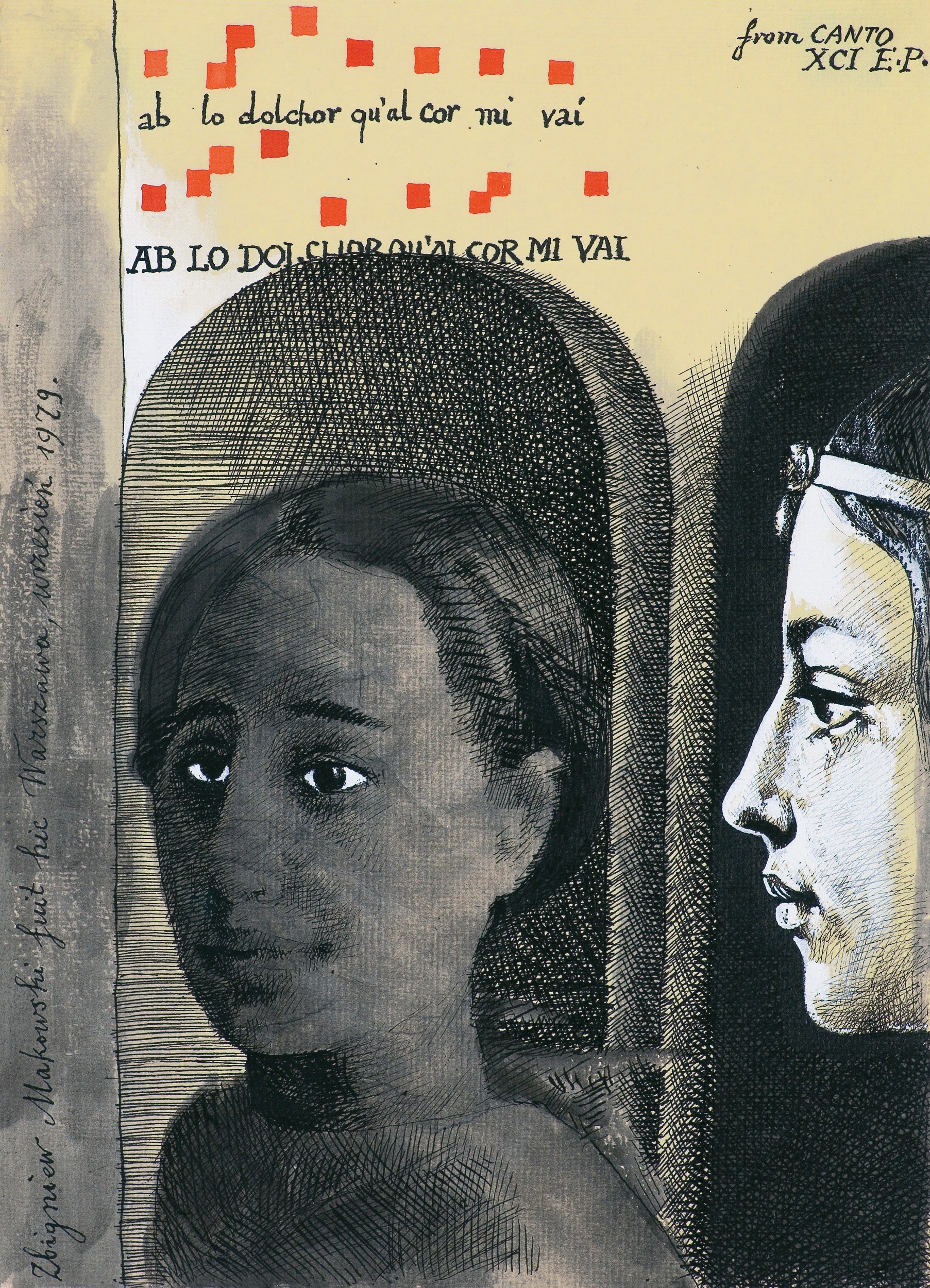

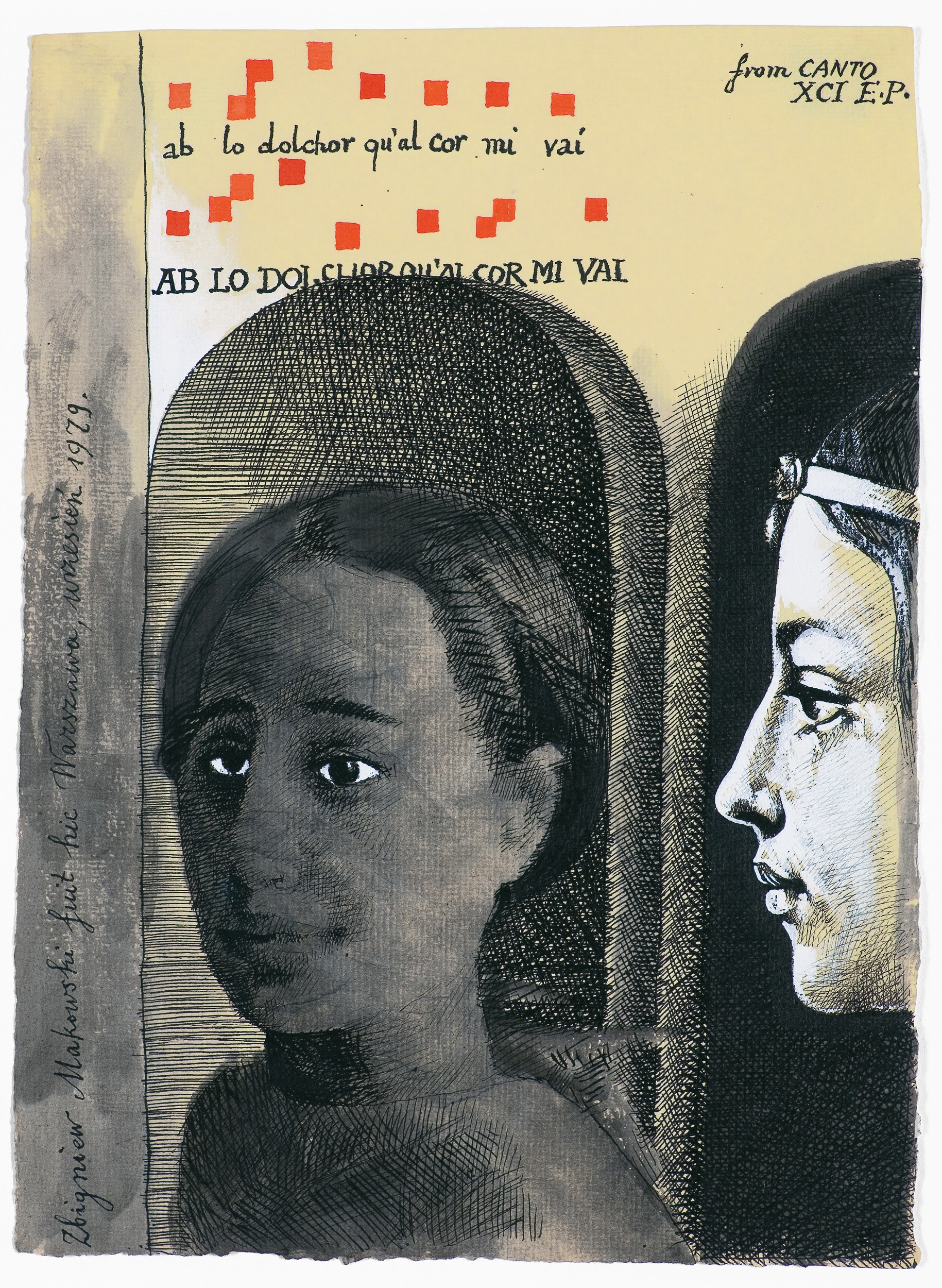
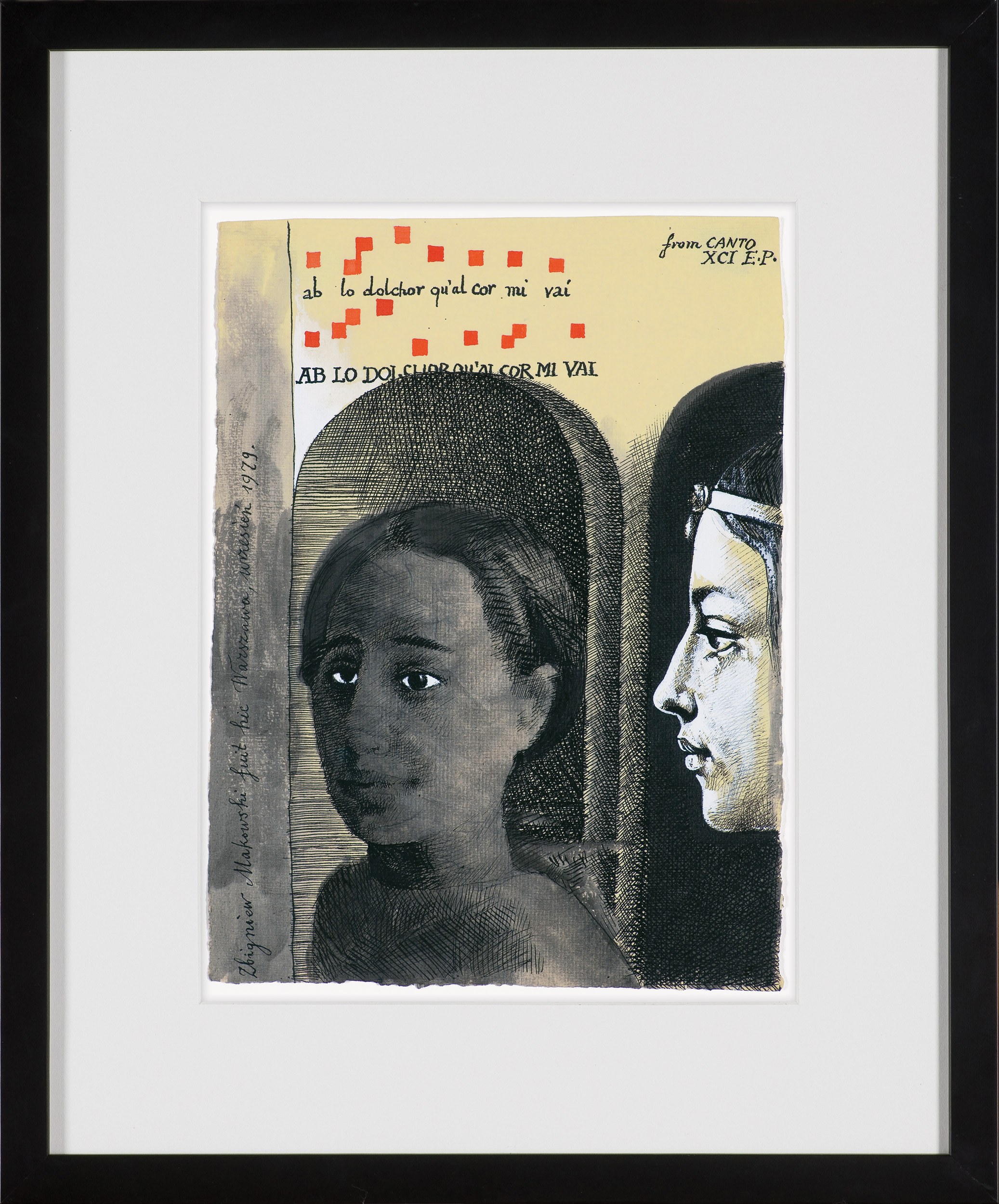
31.0 x 22.5cm - ink pen, brush, gouache, paper
apis in ink l.g.: ab lo dolchor qu'al. cor mi vai, below the same in verso, p.g.: from CANTO | XCI E.P., signed vertically along the left edge: Zbigniew Makowski fuit hic Warsaw, September 1979.
Provenance:
Collection of art historian Teresa Sowinska (1940-2023), author of many publications and exhibitions, professionally associated with the Warsaw "Zachêta".
The artist took the title of the work from Song XCI included in the poem "Songs" ("The Cantos") by Ezra Pound. The poet created this cycle (unfinished) almost all his life (successive editions were published between 1925 and 1969). Like Dante in the "Divine Comedy," on which he modeled himself, he intended to give in them a summation of human history and culture from the point of view of the present day. Wandering through Hell, Purgatory, Paradise - however not so explicitly named in the poem - contains a huge number of paraphrases, borrowings and references to figures, symbols and events from world history, mythology, religion, political systems, as well as to literary styles, including the works of medieval troubadours, from which the title quote was taken. The arrangement of red squares is a score of the melody accompanying the words of these works.
♣ to the auctioned price, in addition to other costs, will be added a fee resulting from the right of the creator and his heirs to receive remuneration in accordance with the Law of February 4, 1994 - on copyright and related rights (droit de suite).
Zbigniew Makowski (Warsaw, 31 I 1930 - Warsaw, 19 VIII 2019) studied at the Academy of Fine Arts in Warsaw from 1950 to 1956, receiving his diploma in the studio of Kazimierz Tomorowicz. Initially he leaned towards Surrealism - during his stay in Paris in 1962 he came into contact with André Breton and the international Phases movement. However, the decisive influence on the expression of his art came from the non-painterly interests he pursued. He is literate, poetic, erudite, especially an expert in the broad spectrum of philosophy and secret knowledge of many cultures. He uses this expertise in his paintings, drawings, as well as in unique books, which he makes with his own hands on specially prepared papers. In his works he layers symbols, quotations and meanings into a seemingly unreadable chaos. However, one should believe critics who claim that Makowski's works open up a world of peculiar narrative for the patient and intellectually prepared "reader." In turn, the artist himself draws attention to the "permutation" structure of his works, in which various quotations and cultural references are intertwined with his private iconography. Be that as it may, it is certainly possible to distinguish a certain visual-symbolic "alphabet" in Makowski's works, the elements of which constantly appear in them in various configurations. These include, for example, such images as a key, ladder, well, mandala, chalice, etc. They are surrounded by inscriptions, often in Latin, as well as single numbers, letters and ornaments. Someone described them as rebuses of great beauty, which can be read, and can also be contemplated. Since 1982, the artist stopped exhibiting, but not creating. At that time, works were created that were a kind of modern notebook, started back in the 1960s, to which the artist returns with new thoughts. The artist is the recipient of many awards, including the Norwid Art Criticism Award (1973) and the Jan Cybis Award (1992). His large composition "Mirabilitas secundum diversos modos exire potest a rebus" (1973-1980) adorns the Geneva headquarters of the United Nations as a gift from the Polish government.











Nesen skatītās
Piesakies, lai redzētu lotu sarakstu
Iecienītākie
Piesakies, lai redzētu lotu sarakstu