


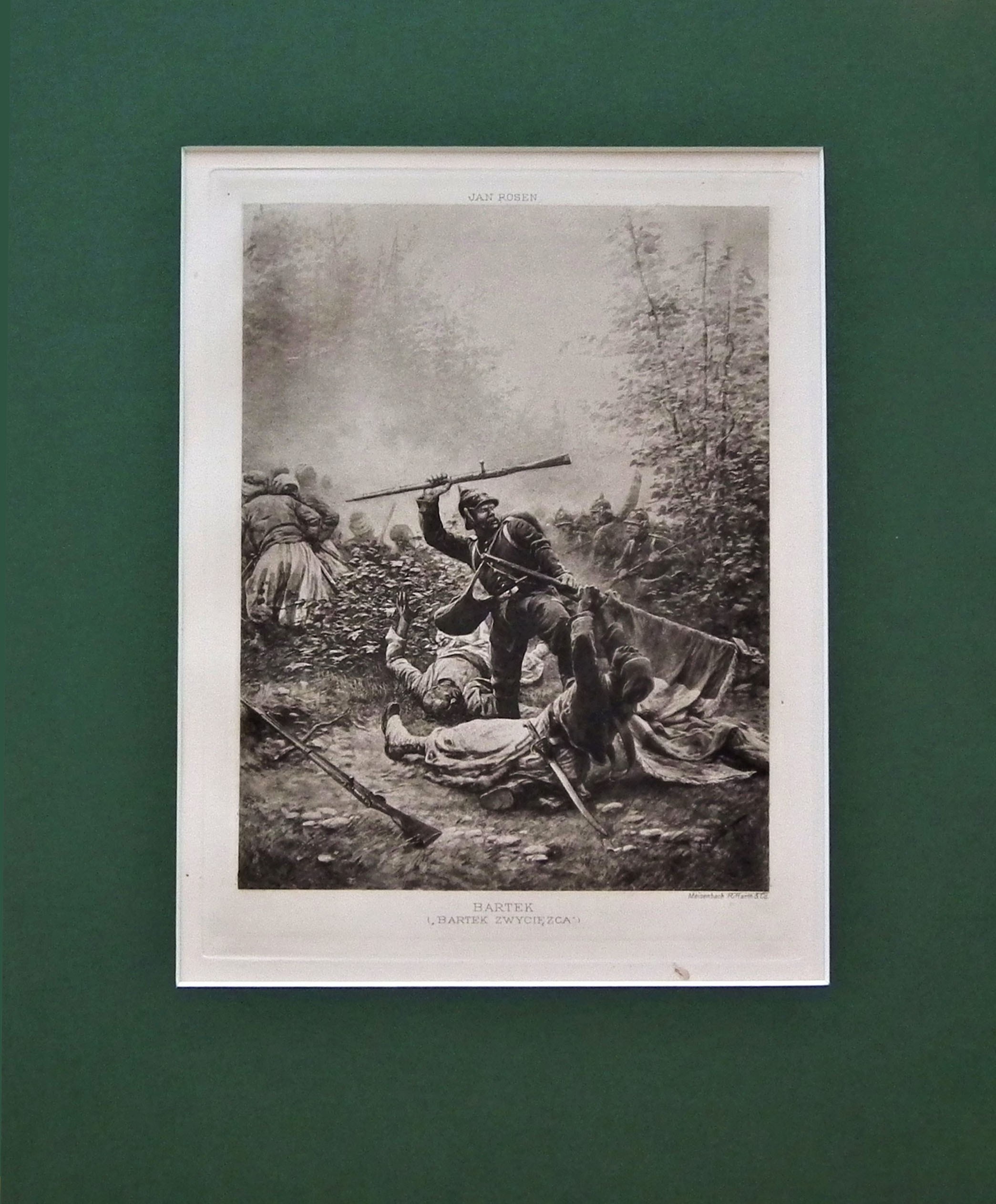
Heliogravure (visible plate impression), 25 x 19 cm, inside the passe-partout.
The print comes from a portfolio illustrating the works of Sienkiewicz, published in 1898.
Below the composition is the signature of the artistic lithography studio "Meisenbach Riffarth & Co."
As a child, Jan Rosen took drawing lessons—in Dresden with H. Redlich and in Warsaw with F. Kostrzewski. He then studied in Munich—at the Academy and in J. Brandt’s private studio—as well as in Paris under I. Pils and J. L. Gerome. He traveled extensively throughout Europe and lived in Munich, Paris, and Lausanne. He painted mainly works with military themes, battle scenes from the Napoleonic era and the November Uprising, as well as genre paintings featuring his favorite motif of horsemen and horses.
Georg Meisenbach was a German engraver and the inventor of the autotype. In 1883, Meisenbach & Co. merged with Heinrich Riffarth & Co. to form Meisenbach Riffarth & Company, a well-known European graphic arts firm.
Heliogravure (Greek: helio + gravure) — a type of intaglio printing technique, similar to aquatint, involving the photographic transfer of an image onto a metal plate (usually copper) and etching it using a photosensitive emulsion so that the brightest areas create the shallowest recesses. Invented in 1879, printing is done on a special hand press. Heliogravure, which was widespread in the 19th century, was later supplanted by rotogravure, as heliogravure is an expensive and very time-consuming method. Heliogravure is used only when it is necessary to produce a small number of very high-quality copies.










Nesen skatītās
Piesakies, lai redzētu lotu sarakstu
Iecienītākie
Piesakies, lai redzētu lotu sarakstu