


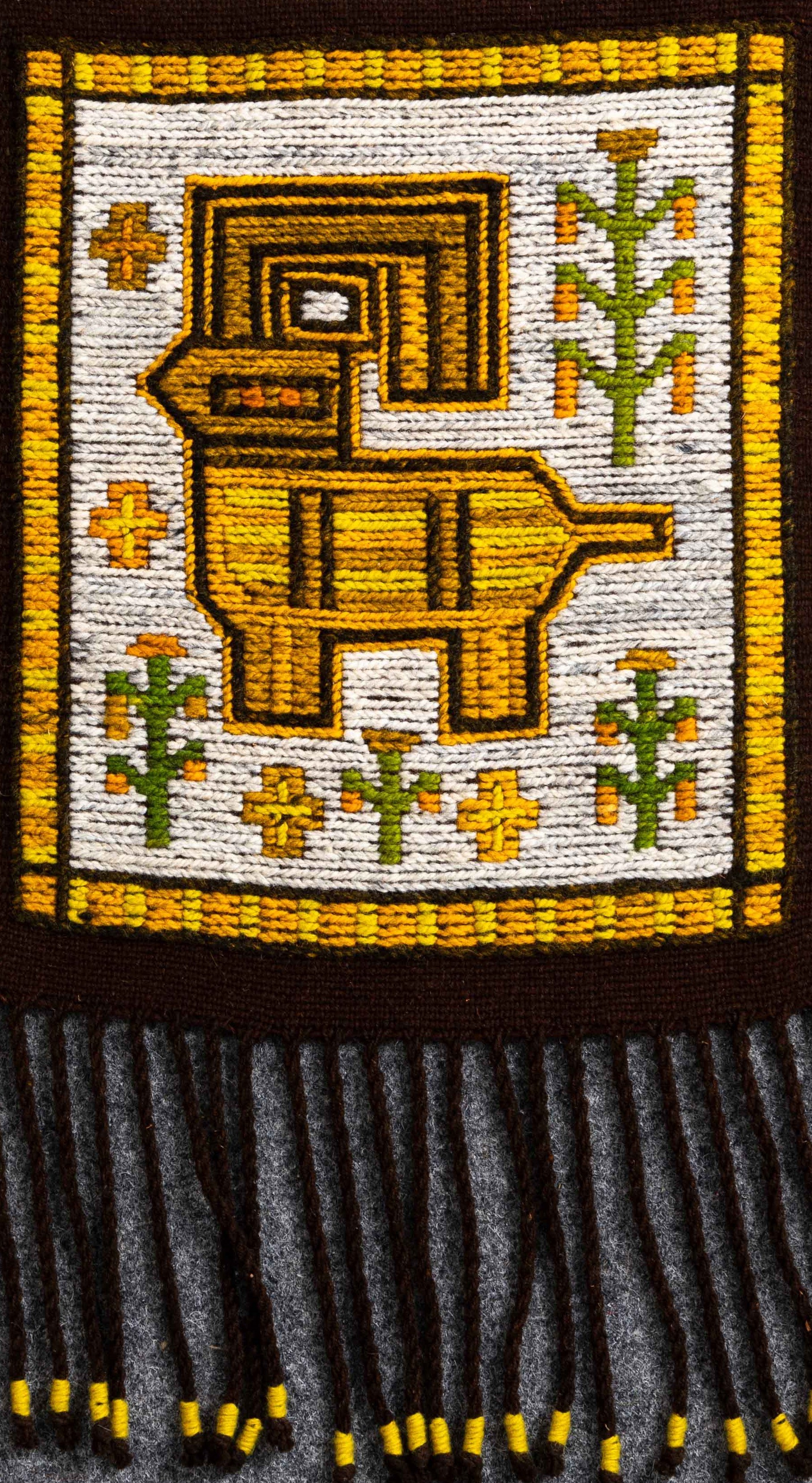
Wool on linen warp, woven by hand; 70 x 41.5 cm
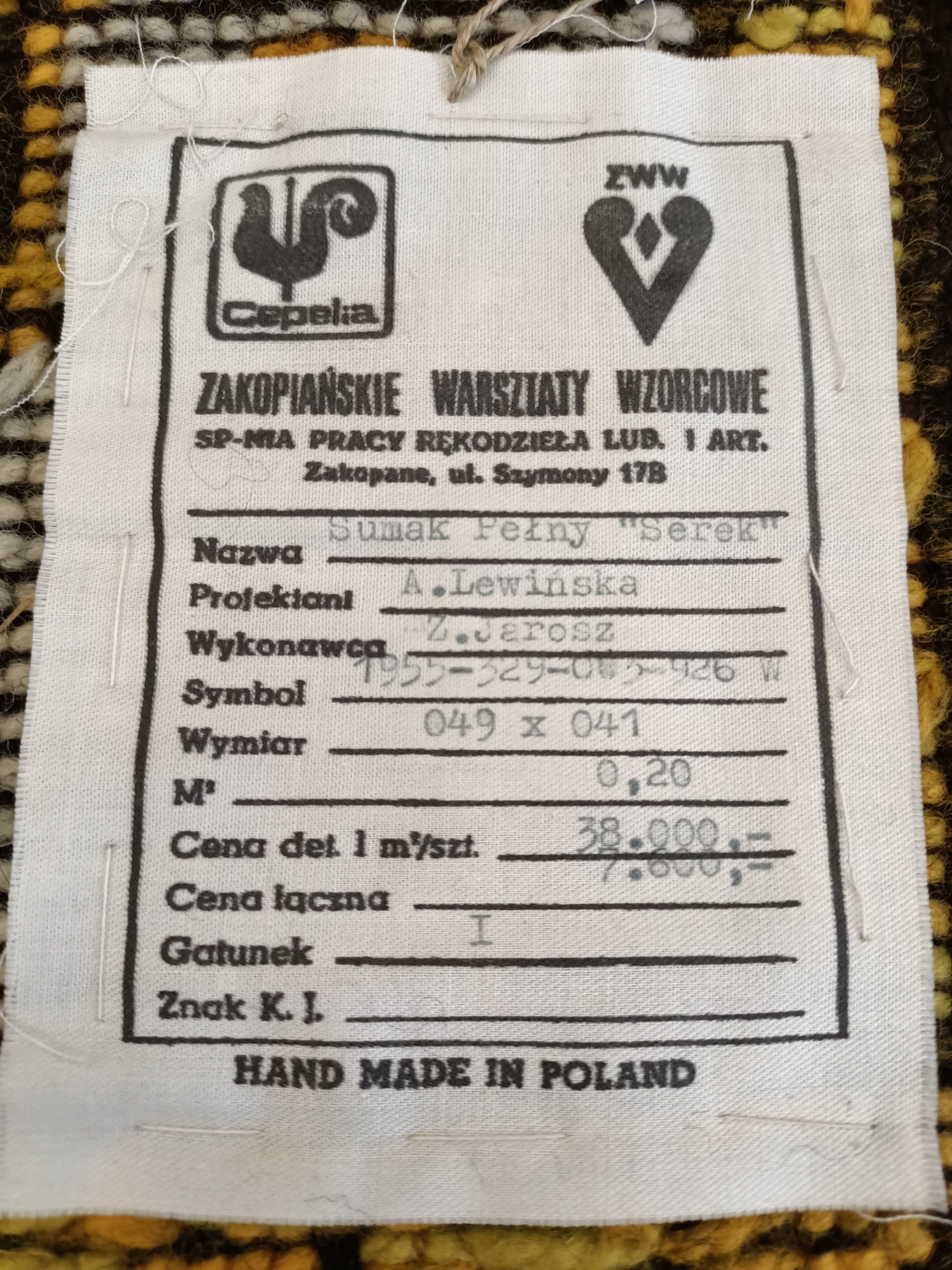
Sp-nia Pracy i Rękodzieła Lub. i Art. Zakopiańskie Warsztaty Wzorcowe; 1970s.
label preserved
Born in 1927 in Klementynów near Piotrków Tryb. Graduate of the State Higher School of Fine Arts; later of the Academy of Fine Arts in Łódź (Textile Department, under the direction of Prof. Maria Obrębska-Stieberowa)(1953). She became professionally connected with the Institute of Industrial Design already during her studies, in 1951. During a visit to the Lodz university, IWP founder Wanda Telakowska spotted the talented student and offered her a job at the newly established Department of Textiles.
She joined the multi-generational top of talented textile designers. They included experienced artists such as Stefania and Andrzej Milwicz, Anna Fiszer, Zofia Butrymowicz, Krystyna Szczepanowska, as well as young designers just entering the market: Alicja Gutkowska-Wyszogrodzka, Danuta Paprowicz-Michno, Danuta Teler-Gęsicka, Jolanta Owidzka, Anna Orzechowska, Anna Nikołajczuk, Kazimiera Gidaszewska.
In the 1950s, several hundred designs of decorative utility fabrics (garments, curtains, tablecloths) were created at the IWP, most of them quickly implemented into production, among others at the Laboratory of Cotton and Silk Industry in Lodz, the Linen Industry Plant in Walim and also at the "First", "Ortal", "Milanówek", "Fasty" plants, as well as short series also at the IWP. Designs were made in various fabric techniques and grades - in printed fabrics (spray printing, film printing, rotary printing), jacquard, hand-painted, silk, linen, cotton, artificial fabrics.
At that time, a line of designs characteristic of the style of the 1950s was developed ; these included abstract, floral and animal motifs, as well as references to folk art propagated at the time. The latter were based on motifs from folk cut-outs, Easter eggs, kilims, lace-making and painting. Teams (collectives) were organized for this purpose, consisting of talented folk artists - amateurs, who worked under the supervision of professional IWP visual artists.
This was a response to the growing social demand, and at the same time fulfilled the idea of Wanda Telakowska - design "every day and for everyone".
A prominent figure in this team was also Aleksandra Michalak-Lewinska. She was the author of dozens of designs for decorative fabrics and clothing, which still delight with their innovative designs, richness of ornaments and colors ; years later, many of them deservedly became icons of Polish design. Co-organizer of folk collectives - pisankarekas from the villages of Krzczonów and Kunów (Lubelskie) (1954-55) ; embroideresses (Żywiecczyzna) (1957) and cut-outs from the villages of Zakościele and Kraśnica (Opoczyńskie) (1962).
After the reorganization of the IWP in 1960, the IWP Textile Department was transferred to the then established Central Bureau of Light Industry Design. Aleksandra Lewinska remained at IWP, joining the Department of Interior Aesthetics, where she continued her research work on the role of fabric, color and light in interiors. Beginning in 1965, she was already working on issues of elementary school color as part of the then established Color Studio (Department). This was part of a separate, large IWP topic - the comprehensive furnishing of "Thousand-Year Schools," i.e., school furniture and entire classrooms, as well as clothing and schoolbags for students.
In 1967, she tackled the subject of the colors of enamelware used in modern kitchens. In 1969-70 she found herself in the Department of Environmental Artistic Inventions headed by Professor Wanda Telakowska. She was entrusted with the task of organizing non-professional workers' creative teams in Upper Silesia and Zagłębie. At the House of Culture in Zabrze, with artistically talented miners and young people, she worked on creating patterns that were used to create a collection of functional textiles.
At the same time, as part of her cooperation with the Training Department, she conducted courses and training at the IWP for designers, engineers, light industry and trade workers, teachers and students (1968-69).
In 1971 she returned to the Department of Color and Light, to research on interior color, which she continued until her retirement in 1982, producing innovative works, atlases and color charts relating to the furnishings of residential interiors, assessments of color in the architecture of Warsaw housing estates or an original study of environmental color charts. She also joined the inter-company Team established in 1980 to deal with the topic of standardization in design. At that time, the IWP worked out the issues of standard elements of interior design, everyday products, household appliances and fabrics. As a specialist in color issues, she participated in the development of "standard" color charts for these issues. After 1982, the artist remained professionally active as a chief specialist at the COBR of the Linen Industry in Zyrardow. She then cooperated with the IWP until 1989, leading to the production of a collection of standard linen-cotton fabrics designed at the IWP at the time. The culmination of this work was the organization of two major exhibitions of "Polish Flax" at IWP (1989 and 1994).
Independently from her work at the IWP, with the approval of the management, Aleksandra Lewinska worked as a design inspector at the Ministry of Light Industry (1952-53) ; a consultant at the United Silk and Decorative Fabrics Association (1954-67) ; an artistic manager and designer at the Zakopane Pattern Workshops "Cepelia" (1955-72) ; a chief design specialist at the COBR of the Linen Industry in Zyrardow (1972-89).
United Nations scholarship holder in Scandinavian countries (1965), which resulted in a number of later works and articles devoted especially to Finnish design.
At the same time, throughout her professional career, the artist did not stop her individual creative activity. She designed unique textiles - tapestries, kilims, sumacs and carpets ; a total of dozens of designs were created.
Her works have been shown and awarded many times, among others, at exhibitions and competitions at home and abroad, becoming a decoration of many museum and private collections. Recently, we have been able to admire them, among others, at the exhibitions "Eternally Young-Polish Vintage" (2007); "We want to be modern" (2011) and in 2021 at an open-air exhibition organized by the IWP at the WZ Gallery in Warsaw. Since 2017, they are also part of the permanent design exhibition at the National Museum in Warsaw.
For her design activities she has been awarded, among others, the Silver Cross of Merit, the badge of the Ministry of Culture and National Heritage "Meritorious Cultural Activist" and numerous departmental awards. (for: IWP)











Nesen skatītās
Piesakies, lai redzētu lotu sarakstu
Iecienītākie
Piesakies, lai redzētu lotu sarakstu