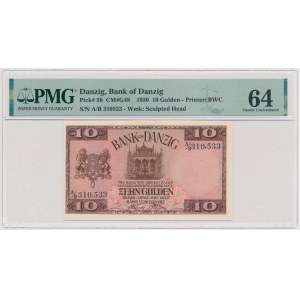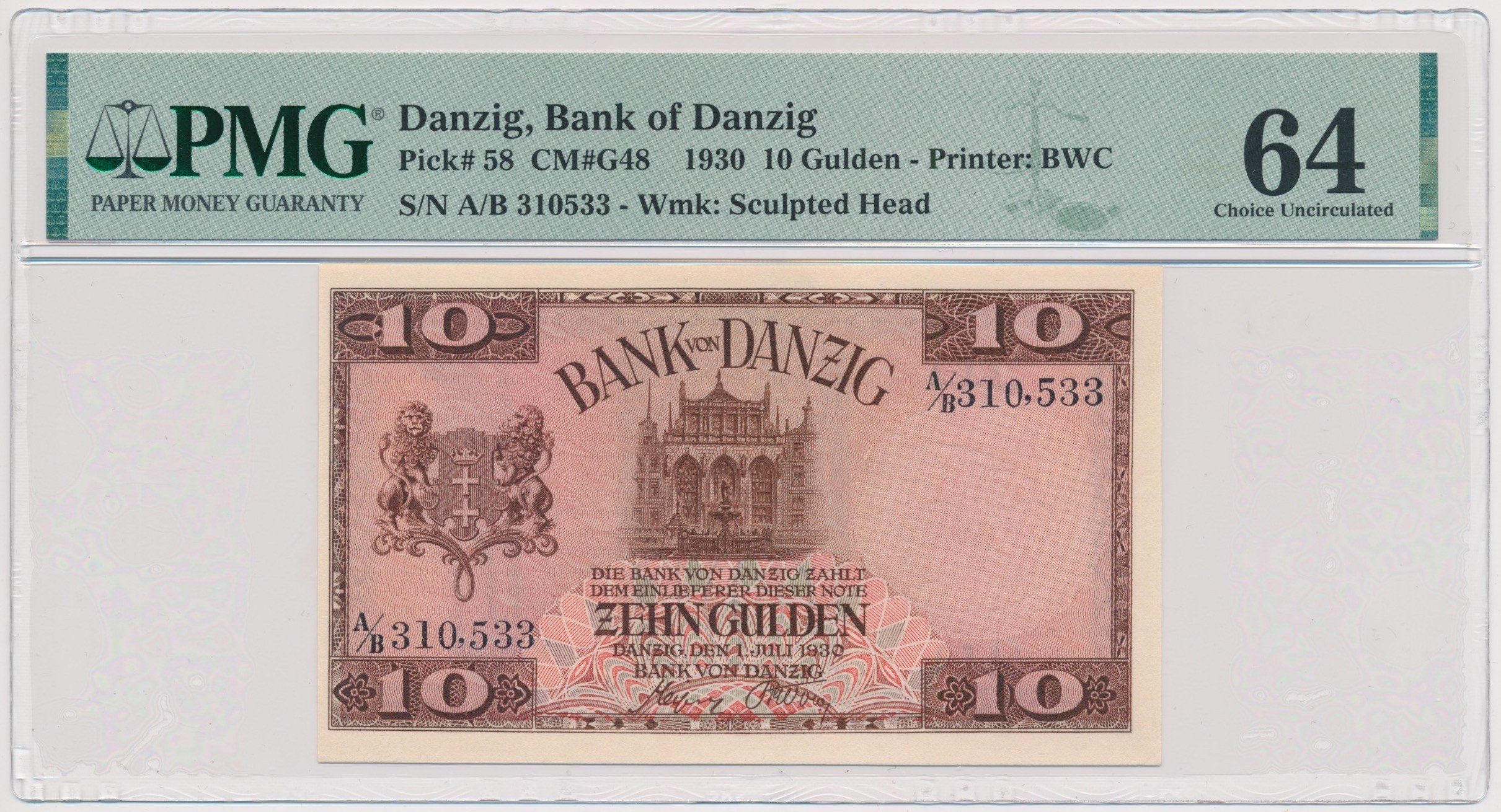
The 10 guilders of the Bank of Danzig from 1930 is a very rare banknote.
Confirmation of this is easily found in sporadic listings in numismatic archives. It has occurred only 2 times in our entire history.
Its rarity today is related to its short circulation time, about a year, in which it did not manage to disperse.
At the end of 1923, due to the hyperinflation of the mark, the city of Danzig decided to create a new, stable currency - the guilder. The effects of this decision, in the form of the first banknotes, went into circulation in October. These were so-called transition guilders, issued by the Danzig Central Bank. They were replaced in the first half of 1924 by a proper guilder issue - the Bank of Danzig.
It was then that the new banknotes were introduced into circulation with the date February 1924. The lowest denomination of this issue was 10 guilders, which was in circulation for as long as 8 years. And as a denomination of common use over the years, it naturally deteriorated and wore out in circulation, which is perfectly evident from the pieces that have survived to our time. Probably this was the reason for the realization of a supplementary issue of 10-gulden (just dated August 1930).
It was put into circulation in June 1931 and withdrawn less than 13 months later, in July 1932, coinciding with the introduction of new 5-gulden coins.
Today it is not only a very rare item, but also the last WMG 10 guilder bill.
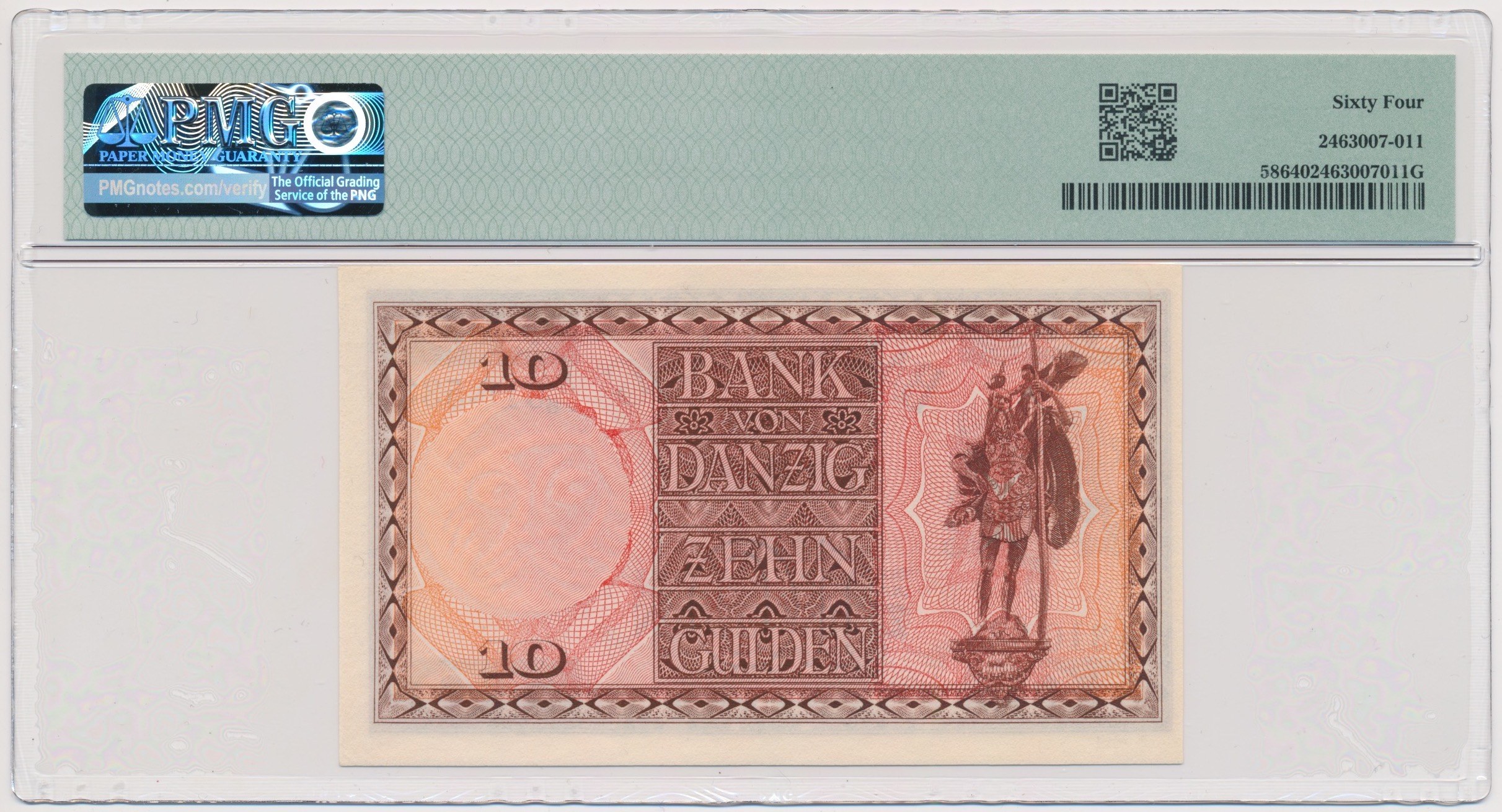
A beautiful, perfectly preserved piece, only with an off-center obverse printing. Rated by PMG at note 64.