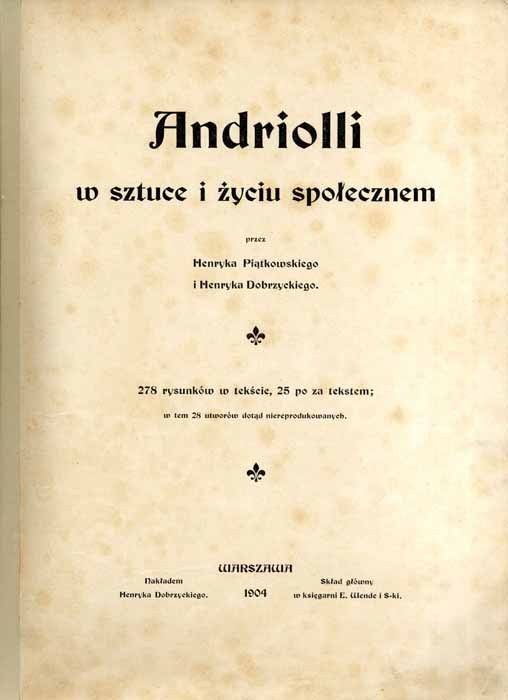
Title: Andriolli in Art and Social Life
Author: Henryk Piątkowski, Henryk Dobrzycki
Item description:
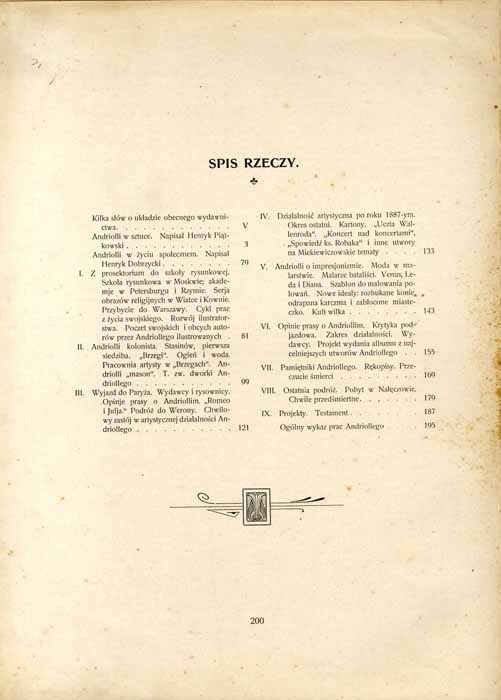
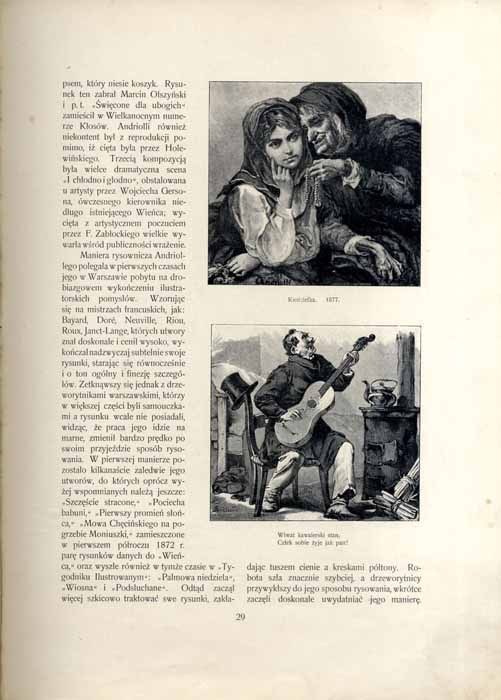
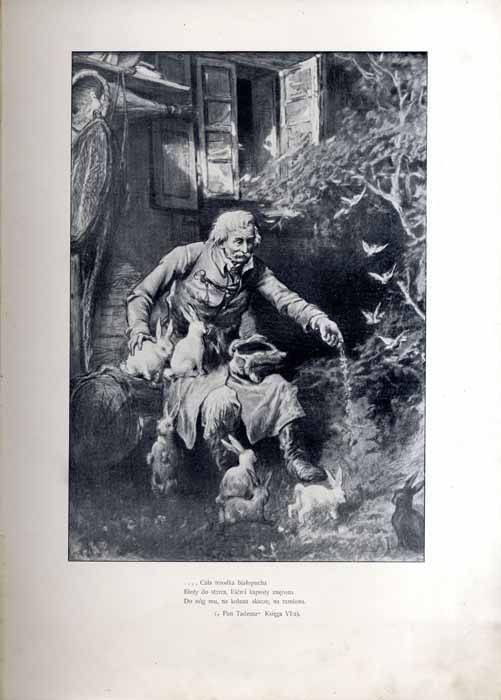
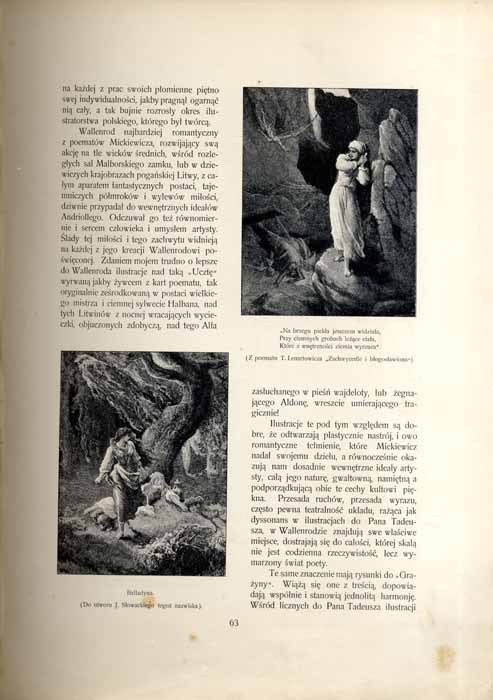
Notes: Aclassic and still fundamental study of the subject; a reprint of this title was published in 2011. Very rich iconography (black and white): illustrations on 12 plates and 278 printed illustrations, including full-page ones; almost all illustrations are printed, with very few in vertical woodcut.
- Michał Elwiro Andriolli - actually Elwiro Michał Andriolli (November 2, 1836, Vilnius – August 23, 1893, Nałęczów, Puławy County) was an outstanding Polish draftsman and illustrator. He graduated from the Moscow School of Drawing and Sculpture in 1857 and studied in Rome for a year starting in 1860. After returning to Vilnius in 1861, he joined the underground movement and took part in the January Uprising of 1863. After the uprising’s defeat in Lithuania, he went into hiding; after being arrested, he escaped from prison and made his way to England in 1863; in 1864, he left for France, where he remained until 1866, working as an illustrator for French periodicals. In 1866, he made his way to the Empire on a secret mission; arrested and sentenced to death, his sentence was commuted to exile in Vyatka, where he remained until 1871. There he painted oil and mural paintings, mainly religious, and gave drawing lessons, including to Anna Bilińska from 1869 to 1871. In the summer of 1871, he returned to Warsaw, where he quickly gained recognition as a prolific illustrator endowed with great imagination and a natural talent for drawing, whose works filled numerous Warsaw illustrated magazines. He also illustrated numerous books. From 1883 to 1886, he lived in Paris, illustrating books for the Parisian publishing house Firmin-Didot. After returning to Poland, he settled on the Brzegi estate near Świder in the Otwock County, where he continued to work as an illustrator and also produced religious oil paintings. During his time in the country, he undertook numerous sightseeing trips, which resulted in many reportage drawings published in the press; see mainly SAP vol. 1, pp. 28–31, as well as the Polish Biographical Dictionary (PSB), vol. 1, pp. 95–96, Śliwowska 2000, p. 134, and others
Condition:
Binding without defects, the block is slightly damaged and quite heavily stained, all plates preserved but 2 loose, several pages re-glued, careful and skillful restoration of the piece, the block without inscriptions or stamps. Item in at least good condition