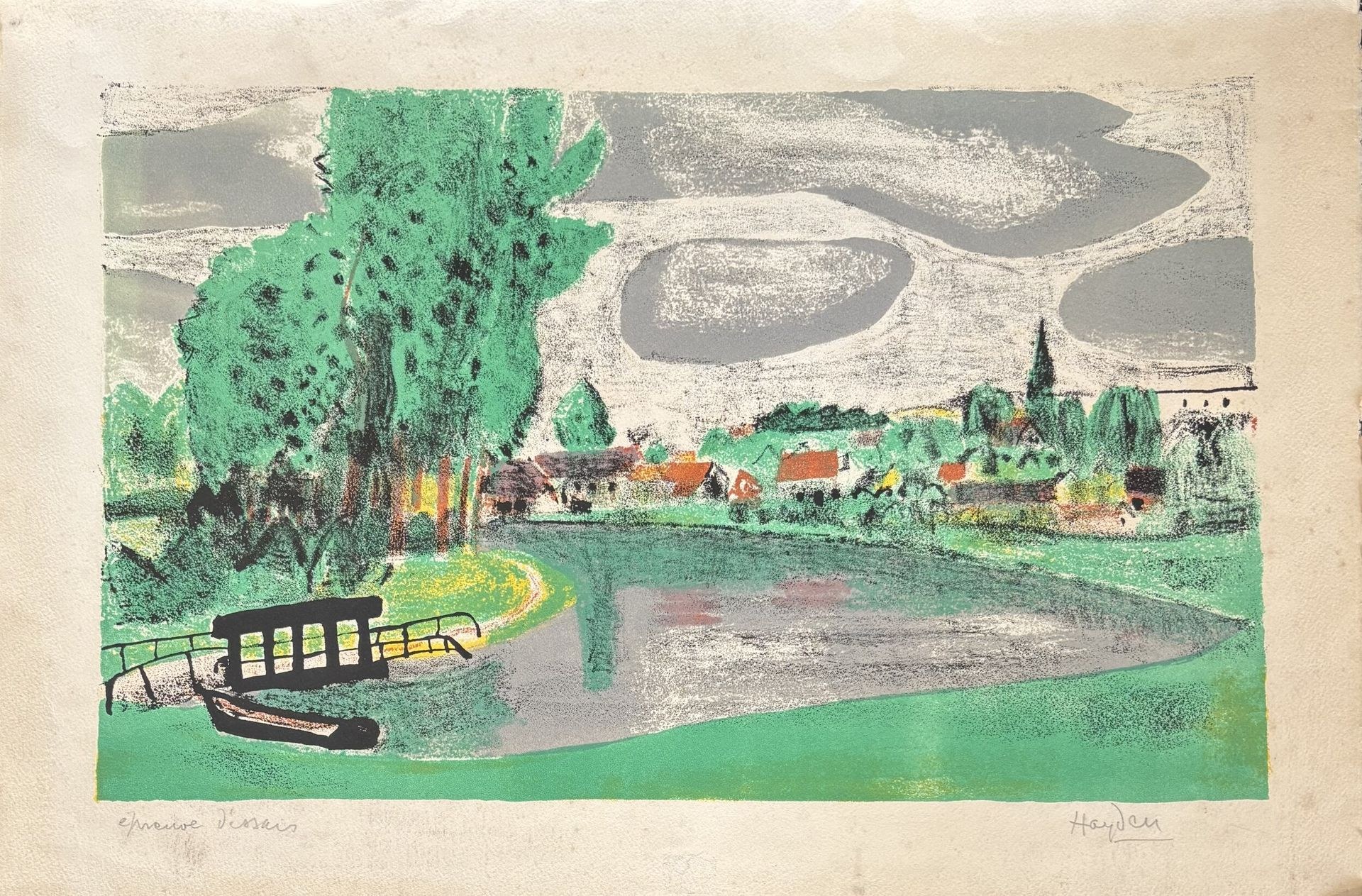
Rural landscape by a pond, ca. 1955-1965
Technique: color lithograph on paper; signed in pencil underneath: Hayden; annotated at bottom left: épreuve d'artiste (artist's piece).
Dimensions: 30 x 48 cm
View of a quiet town by the water: arched shore of a pond, a small bridge and a boat in the foreground, in the background a strip of buildings with red roofs and a slender church tower. Synthetic patches of green, gray and yellow and a free, sketchy outline build up the slightly impressionistic character of the composition - typical of Haydn's landscapes from the École de Paris period, in which the artist combined decorative color with lapidary drawing.
State of preservation: good; in places, soiling and small spots in the margins and traces of aging of the paper; image proper clean, colors fresh.
Provenance: private collection, France
Henryk Hayden (Warsaw 1883 - Paris 1970) was one of the most prominent painters of Polish origin associated with the École de Paris circle. He began his artistic studies at the Warsaw School of Fine Arts; in parallel he also studied at the Warsaw Polytechnic. In 1907 he left for Paris, where he still enrolled in the Académie "La Palette." Since 1908, he often traveled to Brittany, contacting W. Ślewiński there. After 1915, he became associated with the circle of the Parisian artistic avant-garde, including P. Picasso, J. Gris, G. Severini or H. Matisseem. In France he remained permanently. In 1920 he visited his family in Poland, but his ties with the country were quite loose - he only rarely sent paintings to exhibitions. On the other hand, he exhibited a lot in France; from 1909 he regularly took part in the Paris Salons, and also had solo exhibitions. During World War II he stayed in southern France, and it was then that his long-standing friendship with S. Beckett began. He painted landscapes, portraits and still lifes, initially showing connections with the paintings of Slevinsky, and later (1912-21) with the works of Cezanne and Cubism. After 1922, he created realistic portraits and landscapes; towards the end of his life, he returned to Cubist experience.