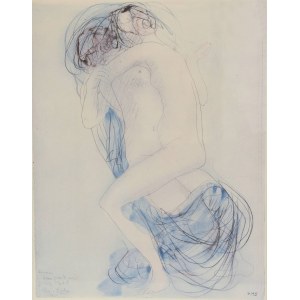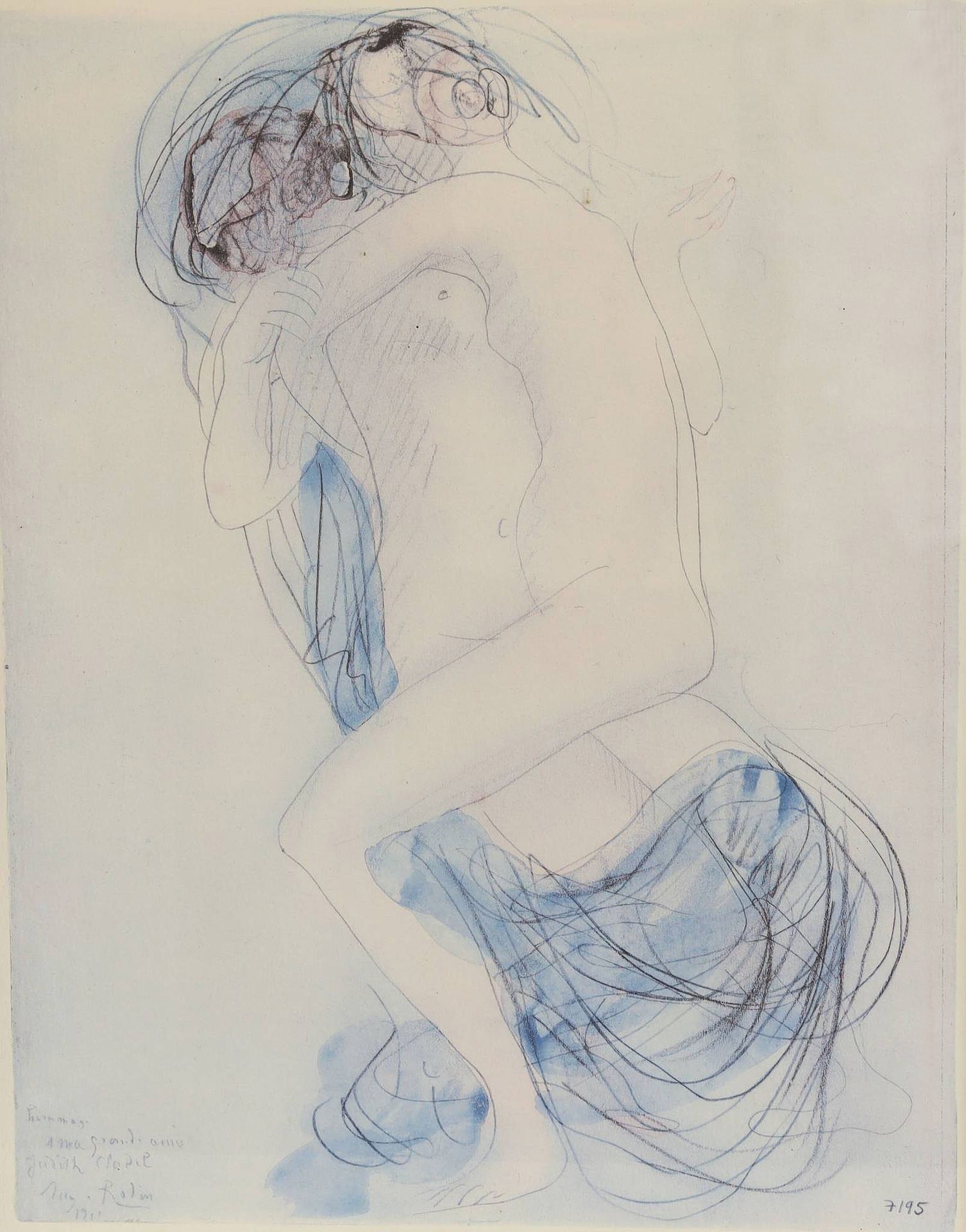
Auguste Rodin (1840-1917), The Embrace
Technique: color lithograph, signed in plate
Dedication, l.d.: "Lithograph by Auguste Rodin, Homage to my great friend Judith Cladel, 1911".
Numbering and stamp: 7/95; publisher's dry stamp
Dimensions of composition/sheet: 39.5 × 29.5 cm
Lesbian love is one of the themes Rodin explored in his work,. Two women are in an intimate embrace that leaves little room for interpretation. Both are naked and look as if they are kissing. It is difficult to see the facial expressions of the figures, as they are just a collection of lines. The mouth is easily visible, but everything else is blurred. Rodin added a touch of color around the heads. Orange and white appear in the hair, which adds life to the figures. The woman on the left is wearing what looks like a blue robe running down her back and covering her legs.
Rodin took care with the details. He used clean lines to emphasize specific parts, such as the cross, breasts and arms. Passion and affection Most of Rodin's paintings have always been about human emotions, specifically passion, love and desire. In "Two Women in Embrace," these themes are at the heart of the work. Straight lines follow the movement of the figures with each tilt. Rodin drew the two figures so that they intertwine in a way that shows deep intimacy.
The print is from an edition authorized by the Musée Rodin (dry-stamped), numbered to 95 pieces.
Condition: very good; minor natural traces of time appropriate to technique and age; fresh, contrasting print.
Auguste Rodin - one of the most important sculptors of modernity, author of The Thinker, The Kiss and The Gates of Hell, among others. Born in 1840 in Paris, he died in 1917. In his drawings and prints, as in his sculpture, he focused on gestural expression and body dynamics, using shorthand and spontaneous line. The artist's legacy is cared for by the Musée Rodin in Paris, which authorizes selected graphic editions of his works.