


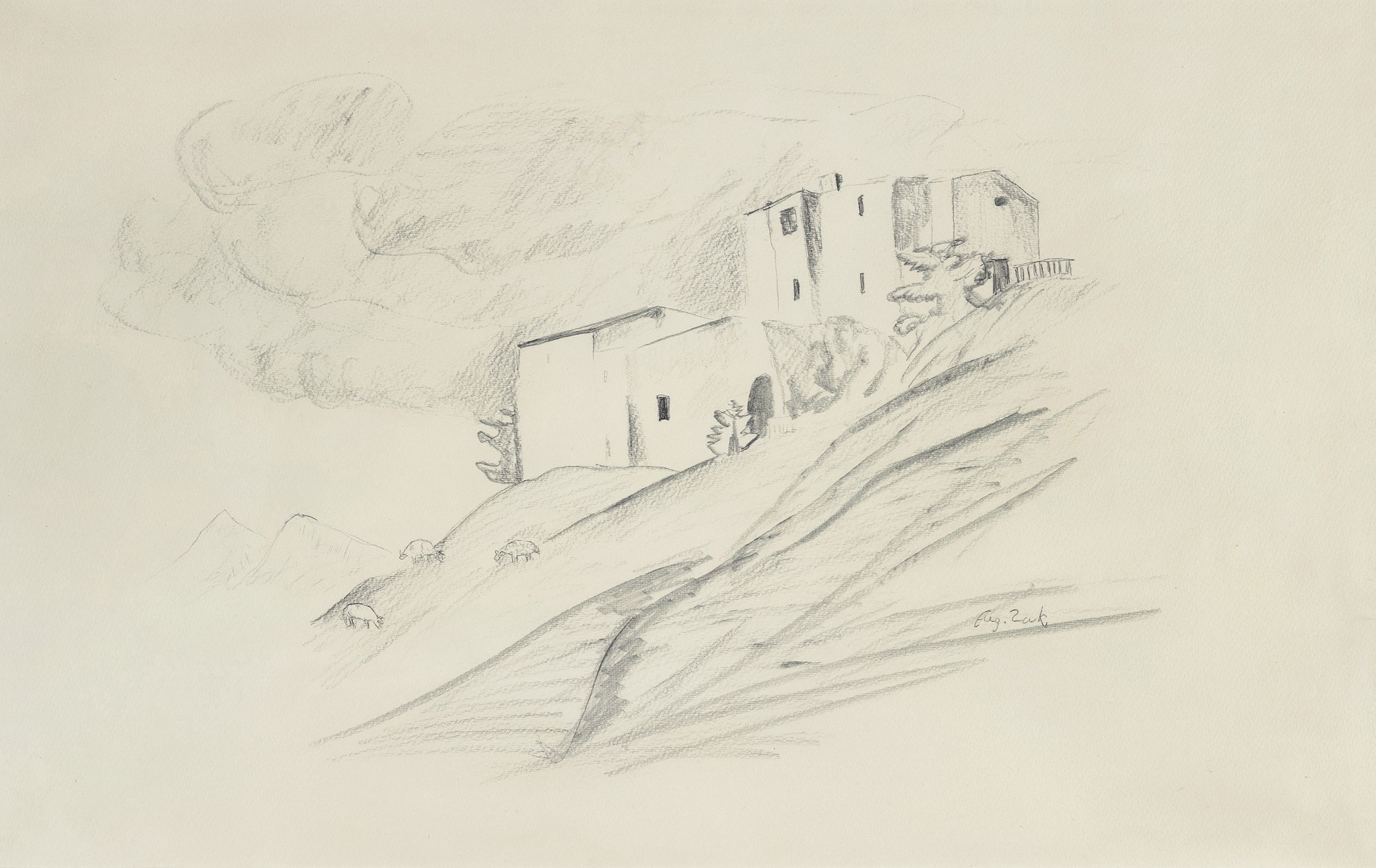
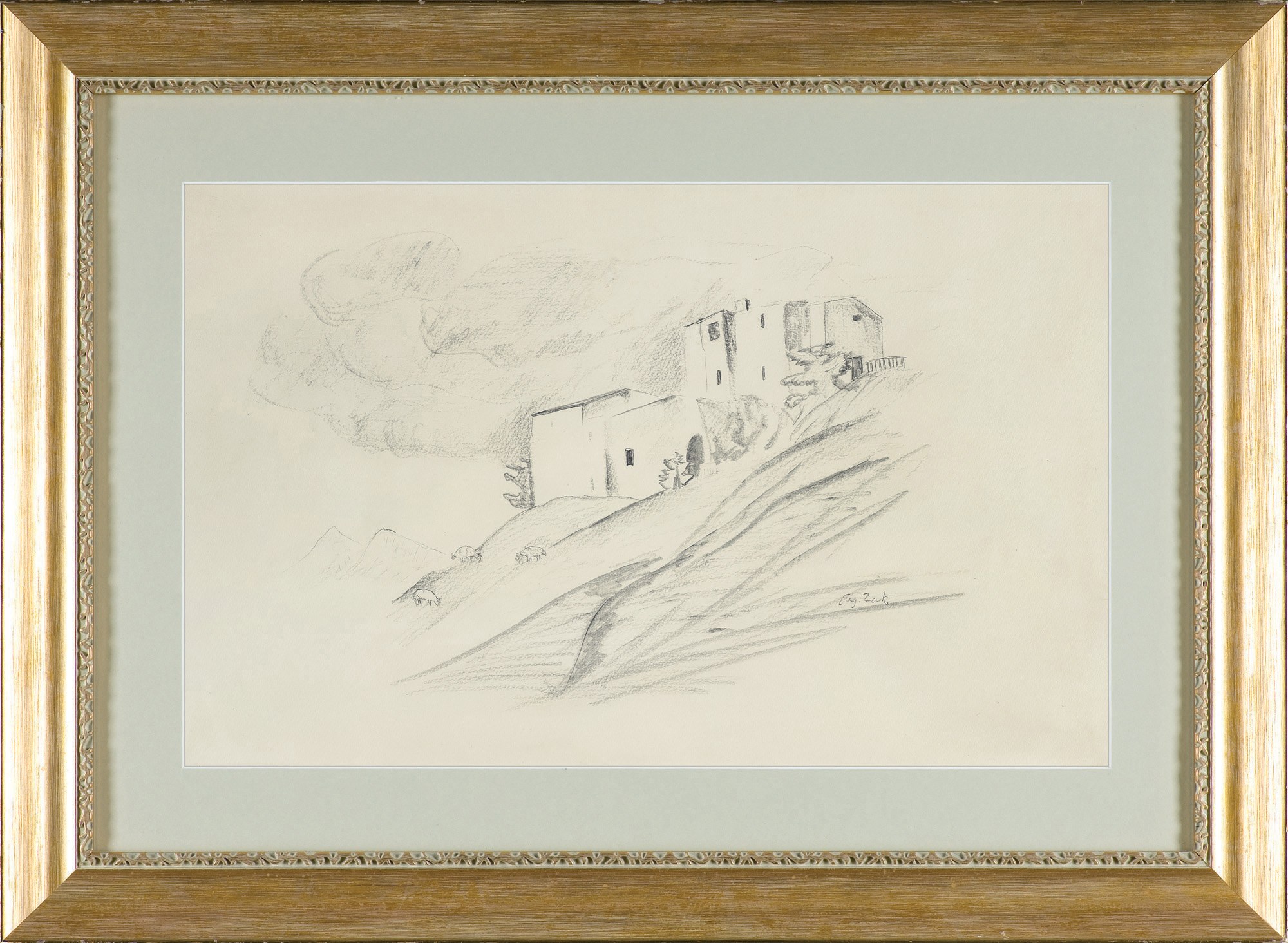
30.5 x 48.0cm - pencil, crayon, paper signed p.d.: Eug. Zak
Landscape motif used in the 1921 oil painting Idyll - Pastoral Romance (next to; MNW collection; https://cyfrowe.mnw.art.pl/pl/zbiory/452095).
Compare with:
- B. Brus-Malinowska, Eugeniusz Zak 1884-1926, National Museum in Warsaw, Warsaw 2004, p. 139, cat. no. 161, ill.
Eugeniusz Zak (Zak) (Mogilno/Mohylno in the former Minsk Governorate 1884 - Paris 1926) spent his childhood in Mogilno (Mohylno) and (from 1892) in Warsaw. In 1902 he went to Paris, where he studied at the École des Beaux-Arts with Jean Léon Gérôme and at the Académie Colarossi with Albert Besnard. In 1903 he traveled to Italy and was in Rome, Florence, Pisa, Milan. He then went to Munich, where he studied with Anton Ažbe for six months. In 1904 he returned to Paris and made his debut at the Autumn Salon. He remained in Paris until 1914, then moved to Vence and Nice. He spent the years 1916-1921 in Poland. In 1921 he went to Germany; he lived in Bonn (where he made polychromes for the villa of architect F.A. Breuhaus), later in Berlin. In 1923 he returned to Paris. He exhibited a lot, taking part in the Paris Salons, exhibitions in Barcelona (1912), Venice (Biennale 1914), Vienna (1915), among others. He also actively participated in Polish artistic life - he belonged to the Polish Artists' Society "Sztuka", also exhibited with the Formists, and was a co-founder of the "Rhythm" grouping. He was one of the most prominent Polish artists of the so-called École de Paris. He sought inspiration in Renaissance art, in the paintings of Cezane and Picasso. In his earlier period, he painted portraits and made - inspired by Renaissance art - sanguine drawings of heads and busts. He also painted idealized scenes in landscapes, lyrical and poetic in mood, and after 1920, figural compositions with one or more figures of shepherds, dancers, harlequins in interiors or landscapes. His paintings are imbued with a gentle mood of melancholy and reverie. The artist subjected the limp silhouettes of the figures he depicted to a kind of stylization - elongating their proportions and giving them supple, almost dancing poses. These paintings are characterized by decorativeness, rhythmic, "dancing" arrangements of forms, soft chiaroscuro modeling, and often textural effects.







![Eugeniusz ZAK (1887-1926), Motywa z parku [Paryskiego?], 1904](https://img1.one.bid/img/10307/3219924_1w.webp?1787159737)








Nesen skatītās
Piesakies, lai redzētu lotu sarakstu
Iecienītākie
Piesakies, lai redzētu lotu sarakstu