


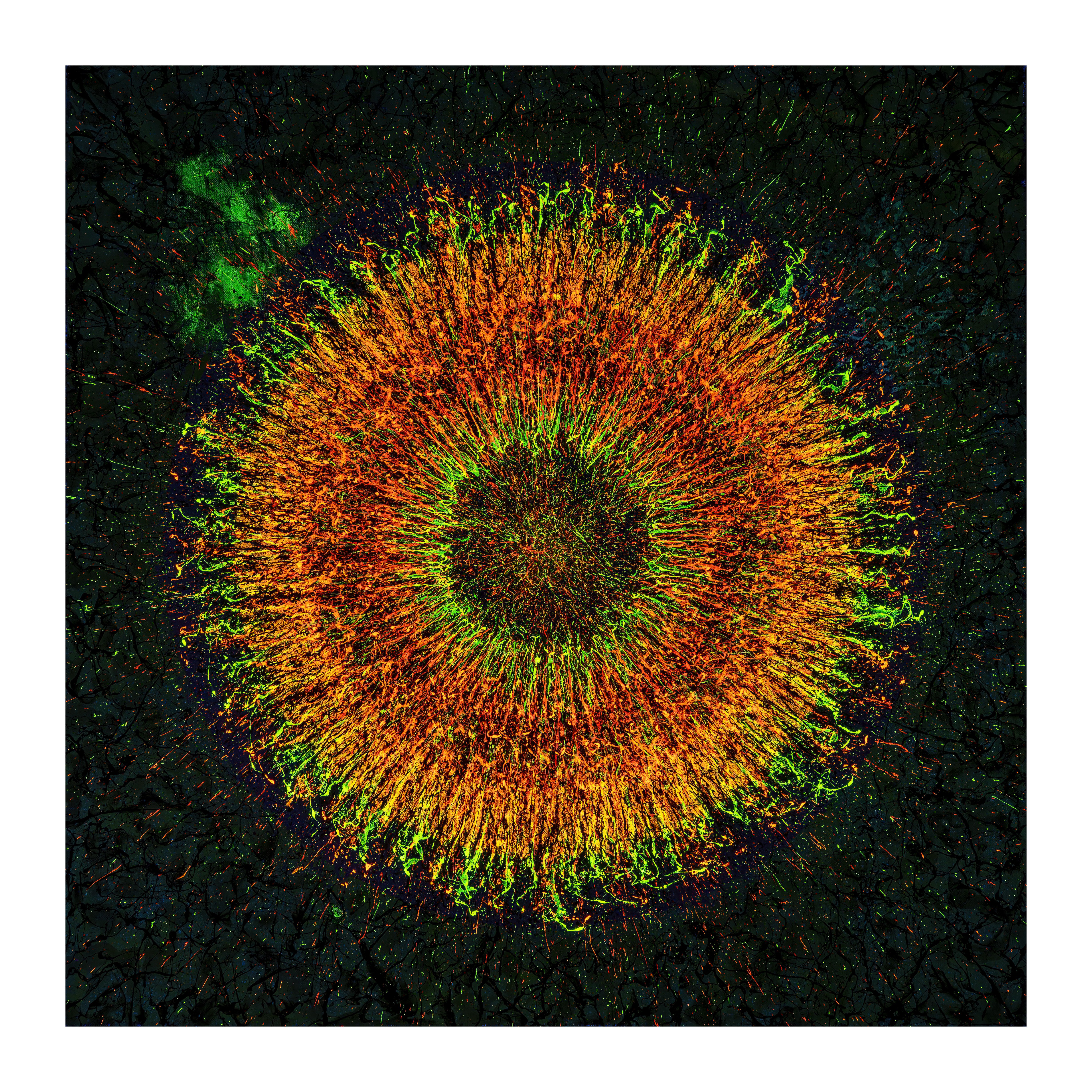
giclee, fine art paper; 50 x 50 cm;
Signed p. d.: Jaremi Picz;
Piece designation l. d.: E/A;
Stamped stamp l. d.: DELL'ARTE FOUNDATION;stamped stamp p. d.: JAREMI PICZ;
embossed stickers on back: DELL'ARTE FOUNDATION and JAREMI PICZ
Paper weight and specification: Hahnemühle 308 g/m², 100% cotton, ISO 9706
Certificate of authenticity attached to the work.
Jaremi Picz (b. 1955 Lewin Brzeski)
Participant of many exhibitions and plein-air events in the USA, France, Germany, Spain, Principality of Monaco, Ukraine, Italy, Lithuania, United Kingdom, Argentina, Czech Republic, Slovakia, Switzerland, Luxembourg, Belgium.
Characterizing the creative process of his most recognizable series, "Epicenter Quantum," the artist cites at its source, among other things, the phenomenon of supernova explosions and the enormous energy released during this process - and thus the desire to show the destruction and at the same time the transition of one form into another. Using the means of painting, Jaremi Picz wants to show a phenomenon that is not so much physical as metaphysical: making symbolically visible the phenomenon of continuity and inseparability of two elements - spirit and matter. The artist wants to draw the viewer into the interior of his paintings by focusing attention on the central point of them. The idea is to reach deeper with one's thoughts and feelings, to what is immediately beneath the showy and violent process of destruction, to the very sense of the change of life into death, and this in turn into another form of continued existence.
For Jaremi Picz it is also extremely important to show the duality of human nature and nature itself. Just as there is good and evil, light and darkness, spirit and matter, so each of his paintings in the "Epicenter Quantum" series has, as it were, two different faces. One is visible in visible light, the other can only be seen when illuminated with ultraviolet light. In this case, the idea behind the creation of the image and its inspiration was Planck's philosophy. Hence the second part of the name of the painter's series of works "Quantum". In a nutshell, the artist's paintings could be called "radioactive" works. Among artistic inspirations, the painter also mentions the works of Kazimir Malevich and Jackson Pollock.










Nesen skatītās
Piesakies, lai redzētu lotu sarakstu
Iecienītākie
Piesakies, lai redzētu lotu sarakstu