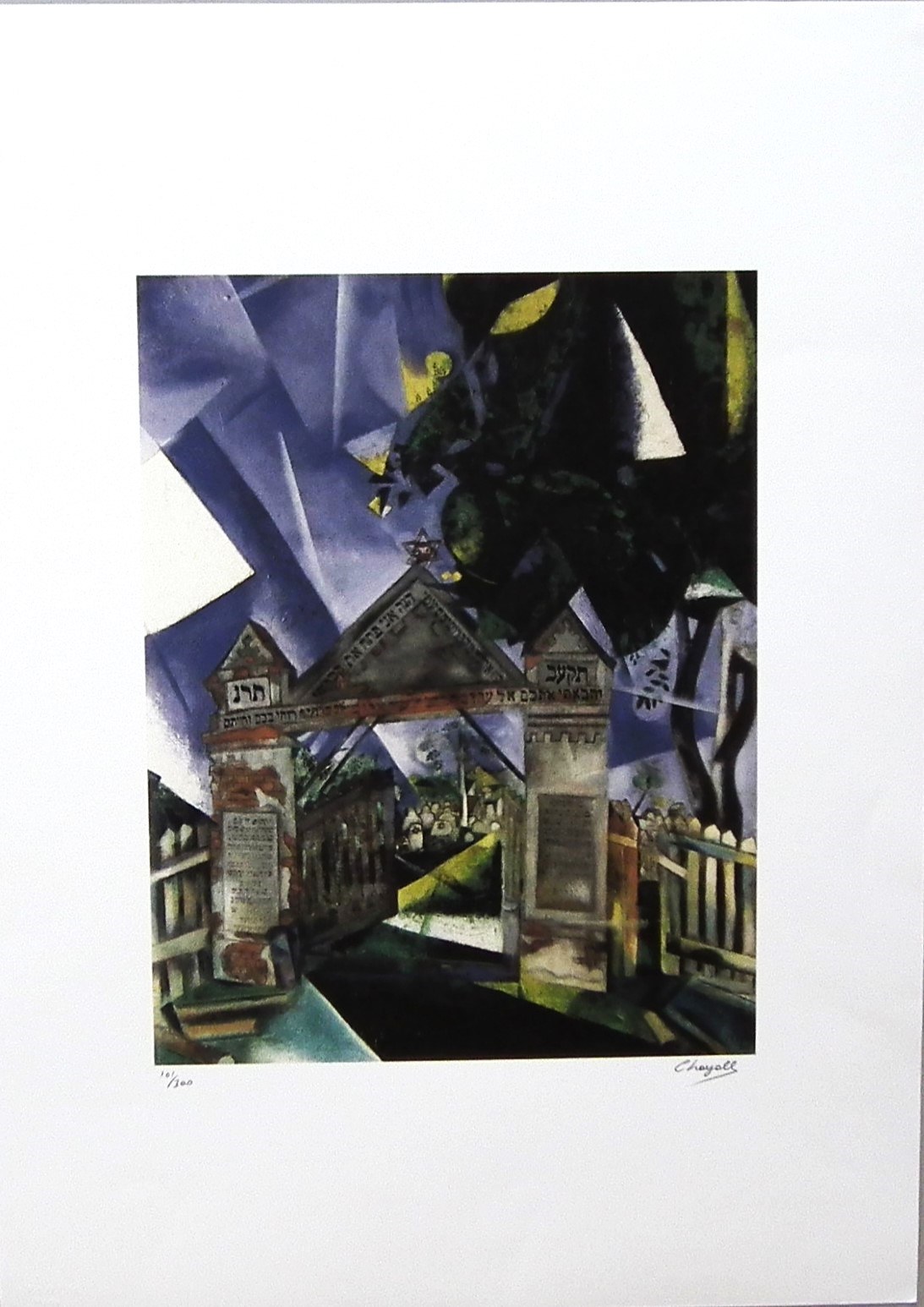
color lithograph, heavy lithographic paper; 42 x 33 cm (composition), 70 x 50 cm (sheet); signed in pencil under composition p. d. "Chagall" and numbered in pencil "101/300".
In 1914 Marc Chagall left Paris for Berlin at the invitation of Herwarth Walden, director of Galerie Der Sturm, and joined his fiancée Bella in Vitebsk. Forced to remain there by the outbreak of war, he took part in the 1917 revolution. In this painting, Chagall shows the hopes of Russian Jews, who finally had equal civil rights with other Russians. Chagall associated the cemetery with resurrection: on the triangular pediment of the gate he wrote a verse from the prophet Ezekiel's vision in the Valley of the Dry Bones: "Thus says the Lord Almighty: My people, I will open your graves and bring you out of them; I will bring you back to the land of Israel." In fact, Chagall celebrates the death of the old tsarist regime, symbolized by the cemetery, and is optimistic about the future and a new beginning for Russia and its people.
The 87 x 68 cm painting is on permanent loan to the Musée d'Art et d'Histoire du Judaïsme from the Musée National d'art Moderne, Centre Pompidou in Paris, to which it was in turn donated by Ida Chagall, the artist's daughter.