


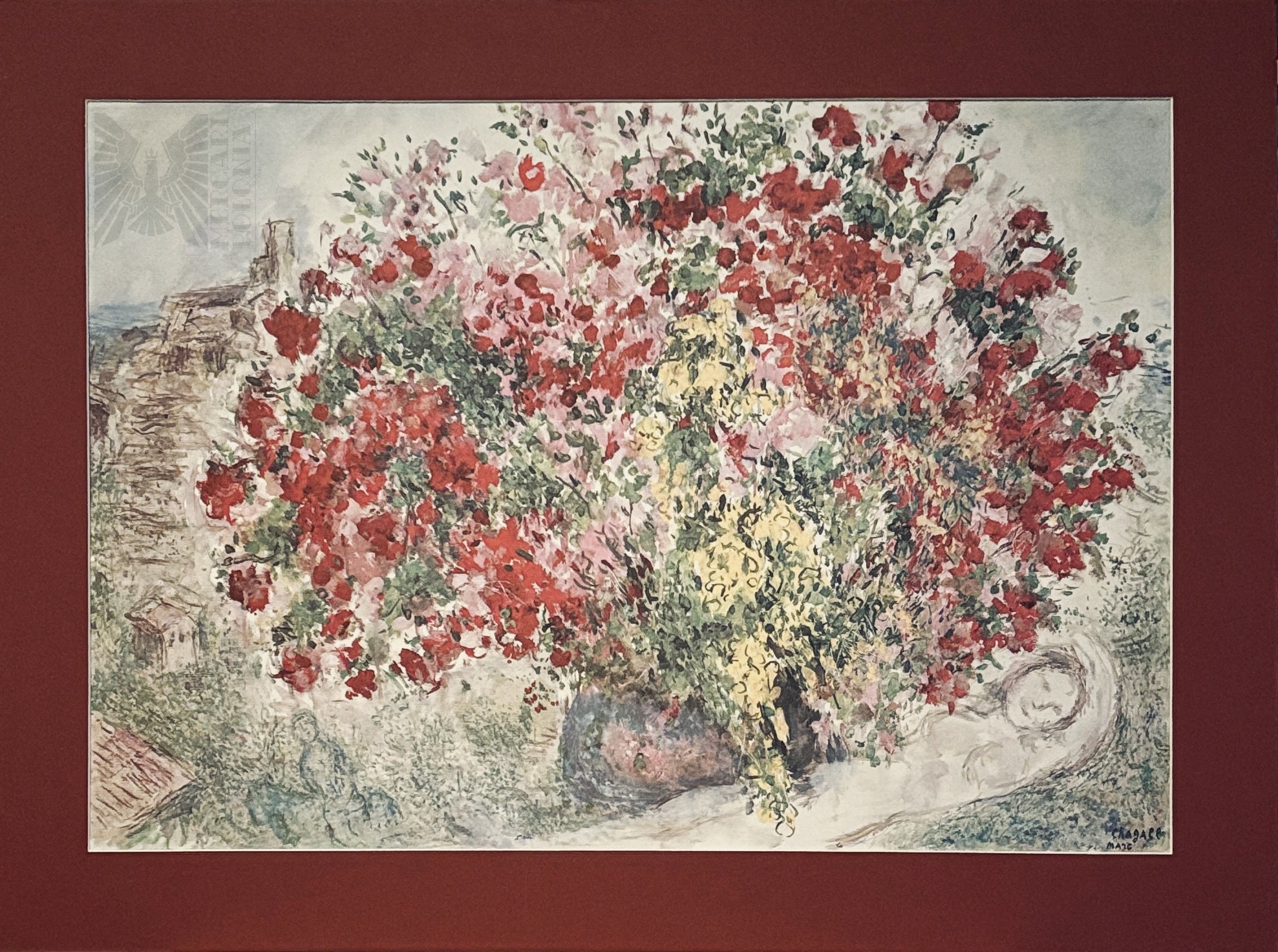
Color lithograph on Arches Velin paper, 41 x 59 cm (inner dimensions) in a 52 x 70 cm mat;
In the catalog raisonné (the so-called
Publisher: Maeght Éditeur in Paris, in collaboration with the Mourlot studio.
References: Catalogue Raisonné) by Fernand Mourlot, item no. 291.
In 1957, Maeght Éditeur published the first edition of lithographs produced by the famous Parisian printing house Mourlot Frères (the finest lithographers of that era) for Jacques Lassaigne’s book titled *Chagall*. These were lithographs in the 23 x 39 cm format.
This lithograph comes from the second edition in a large (gallery) format produced for exhibitions at the Maeght Gallery with Chagall’s permission.
Marc Chagall is one of the most outstanding representatives of the 20th-century avant-garde, associated with Surrealism; though he developed his own poetic style based on memories, metaphors, and vivid colors, he is a figure who cannot be easily categorized. He painted like a child who had mastered the technique of an old master and possessed the imagination of a surrealist.
In Chagall’s work, gravity does not exist. If the figures in a painting are in love or happy, they simply float upward. He was the one who introduced pure, even naive joy and romanticism into modern art—a true phenomenon in the brutal 20th century. His style is a unique blend of memories from his hometown of Vitebsk (now in Belarus) and the modernity of Paris. In a single painting, he could depict a rural goat playing the violin next to the Eiffel Tower. Throughout his life, he claimed that he carried his hometown beneath his eyelids. For Chagall, color was not just a hue—it was an emotion. He was famous for his deep blues (“bleu Chagall”) and intense reds. He said: “When I paint, I think of nothing else but color.” His greatest muse was his wife, Bella. She appears in hundreds of his paintings, even many years after her untimely death. Chagall believed that love was the only color that gave meaning to art.
In Chagall’s work, the motif of a woman with a bouquet recurred dozens of times, but “Le Nu au Bouquet” (often cataloged as Mourlot 195) is one of his most sensual and highly regarded lithographs from the 1950s.
Chagall lived to be nearly 98 years old and painted almost until his last day. He died in an elevator while returning to his studio in Saint-Paul-de-Vence. One might say that he “flew away” to his own world, just like the characters in his paintings.
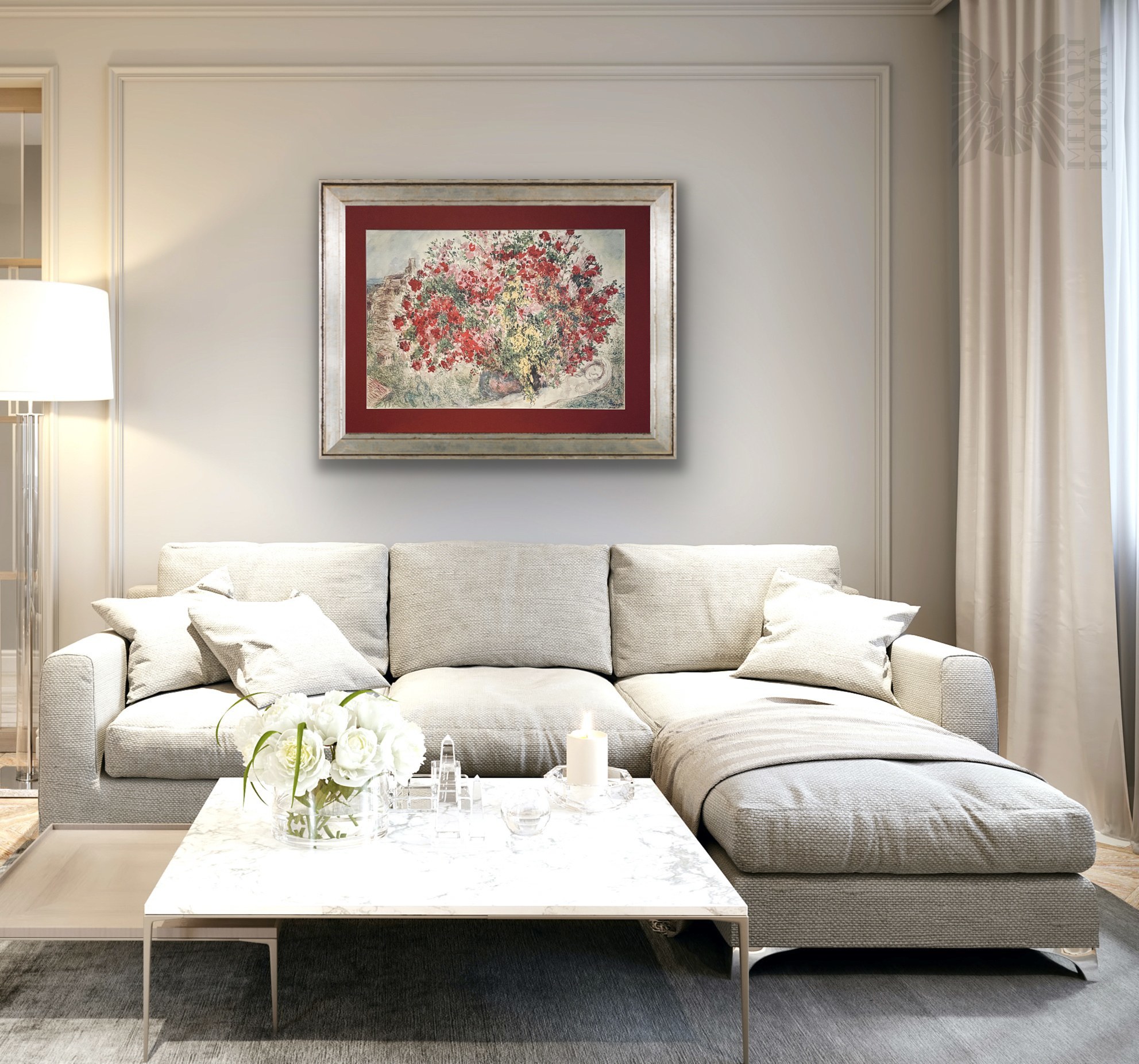
The frames shown in the renderings are for illustrative purposes only and do not constitute a commercial offer.











Nesen skatītās
Piesakies, lai redzētu lotu sarakstu
Iecienītākie
Piesakies, lai redzētu lotu sarakstu