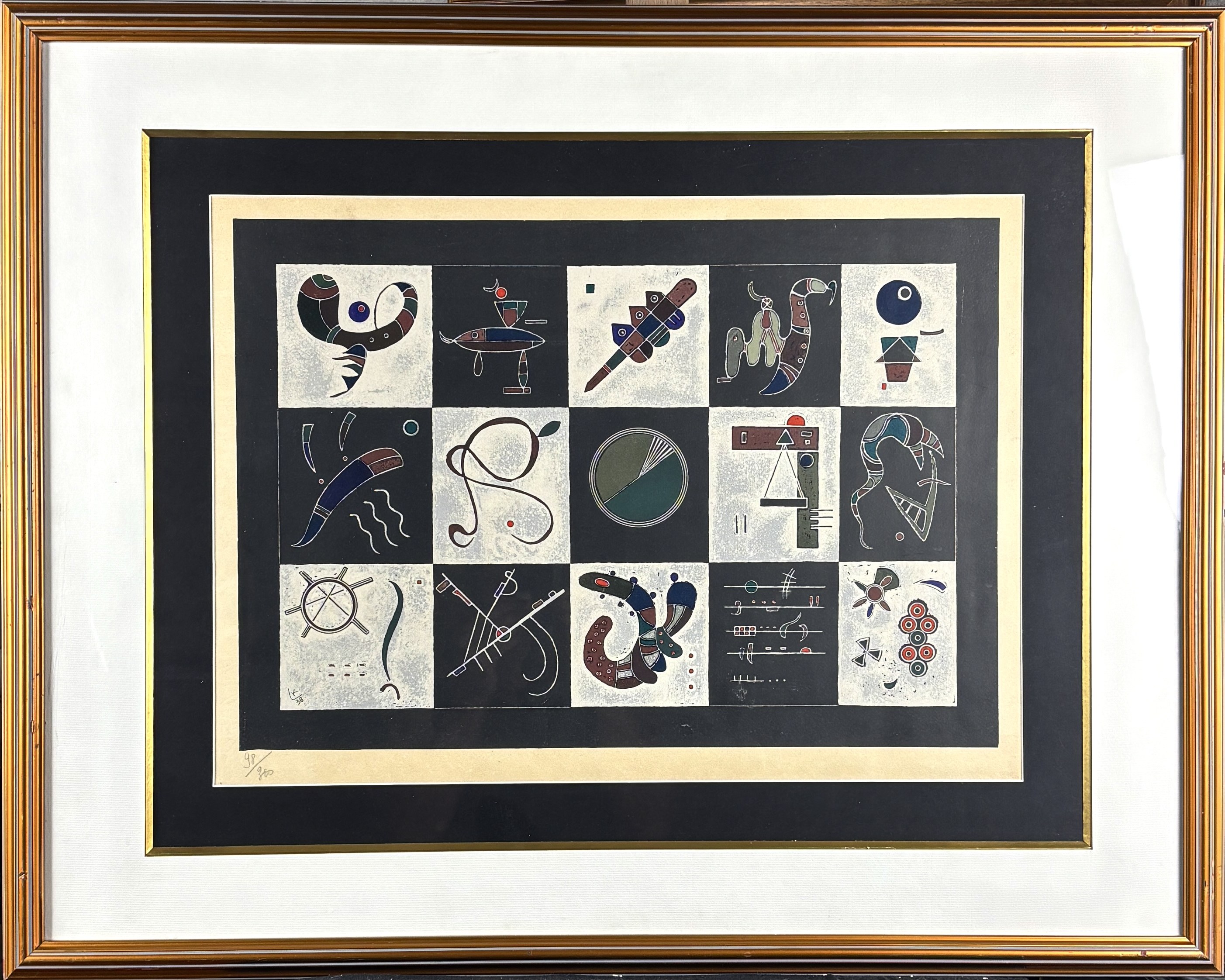
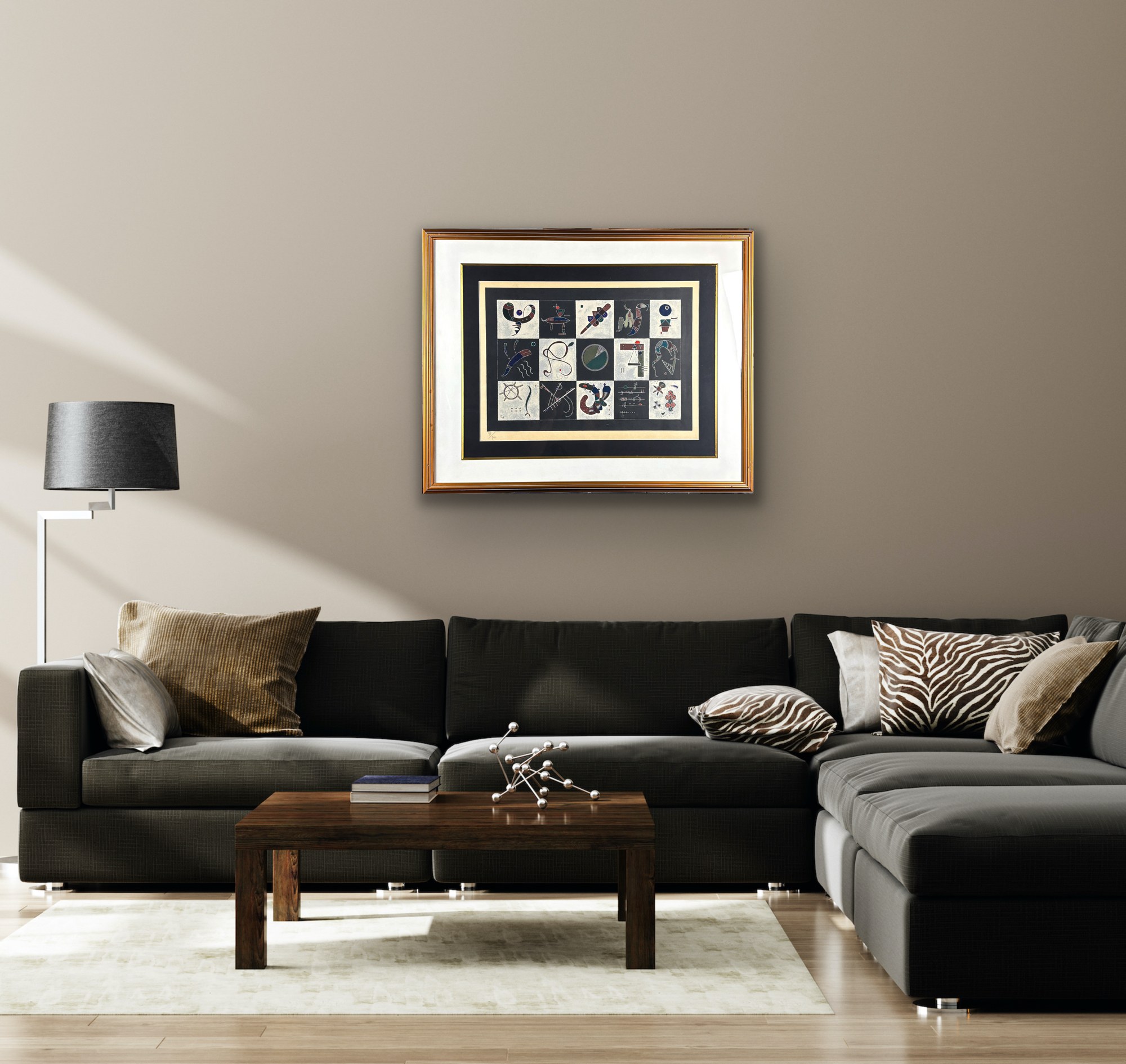
Workshop lithograph on Velin Arches paper, 46 x 61 cm light double passe-partout, framed 62 x 80 cm,
dated and signed on the plate l.d.: "VK38"
limited edition , numbered in pencil 90/300
Publisher: Maeght Editeur, Paris , in collaboration with the famous Atelier Mourlot,
After Kandinsky's death in 1944, the artist's widow, Nina Kandinsky, entrusted Aimé Maeght with the almost exclusive care of promoting and publishing her husband's works. It was Galerie Maeght that became the main center that popularized the artist's "Paris period."
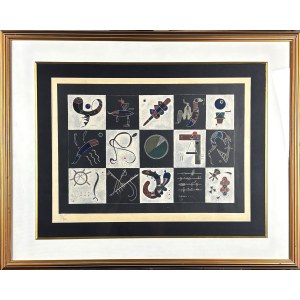
"Fifteen" by Vasily Kandinsky is a fascinating painting that stands out among his best-known multicolored compositions.
This is the so-called Paris period of Kandinsky. The artist moved to France after the Nazis closed the Bauhaus in 1933. During this time, his style evolved towards more organic, biomorphic forms, reminiscent of microorganisms The artist limited the background to black and white, which gives the whole work a graphic, austere character.
Although black and white contrasts dominate, within the individual squares there are subtle, muted color accents (pinks, blues, greens) that enliven the composition, but do not dominate its structure. Each of the 15 squares contains a separate "micro-world." There one can find signs resembling notes, hieroglyphs, sea creatures or geometric figures. This is a kind of dictionary of forms that Kandinsky has developed over the years. "Fifteen" is an expression of the search for absolute balance. While his earlier works (such as the famous Compositions) were dynamic outbursts of emotion, this painting is muted, orderly and analytical. It is an attempt to organize the chaos of abstract forms inside the rigid framework of geometry.
The work is currently in the collection of the Musée National d'Art Moderne (Centre Pompidou) in Paris.