


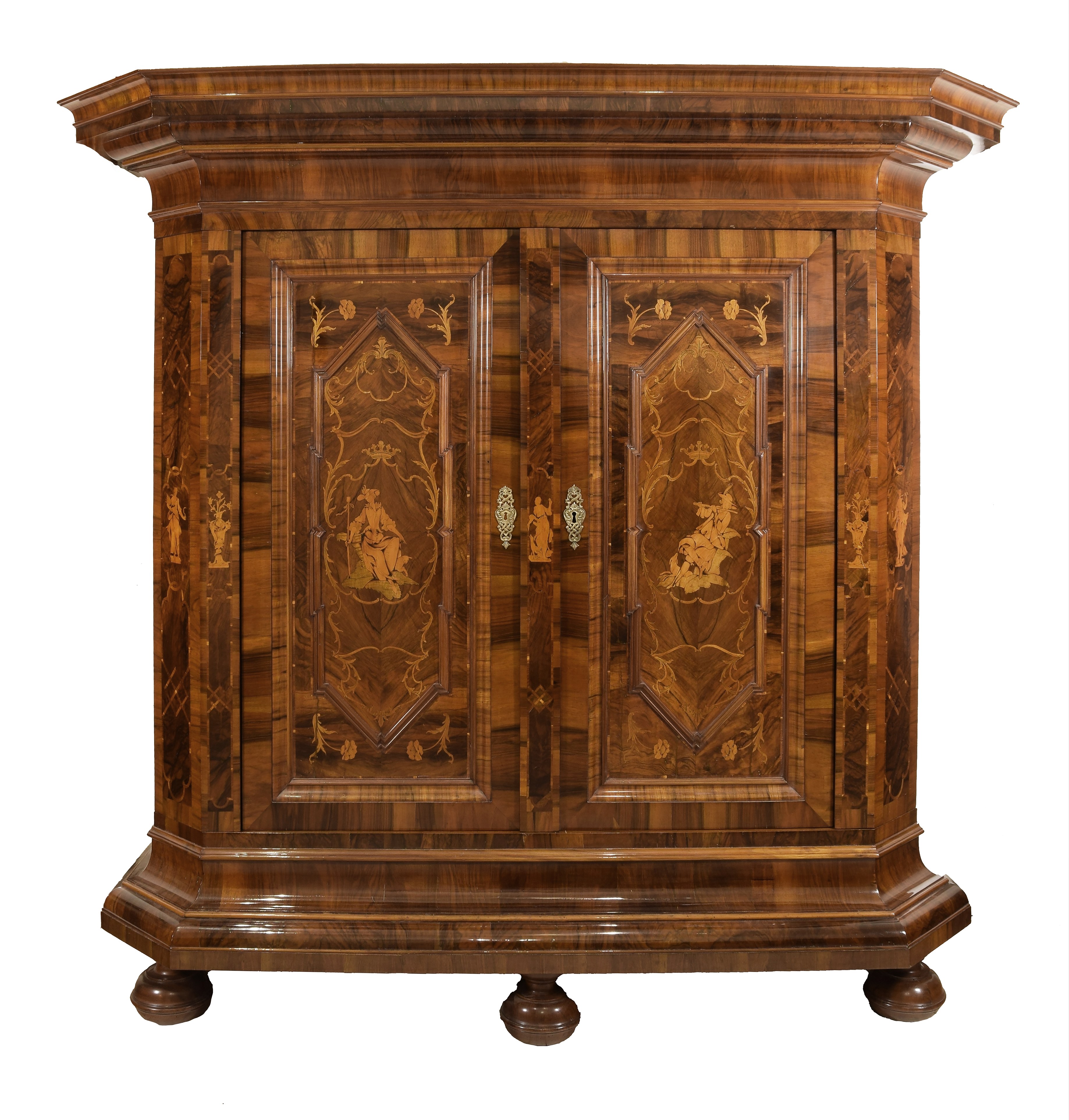
construction - pine, veneer - walnut, marquetry - birch, veining - plum, hardware brass, steel; 201 x 223.3 x 81.5 cm;
Southern Germany, after mid-18th century.
Of tie-beam construction with straight sides, chamfered front corners, closed with two leaves, surmounted by an upward expanding, profiled, straight closed top wreath, supported on a bottom wreath also profiled and expanded downward and on five turned legs, in the form of flattened spheres, veneered with patterned walnut veneer, decorated with inlaid, flamed and engraved figures and other floral and geometric decorations.
The front is divided into two axes by three pseudo pilasters delineated by marquetry, located on the sides of the front and a buttressing strip mounted on the right wing. The wings of frame construction, with single rectangular panels, on which flat cushions sharply beveled at the top and bottom, and on the sides with bevels. The edges of the panels and cushions are covered with profiled moldings.
Pilasters and corners of the front framed by ribbon, decorated with fields delineated by veining, inlaid lattice, and in the center with vases (on the sides of the front) and a woman with a dog and a mirror (in the middle of the front) and women with a sheaf and a sickle and a grape knife and a sprig of wine grape (on the front corners). On the wing cushions in wavy reserves of leaves and channels, topped with crowns, a pair of seated figures in stylized shepherd's outfits, on the right a man playing a pipe with a dog at his side, and on the left a woman with a shepherd's staff in her hand and a lamb. Around the sides, wide borders and ribbons forming inscribed rectangular fields.
Brass key signs, oblong, wavy on the rim, lace-like with regency grille and leaves capturing the cartouche sign (left blind). Steel lock, exemplary mortise with rectangular box decorated with channelled lace on the rim, double-barrelled. The deadbolts on the left sash are steel, plain, overlaying, on a decorative openwork escutcheon, with a long bolt arm ending in a ball. Planked back, on the inside of the wing structure covered with boards.
The cabinet was made in southern Germany around the middle of the 18th century. The late Baroque form was decorated with a variety of Rococo marquetry ornaments, including depictions of women personifying the seasons, which also appear in closet decorations in this area. In the piece on display, the women pictured with a sheaf and with a vine branch are decorative, while also characteristic of the region, where grapevines have been cultivated for hundreds of years.










Nesen skatītās
Piesakies, lai redzētu lotu sarakstu
Iecienītākie
Piesakies, lai redzētu lotu sarakstu