


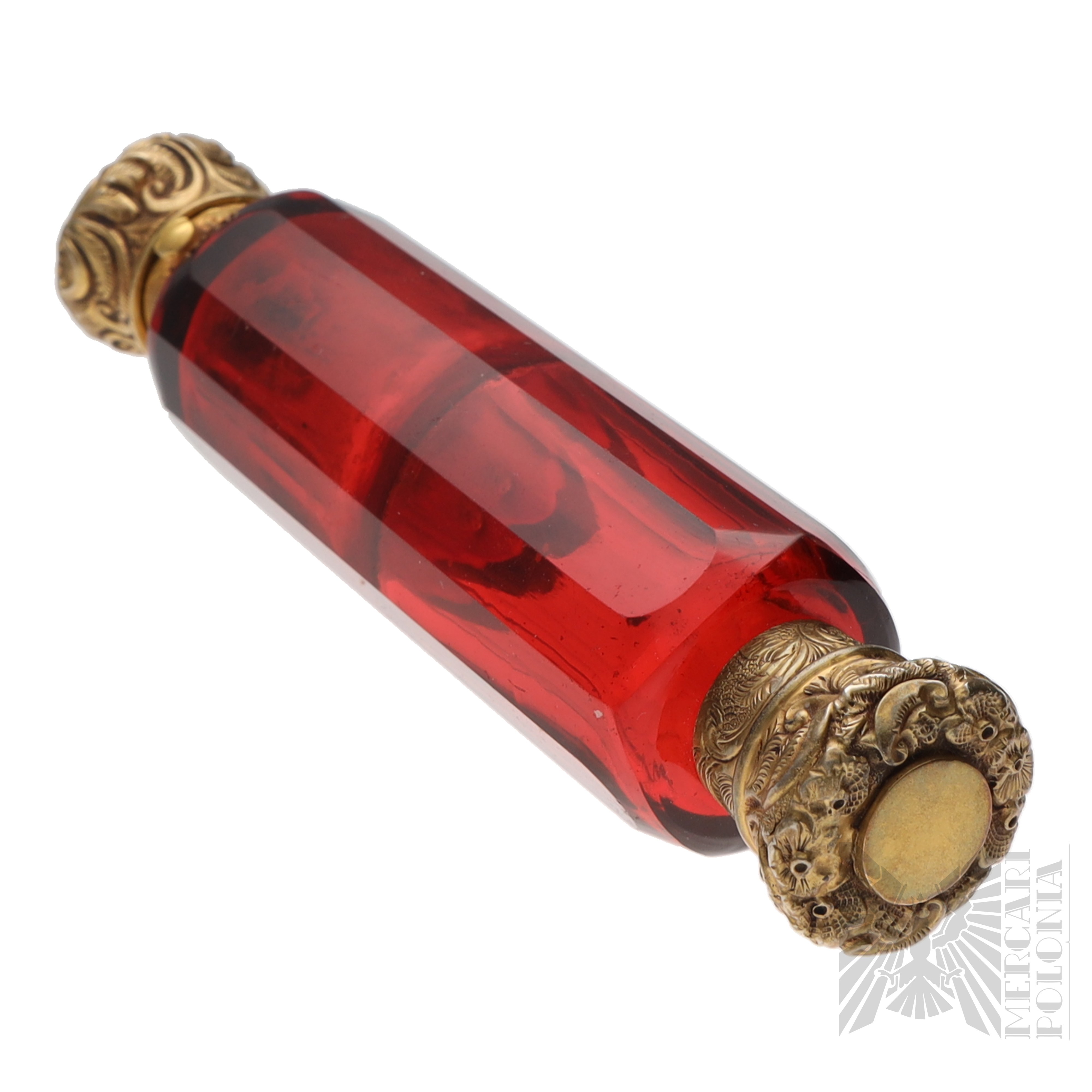
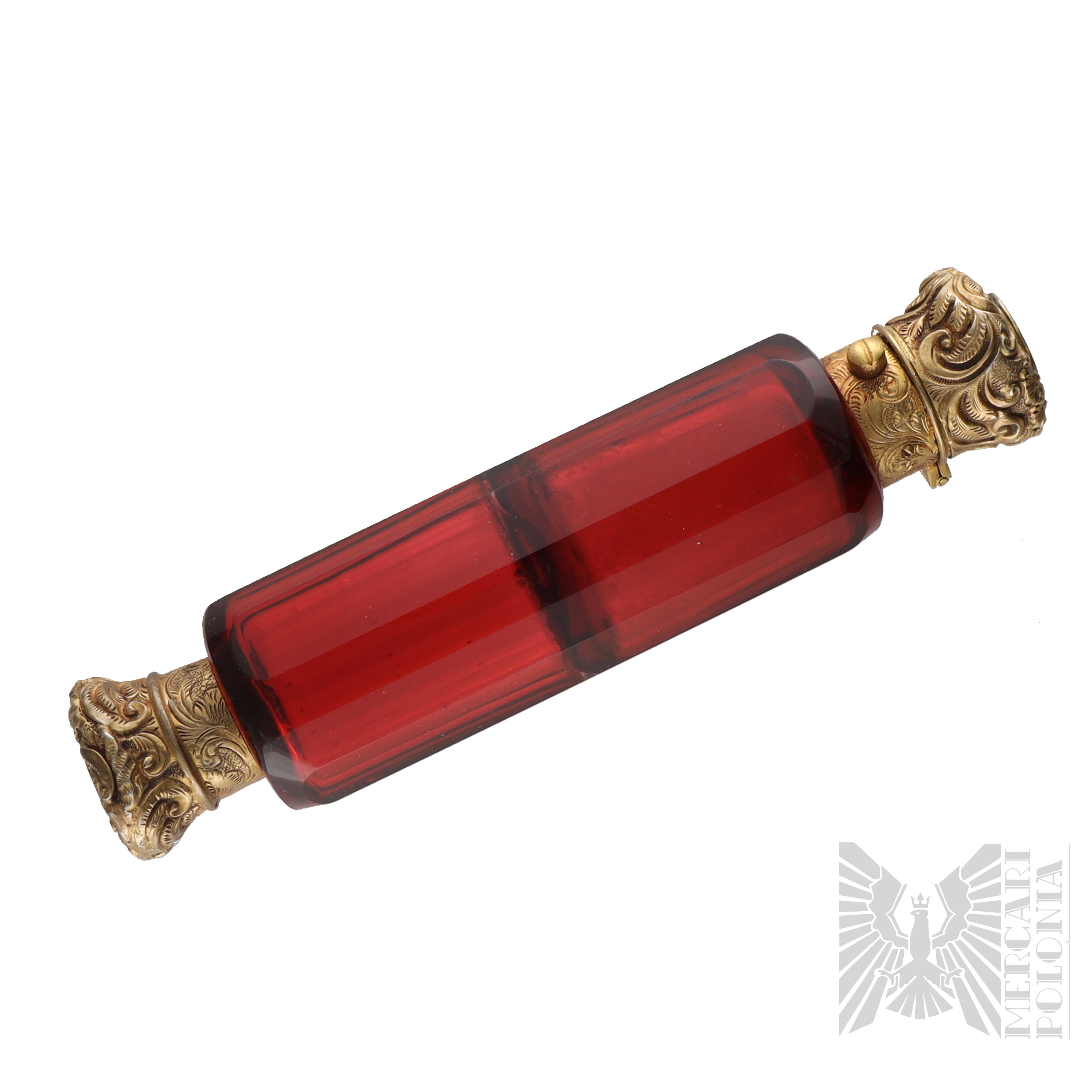
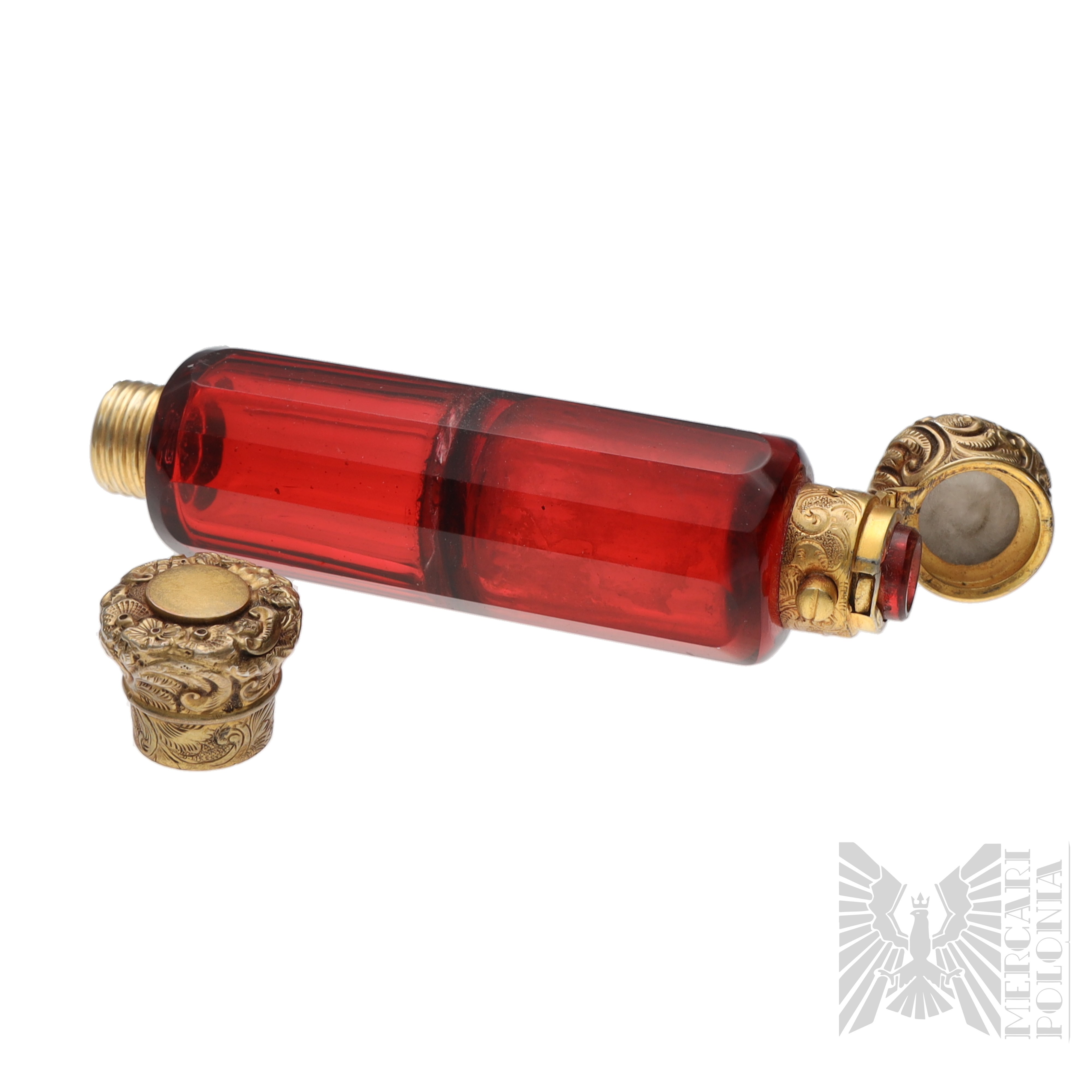
A double-ended scent bottle with an elongated, cylindrical shape, designed to hold perfume and a second aromatic substance, most likely smelling salts. The body is made of thick, transparent glass with an intense ruby-red color. Both ends are sealed with richly decorated, gilded metal fittings. The form corresponds to the English “double-ended scent bottles”—travel bottles with openings on both ends—that were popular in the second half of the 19th century.
Dimensions: 12.5 x 2.5 cm.
The glass body has a polygonal cross-section. Its surface is shaped into wide, elongated facets running parallel to the axis of the vessel. The surfaces are separated by sharply angled edges, on which light creates brighter, carmine-colored reflections. The ends of the body are gently beveled and taper toward the metal mounts. In the central section, a transverse line or internal partition is visible, indicating that the bottle is divided into two separate chambers.
The glass has a deep shade of red, which transitions to a nearly dark cherry hue at the thicker edges. In areas of strong light, it becomes transparent, revealing the internal channels of both chambers. This type of colored, faceted glass was popular in luxury toiletries during the second half of the 19th century. In market descriptions, it is usually referred to as ruby or cranberry glass.
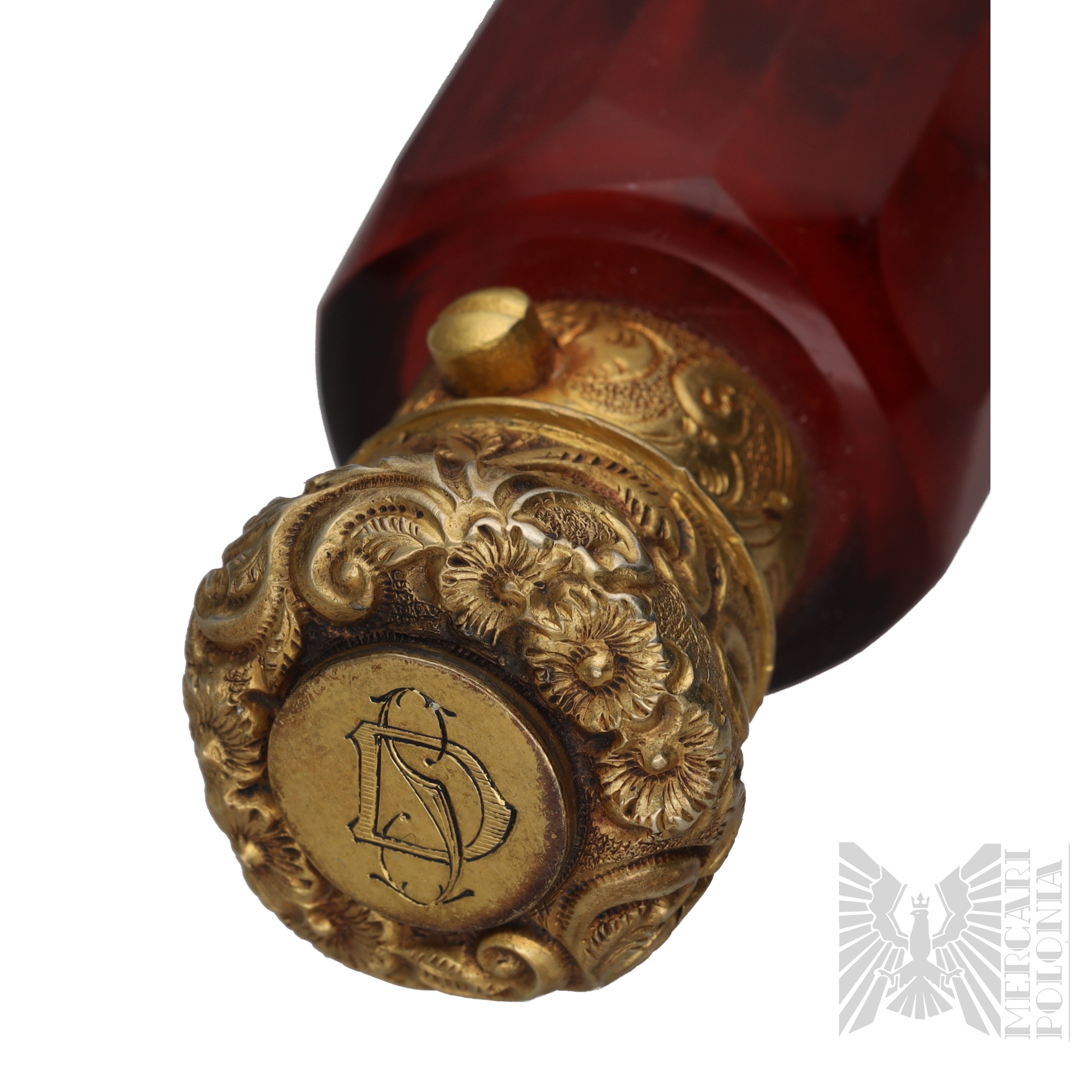
Both ends feature decorative metal ferrules with a gilded finish. The decoration is executed in shallow relief, complemented by chiseled and engraved details. The ornamentation consists of fleshy acanthus leaves, S-shaped volutes, fan-shaped palmettes, and small flowers with radially arranged petals. The botanical motifs densely cover the surface of the fittings, and their raised sections contrast with the finely dotted background. The decoration is in the Neo-Rococo style, typical of elegant toiletries from the Victorian era.
One end of the bottle is sealed with a removable, threaded cap. When unscrewed, a metal, spirally grooved thread is visible, set directly against the glass body. The cap takes the form of a flattened, polygonal dome. Its side surfaces are covered with a leaf-and-flower ornament. An interlaced monogram, composed of the letters “D” and “S,” is engraved on the outer, circular medallion. The letters are decoratively intertwined and outlined with a thin engraved line. The monogram indicates that the bottle was a personal item or a gift, made or personalized for a specific owner.
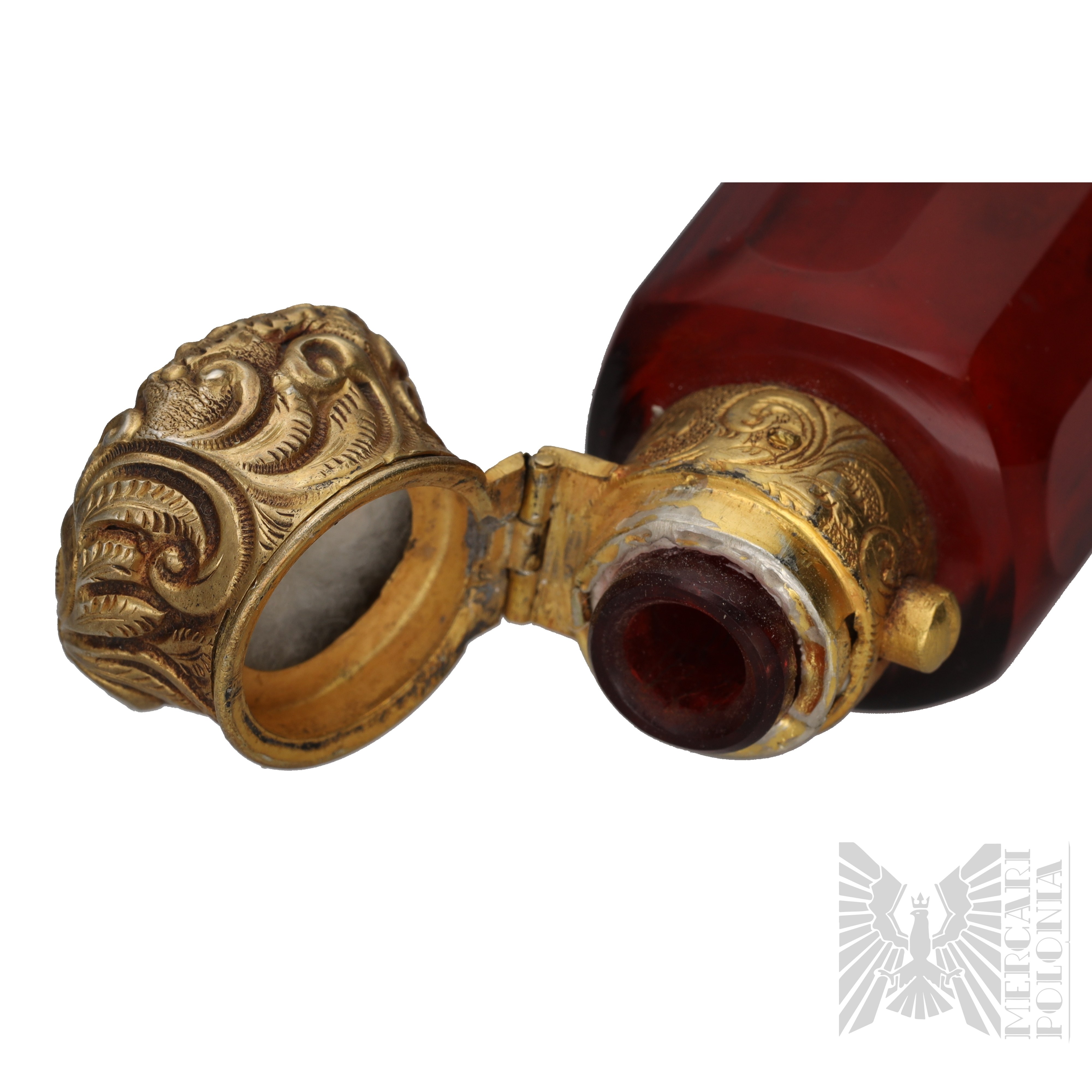
The other end is fitted with a hinged cap. It opens when a small, spring-loaded button on the side is pressed. The outer surface of the lid is adorned with a similar composition of volutes, leaves, and small flowers. In the center is a smooth, oval medallion left without a monogram. The inside of the lid retains a round, gray-colored sealing insert, likely made of cork or another organic material.
Beneath the hinged lid is the opening of a second glass chamber. Its neck is encircled by a metal ring. A light-colored sealing compound is visible around the junction of the glass and the metal fitting. This may be a remnant of the original assembly putty, but its uneven distribution also suggests the possibility of a later repair. The opening no longer has the separate cork or glass stopper visible in the photographs.
The difference in the closure systems at both ends stemmed from the chambers’ distinct purposes. The section closed with a cap was typically used to store perfume or cologne. The end with a quick-opening spring-loaded lid could hold a second fragrance or smelling salts. In similar Victorian bottles, one side was intended for liquid, while the other was for an aromatic substance used in case of fainting. The design featuring a cap at one end and a hinged lid at the other is a typical characteristic of this group of objects
The bottle was a personal toiletries accessory and could be stored in a lady’s toiletry case, travel purse, or on a dressing table. Its compact, symmetrical shape allowed for the transport of two different substances in a single vessel. The absence of feet and the distinctly shaped ends indicate that the object was intended to be placed horizontally; for this reason, items of this type are also sometimes referred to by the English term “lay-down scent bottle.”
The combination of deep red glass with richly decorated, gilded fittings lends the object a stately character. The ruby-red color was particularly striking under artificial light and harmonized well with the historicizing ornamentation of the metal finials. The striking contrast of materials and the engraved monogram indicate that the object was intended for a wealthy patron.
The dating to approximately 1870–1890 is based on the double-sided body, the combination of two types of closures, the Neorococo ornamentation of the fittings, and the use of ruby-colored, faceted glass. Bottles of this type were particularly popular in Great Britain in the second half of the 19th century, although they were also produced in France, Austria, and the Czech lands. Without hallmarks or a maker’s mark, it is not possible to definitively identify the country or workshop of origin.
Condition: as shown in the photos.











Nesen skatītās
Piesakies, lai redzētu lotu sarakstu
Iecienītākie
Piesakies, lai redzētu lotu sarakstu