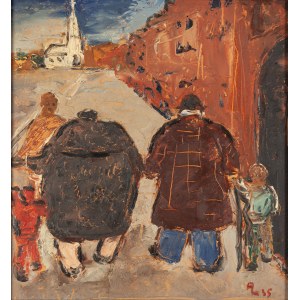


Dimensions: 27.5 x 26 cm
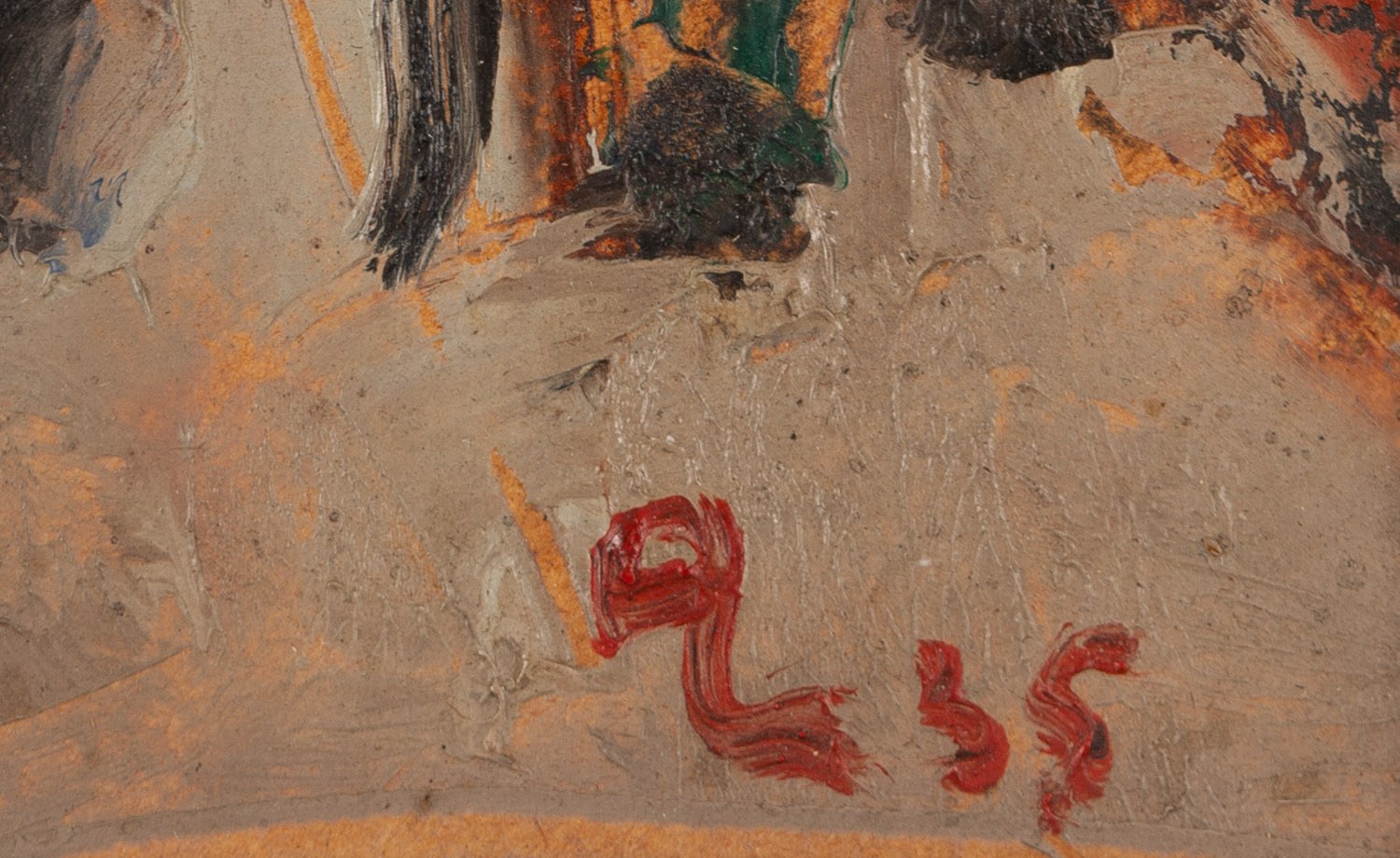
Signed monogrammed and dated p.d.: 'AL 35'
Origin:
private collection, Poland
Exhibited
Alfred Lenica: paintings, "Arsenal" City Gallery, "Castle" Cultural Center, ABC Gallery, Poznan, January-February 2002; Pomeranian Dukes' Castle, Szczecin, March-April 2002; Silesian Museum in Katowice May-June 2002; Palace of the Society of Friends of Fine Arts, Cracow, July-August 2002.
Alfred Lenica 1899-1977, Silesian Museum, Katowice, 1987.
Alfred Lenica, CBWA Zachęta Gallery, Warsaw, October 1959.
Literature
Alfred Lenica: painting, exhibition catalog, ed. Wojciech Makowiecki, Miroslaw Pawlowski, Marian Szczepaniak, Municipal Gallery "Arsenal" in Poznan, Poznan 2002, p. 46 (ill.), p. 148 (list of works exhibited at the exhibition)
Alfred Lenica 1899-1977, exhibition catalog, catalog text and selection of il. Marian Szczepaniak, Silesian Museum in Katowice, Katowice 1987, p. 40 (ill.), cat. no. 9
Alfred Lenica, exhibition catalog, CBWA Zachęta, Warsaw 1959, p. nlb. (one version of the composition "Haunted townsfolk", nos. 22, 25, 67)
Biography
Polish painter, father of Jan Lenica and Danuta Konwicki. Father-in-law of Tadeusz Konwicki. He began his studies in 1922 at the law and economics department of Poznan University. At the same time he studied music at the Conservatory of Music. He furthered his painting interests by studying at the Private Institute of Fine Arts run by Adam Hannytkiewicz. In the 1930s, Alfred Lenica painted figurative paintings, primarily still lifes and landscapes, taking his inspiration from Cubism. At the beginning of the war, the Lenica family was displaced from Poznan and went to Krakow. The war time was a turning point in the painter's career. The Krakow artistic milieu centered around Tadeusz Kantor, especially his friendship with Jerzy Kujawski, resulted in a deepening of the painter's interest in the avant-garde. In 1945, Alfred Lenica returned to Poznan, where he became involved in artistic activities. In 1947 he became a co-founder of the avant-garde group 4F+R. After years of trials and explorations, Lenica moved more and more towards abstraction and Tashism. In 1948 he took part in the First Exhibition of Modern Art in Cracow organized by Tadeusz Kantor. In addition to his search for and fascination with abstraction, Alfred Lenica actively participated in the Socialist Realist trend, creating many realistic paintings in the early 1950s. In the first half of the 1950s, during the period of Socialist Realism, Lenica stopped his creative experiments, turning to the artistic doctrine introduced by political imperative. Because of his political beliefs, it was a return for him to the socially and politically engaged paintings he had already painted in the 1930s. At that time he painted such paintings as "Young Bierut among the Workers" (1949), "Pstrowski and Comrades," "Admission to the Party," and "Red Poster" (1950). For his own use, he also tried to combine formal experiments with ideologically committed subject matter, as in his 1953 work "Losing Day Laborers," in which he used collage and monotype. From 1955, Alfred Lenica's painting style, which would accompany him until his death, finally clarified. The style was a combination of Tashism, Surrealism, Informel and Dripping. It involved large-format oil paintings painted in a technique developed earlier by the artist (getting color translucence from under successive layers of paint), which he later perfected and developed. Lenica readily used lacquers and industrial paints. He presented a style of abstract painting with a Surrealist-Expressionist tinge. Lenica traveled extensively; at the invitation of the United Nations, he was in Geneva in 1959/60, where he created a mural painting "Three Elements" (Water, Fire and Love) at the headquarters of the organization. He maintained constant contact with the domestic artistic avant-garde, exhibited with the Cracow Group, took part in most open-air events in Osieki near Koszalin, and participated in the symposium "Art in a Changing World" in 1966 in Puławy.