


67,3 x 45,5cm - watercolor, tempera, gouache, pencil
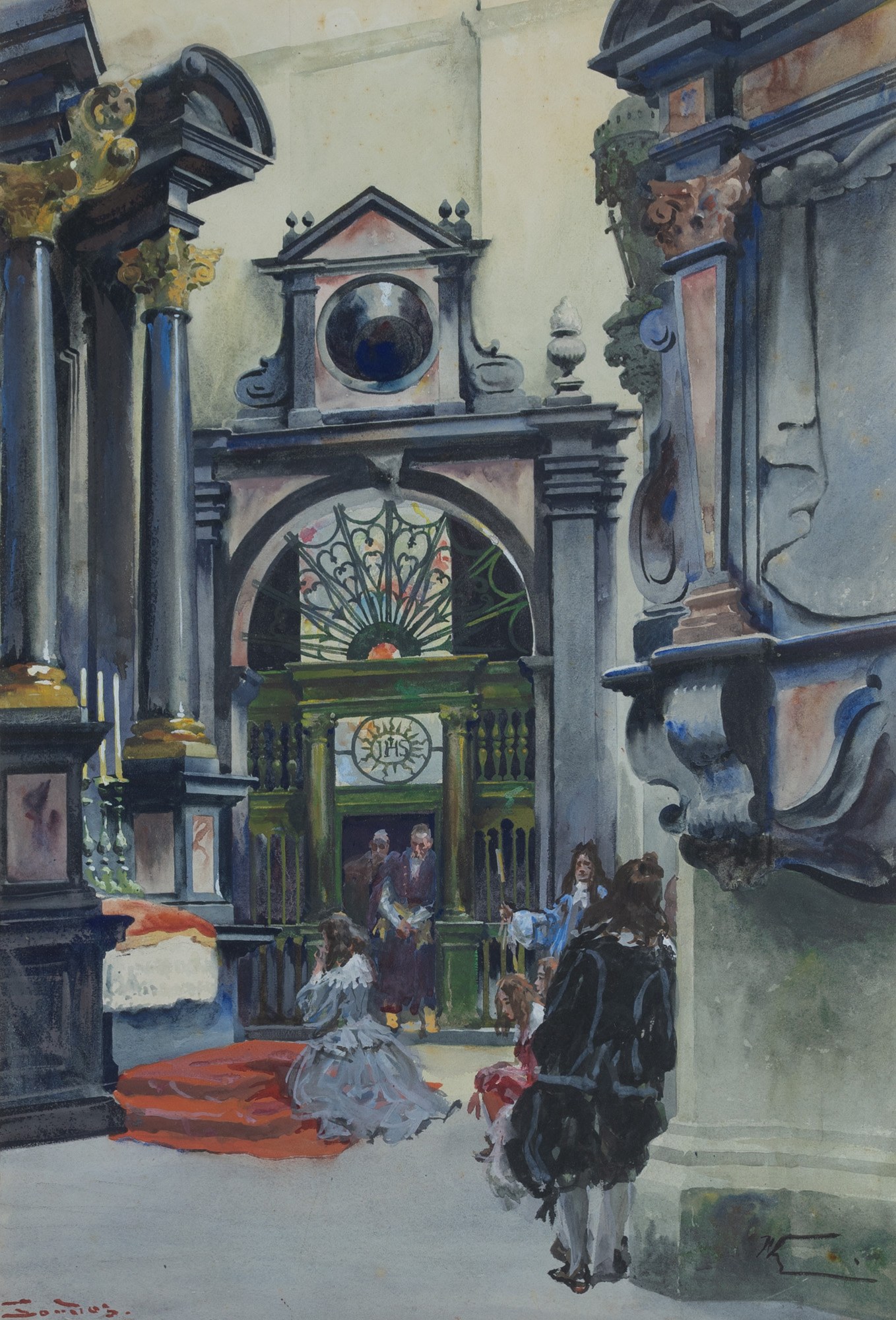
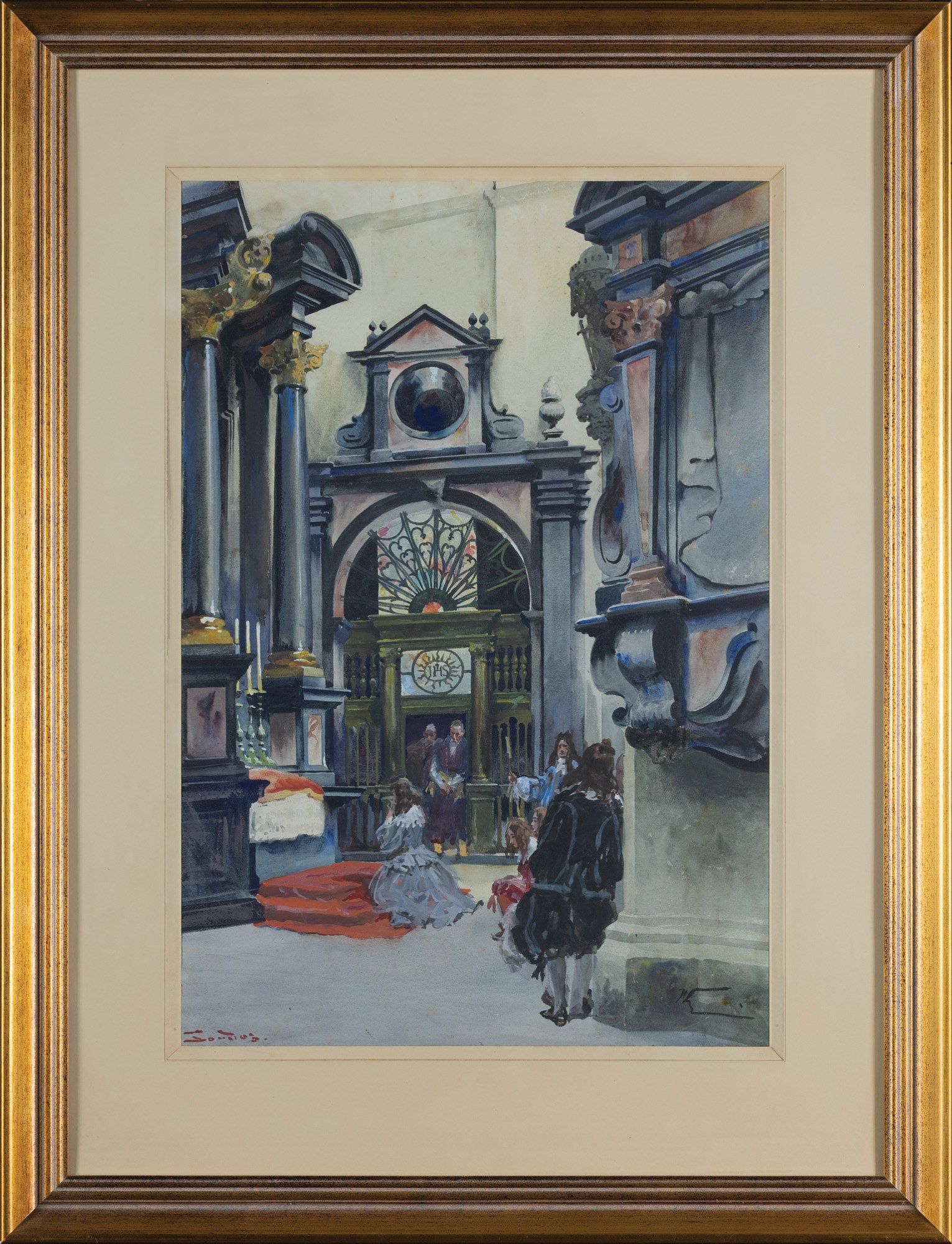
INTERIOR OF WAWEL CATHEDRAL, 1910
Queen Marysieńka prays for victory over the Turks before the altar of the Holy Cross.
Watercolor, tempera, gouache, pencil, 67.3 x 45.5 cm (in light passe-partout);
Signed l.d.: Tondos; p.d.: W. K.
Agra-Art sticker dated May 2006 on the upper border of the frame.
The paintings depicting the Interior of Wawel Cathedral come from a series entitled Wawel of the Past, the Treasury, the Seat of the Piasts and Jagiellons created in 1910 and painted by Stanislaw Tondos in collaboration with Wojciech Kossak. This was another joint work by the two artists (after the series St. Mary's Church in Krakow from 1892). On Tondos' watercolors depicting architecture, Kossak - in tempera or gouache - added staffage; silhouettes of people, horses, and often whole genre scenes. In the case of the "Wawel" series, these were depictions of historical figures - kings, queens, hetmans or chiefs.
As early as 1910, the entire series, numbering 21 paintings, was shown at the Perpetual Exhibition of the Society of Friends of Fine Arts in Cracow and was described in the accompanying catalog (see Perpetual Exhibition of the Society of Friends of Fine Arts in Cracow, July-August-September 1910, pp. 7-9, cat. nos. 1-21; No. 7 Prince Józef Poniatowski.... and No. 14 Queen Marysieńka...). He was also widely popularized by color postcards printed in 1910 by the firm of L. Anczyc, published by Henryk Frist's Salonu Malarzy Polskich publishing house in Cracow (the watercolor with Father Joseph appeared with number 7, with Queen Marysieńka - with number 14 of the series).
Wojciech Kossak (Paris 1856 - Krakow 1942) - widely known painter, seen primarily as a great battle artist. The son and pupil of Juliusz Kossak, he studied at the Cracow School of Fine Arts, the Munich Academy and in Paris. In 1895-1902 he stayed mainly in Berlin, working for Kaiser Wilhelm II. He traveled extensively, including to Spain and Egypt, where he made sketches for intended panoramas. In later years, he traveled to the United States several times doing portrait commissions. In 1913 he was appointed professor at the Warsaw School of Fine Arts. During the years of World War I, he served in the military. He was co-author of panoramas: "Raclawice" (1893-1894), "Berezina" (1895-1896), "Battle of the Pyramids" (1901) and sketches for the unrealized "Samosierra" (1900). With temperament and freedom, he created extensively painted dynamic battle scenes, historical scenes, genre scenes and portraits. He was fond of painting horses. His paintings, glorifying the Polish military and the heroism of soldiers, both ancient and contemporary to the artist, appealed to the patriotic feelings of the public and enjoyed great popularity.
Stanislaw Tondos (1854 - 1917) is best known as a painter of his native city of Krakow. Here, after graduating from high school, he studied at the School of Fine Arts under Władysław Łuszczkiewicz and Jan Matejko from 1869 to 1975. He continued his studies in Vienna, and for a short time also at the Munich Academy under Otto Seitz. Early in his career, he took up veduta painting. He traveled to Venice, Prague, Vienna, Rapperswill, Nuremberg, Magdeburg painting views of the architecture of these cities. His favorite, most frequently used and mastered technique was watercolor, but he also painted in oil and pastels. The most numerous group of his works are views of Cracow. These paintings, depicting - often no longer existing - houses, streets, alleys, are today a testimony to a bygone time, an important iconographic document. The artist also painted views from other Polish cities - Lviv, Poznan, Warsaw. In 1886, together with Juliusz Kossak, he painted a series of 24 watercolors, which were later published in a graphic portfolio as "Jewels of the City of Cracow." In later years there were still cycles of watercolors "St. Mary's Church in Cracow" (1892), "Wawel of the past treasury, seat of the Piasts and Jagiellons" (1910), "Cracow Legions" (1915-1917), painted this time in cooperation with Wojciech Kossak, who was the author of the staffage - silhouettes of people, horses, genre scenes. Starting in 1875, Tondos regularly exhibited his works at the Society of Friends of Fine Arts in Cracow. He also took part in exhibitions in Warsaw, including the Zachęta Society and the Krywult Salon. Many of the artist's works were popularized in the form of postcards published by the publishing house of the Salon of Polish Painters. In 1900, at postcard exhibitions in Warsaw and Paris, Tondos was awarded gold medals "for his highly artistic recreation in watercolor designs of Polish cities - Lviv, Cracow, Warsaw."













Nesen skatītās
Piesakies, lai redzētu lotu sarakstu
Iecienītākie
Piesakies, lai redzētu lotu sarakstu