


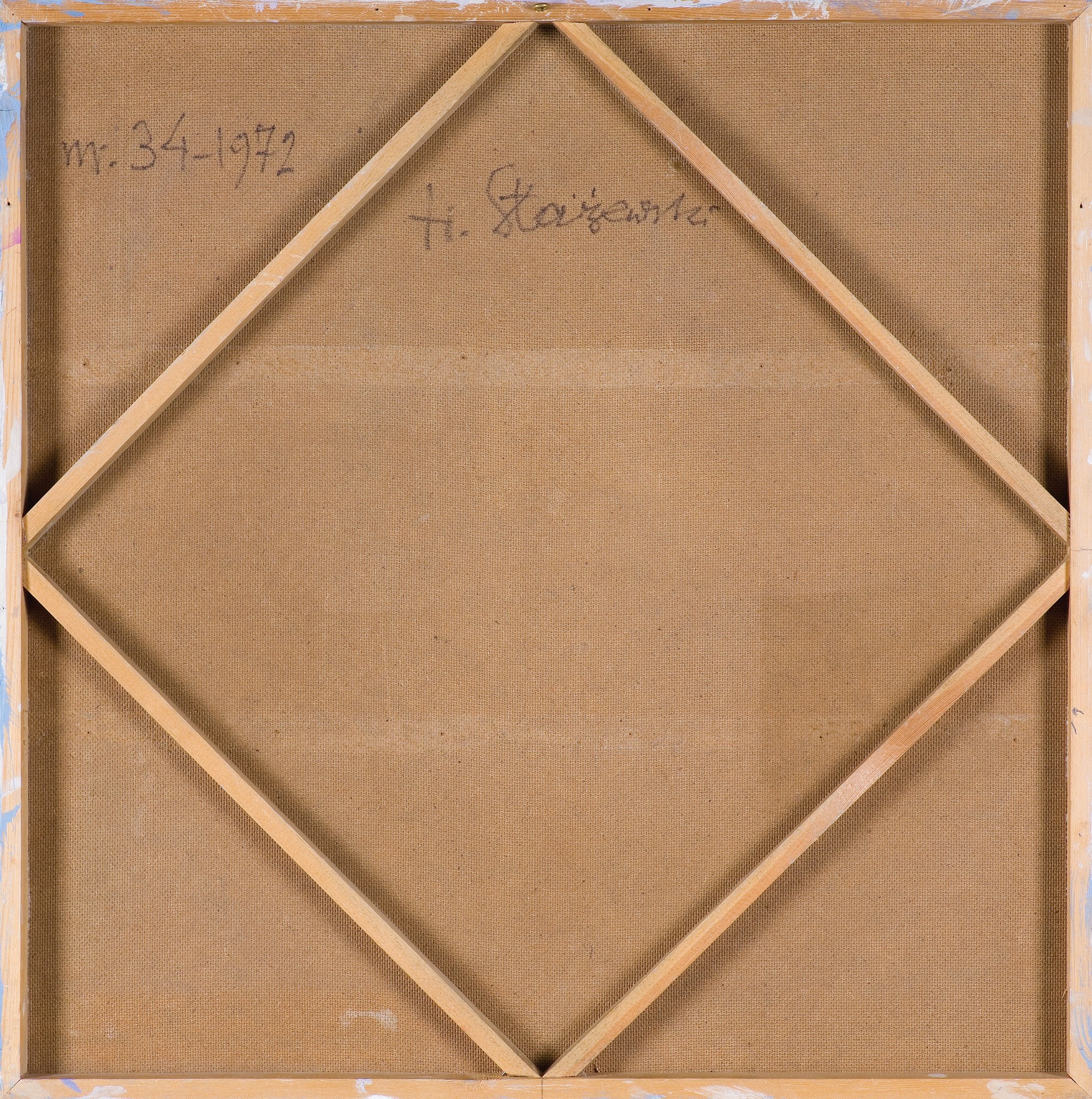

60 x 60 cm - acrylic on panel
signed on the reverse, bottom left: No. 34-1972; center: H. Stażewski
Henryk Stażewski, known as the “pope of the Polish avant-garde,” developed the language of abstraction throughout his life. He turned it into a tool for objectively representing the world. He wrote: “Abstract art is the most uniform, holistic, and organic vision of shapes and colors. Its aim is to heighten our visual sensitivity to the utmost, to achieve “absolute hearing” in color perception and mathematical precision in sensing form and proportion. Abstract art does not depict the external aspect of matter, the “object”; however, it can maintain contact with the concrete and objective phenomena and facts of the external world, for it is the sum of impressions and observations; it is a sense of the spirit of the present, an expression of the dynamism of today’s life, a lyrical portrait of an era marked by upheavals caused by major social movements, inventions, and discoveries—an era of the splitting of the atomic nucleus, and so on. All of this is bringing about fundamental changes in the nature of our lives and must find an echo in art and give rise to new means of artistic expression. (Stażewski, in: Michał Bylina / Henryk Stażewski, Warsaw, January 1978, p. nlb.)
Provenance: From the collection of art historian Teresa Sowińska (1940–2023), author of numerous publications and exhibitions, professionally associated with Warsaw’s “Zachęta”
The painting has been exhibited, mentioned, and reproduced, among others, in: – Michał Bylina / Henryk Stażewski, Exhibition of works by recipients of the Minister of Culture and Art’s awards granted in 1977 for artistic achievement in the visual arts, CBWA Zachęta, Warsaw, January 1978, cat. 1 (listed in the inventory of works).
♣ Droit de suite: ♣ A fee resulting from the right of the artist and his heirs to receive remuneration in accordance with the Act of February 4, 1994, on Copyright and Related Rights (droit de suite) will be added to the Purchase Price.
Henryk Stażewski (Warsaw, January 9, 1894 – Warsaw, June 10, 1988) studied at the School of Fine Arts in Warsaw from 1913 to 1920. Early in his career, he painted still lifes. For a time, he exhibited with the “Formists” group (1922). He also took part in the New Art Exhibition in Vilnius in 1923. At that time, his work was influenced by Constructivism. In addition to his paintings, he worked in book illustration, designed interiors and furnishings, and created stage sets—most of these were theoretical and preparatory studies. The Polish and international avant-garde groups with which he exhibited and collaborated as a writer were, in order: “Blok” (1924–1926), “Praesens” (1926–1930), “Cercle et Carré” (1929–1931), “Abstraction-Création” (1931–1939), and “a. r.” (1932–1939). He was also a member of the Circle of Advertising Graphic Artists (1933–1939). In 1930, he co-organized a collection of works by international avant-garde artists intended for the museum in Łódź (currently housed at the Museum of Art in Łódź). After World War II, he lived and worked in Warsaw. In the 1940s and 1950s, he attempted to conform to the demands of figurative art. His drawings and paintings from this period depict themes of labor and construction, as well as monumental designs. After 1956, widely recognized as the patron of the Polish avant-garde, he devoted himself exclusively to abstraction with constructivist roots. He created series of works that were studies of planes, lines, and colors in various arrangements relative to one another. Beneath the appearance of cool perfection, he knew how to infuse them with the emotion of direct touch and the trace of the hand. In addition to painting and related forms, such as collages, reliefs, and multiples, he created three-dimensional works and prints (he authorized silkscreen reproductions of his works). He was the recipient of numerous national and international awards and honors, including the Herder Prize, Vienna 1972.













Nesen skatītās
Piesakies, lai redzētu lotu sarakstu
Iecienītākie
Piesakies, lai redzētu lotu sarakstu