


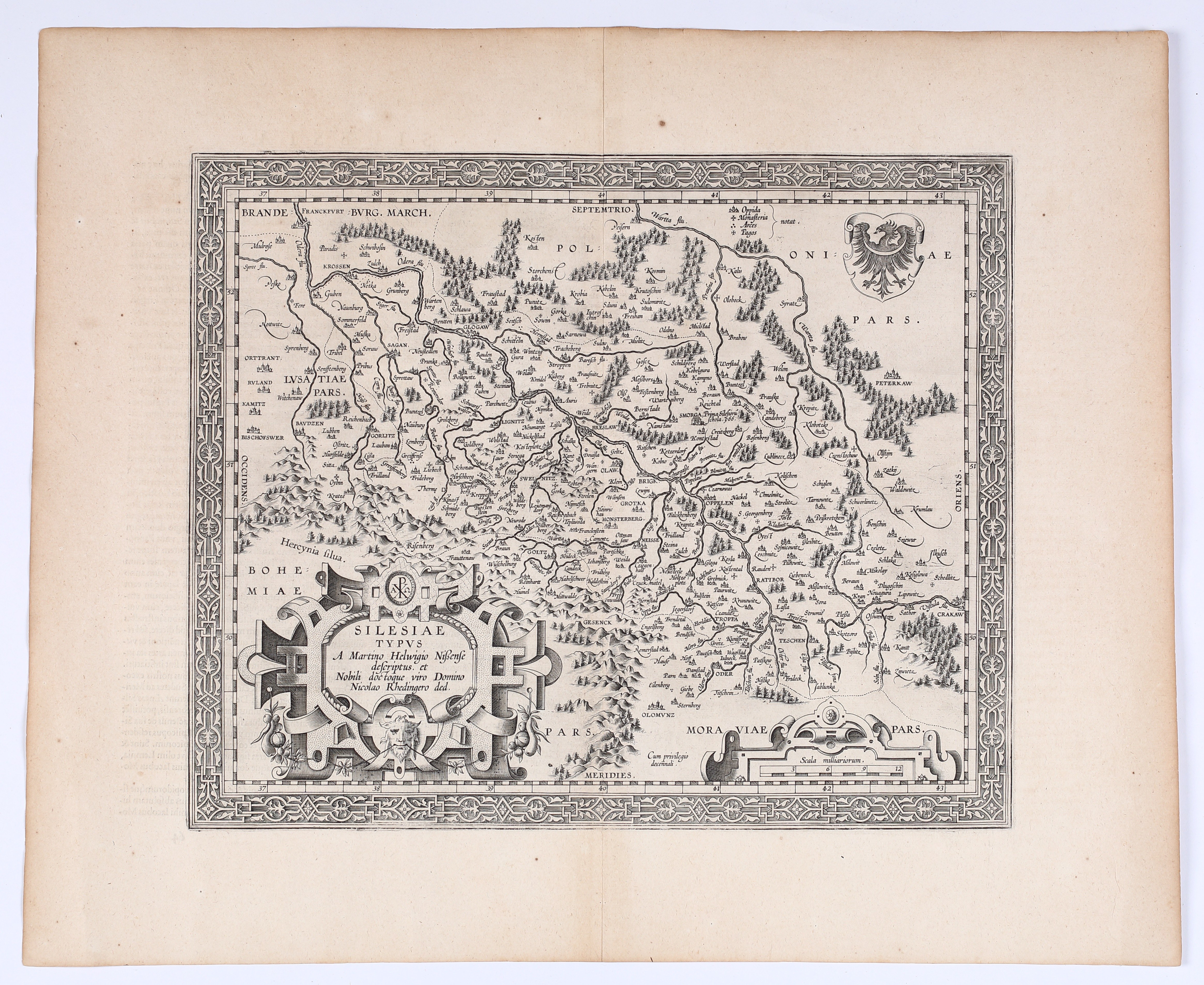
HELWIG, Martin (1516–1574), ORTELIUS, Abraham (1527–1598) — *Silesiae Typus*. Antwerp: Jan Baptist Vrients, 1603.
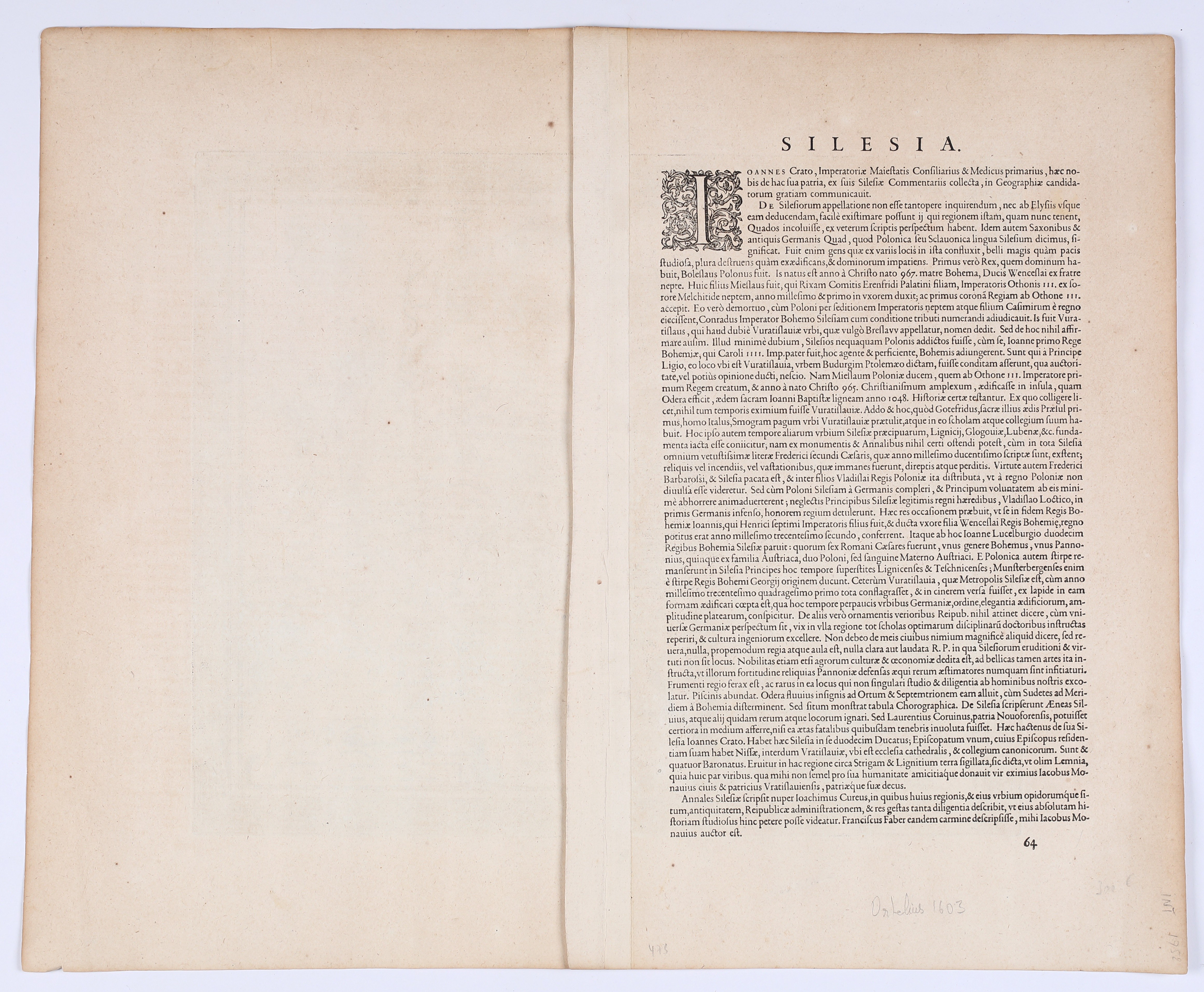
Copperplate engraving, paper, 340 × 420 mm, on a sheet measuring 475 × 590 mm, with Latin text on the reverse. Paper slightly discolored, edges slightly frayed. From the Latin edition of Ortelius’s *Theatrum Orbis Terrarum* from 1603, published by Jan Baptist Vrients in Antwerp.
The map is based on the famous wall map of Silesia, first published in 1561 by Martin Helwig (1516–1574) of Nysa, rector of St. Mary Magdalene School in Wrocław. Helwig’s original map, published by Jan Creutzig, was a large-format work consisting of four sheets (printed from 12 blocks) and oriented toward the south, with Upper Silesia at the top of the map. The map features twenty-eight coats of arms, fourteen Silesian duchies and their capitals, and the Czech lion and the Polish eagle in the upper corners. Helwig’s map remained the primary source for cartographic depictions of Silesia for over 160 years. In the 18th century, the Wrocław scholar Christian Runge described it as “the mother of all maps of Silesia.”
For the first edition of *Theatrum Orbis Terrarum* in 1570, Abraham Ortelius created a scaled-down version of Helwig’s map, slightly expanding its coverage in all directions. In adapting the map, Ortelius rotated it to the conventional orientation with north at the top, removed Helwig’s decorative coat-of-arms cartouches, and introduced political boundaries that were absent from the original map. The symbols for mountains were also simplified. Ortelius’s version itself became an important model for subsequent cartographers, including Gerardus Mercator, Jodocus Hondius, and Willem and Joan Blaeu. In the upper right corner, within an ornate ribbon cartouche, is a crowned Silesian eagle along with explanations of the symbols representing cities, monasteries, fortresses, and villages. The elaborate title cartouche at the bottom of the map, flanked by a satyr’s mask and fruit garlands, contains a scale and the text of the publishing privilege.
On the reverse side is a text in Latin titled “Silesia,” containing a description of Silesia based on the commentaries of Johannes Craton, a physician at the imperial court.
Van der Krogt 3, 2900:31B; Van den Broecke 103.










Nesen skatītās
Piesakies, lai redzētu lotu sarakstu
Iecienītākie
Piesakies, lai redzētu lotu sarakstu