


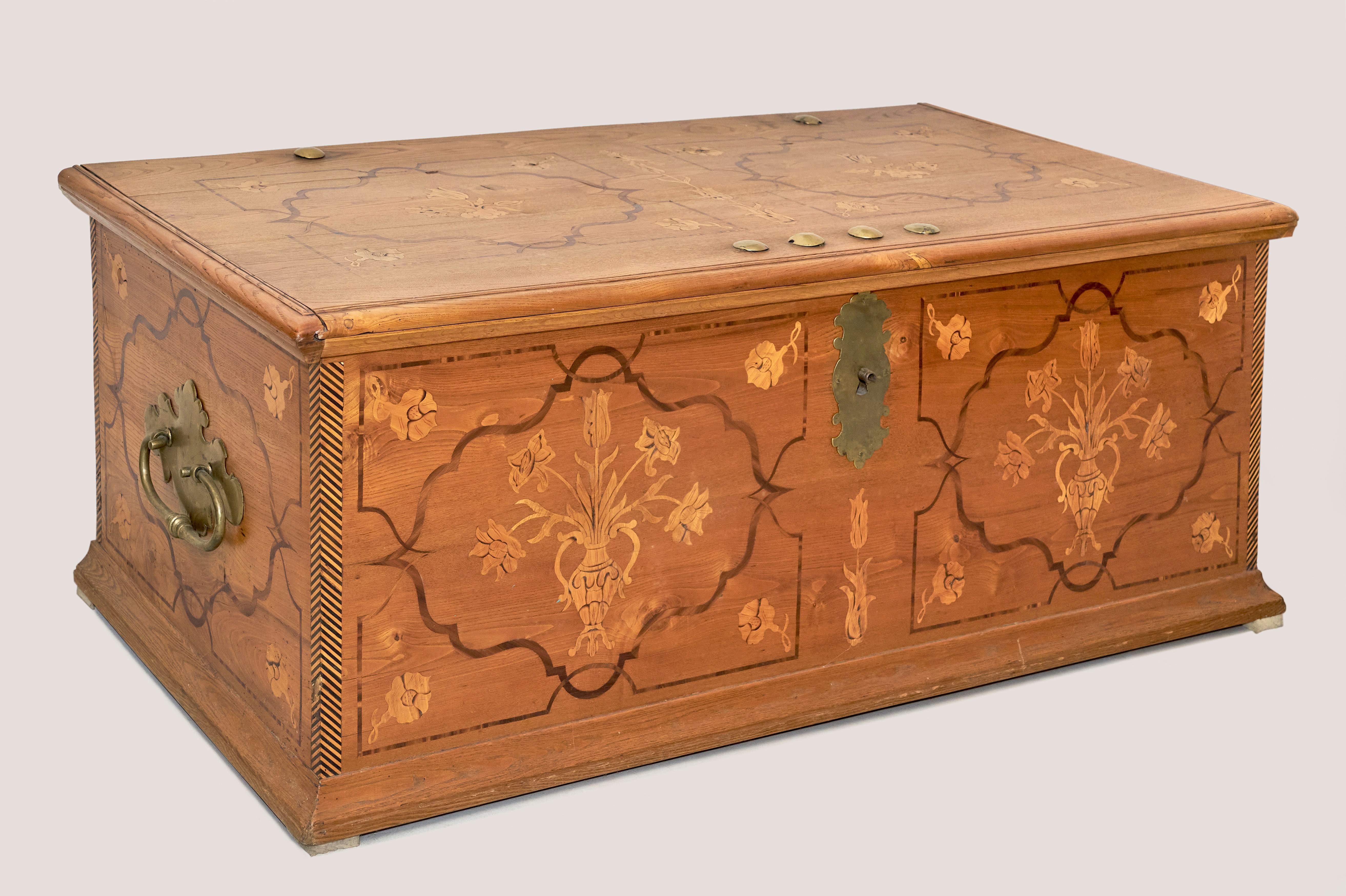
construction - ash; marquetry - plum, boxwood; hardware - steel, brass; 58 x 146 x 69.5 cm;
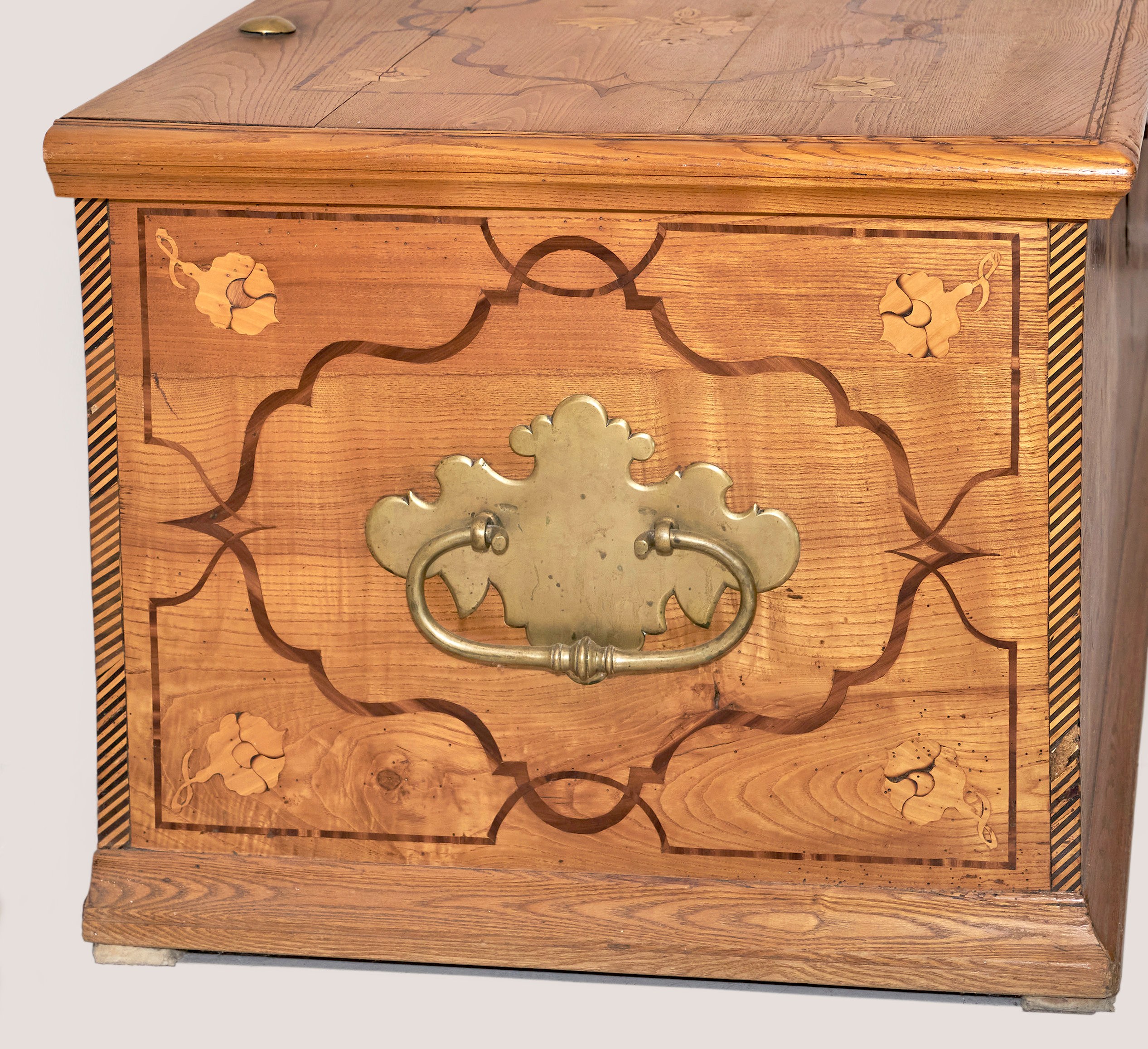
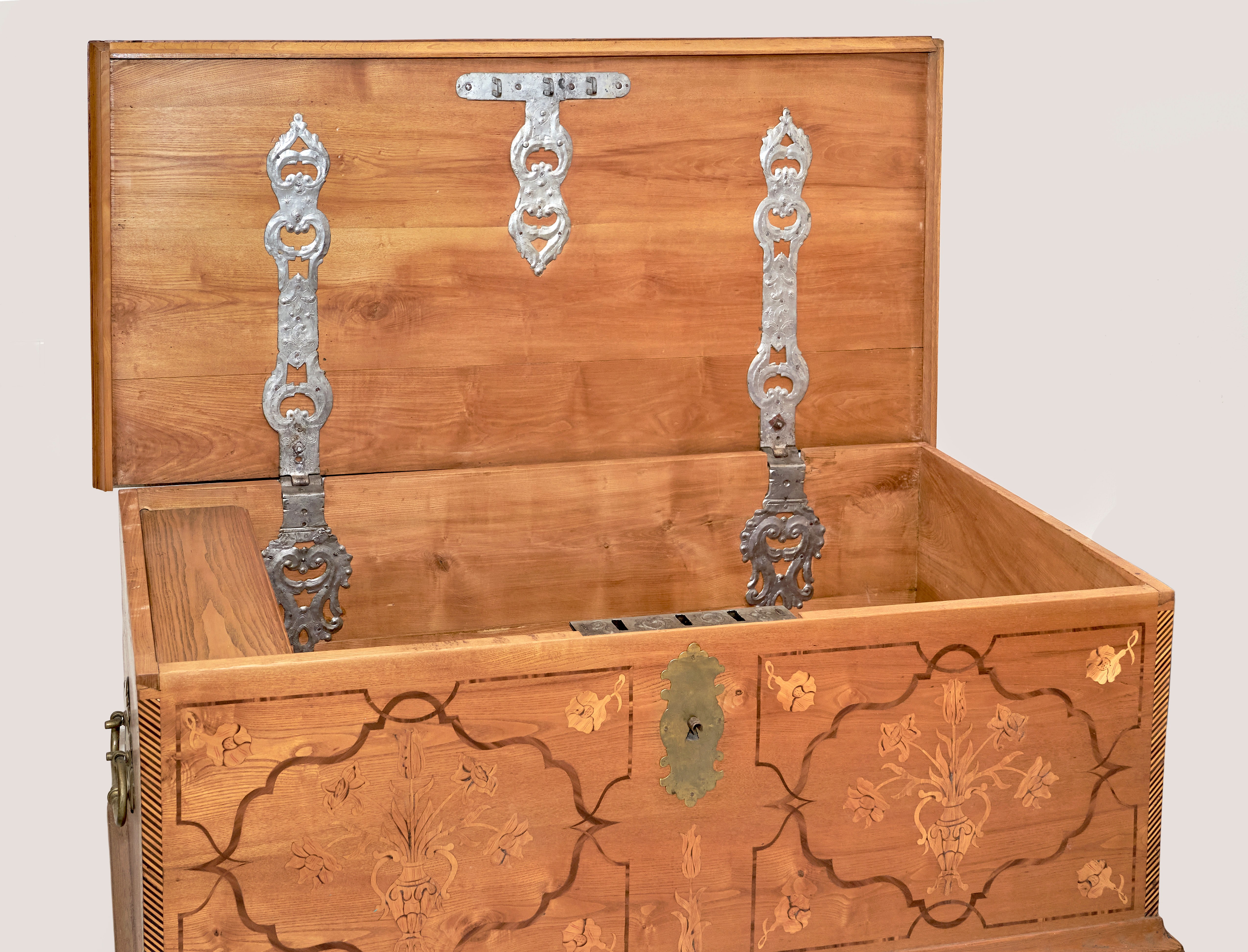
Perpendicular chest, richly inlaid with floral and cord motifs and ribbons and veins separating decorative, symmetrical fields. The rim of the lid and the narrow pedestal moulding. Marquetry enriched with burnishing and engraving. Inside, on the left side of the bustle. Exemplary latch with three catches and a tin decorated at the top with repoussed flowers; belt hinges of steel, forged, repoussed, engraved, tinned. On the sides of the body, brass oval entablatures on wave-cut brass sheet metal signs.
Time and place of creation: Elblag or Zulawy, 2nd half of the 18th century (ca. 1770-1780?);
Dimensions: 58 x 146 x 69.5 cm;
Materials: construction - ash; marquetry - plum, boxwood; hardware - steel, brass;
State of preservation: good, after general repair (lid and body from the inside cleaned, smoothed and polished; supplemented the upper edge of the body back at the right hinge and the front edge of the lid above the lock; supplemented the motifs of twisted cord in the corners of the body, especially the left back one). Lid - cracked at full width, in 2 places with small losses in the part of inlaid flower heads. Body - missing legs; sides and back with traces of cracks, back reinforced from the outside with four vertically glued slats; traces of insects in the lower part, especially on the bottom and sides; bottom cracked on the full width.
A chest with solutions typical of the Elblag and Bujawy and Malbork and Torun environments, characterized by attachment to the use of local wood - golden ash, as a construction material and used in richly inlaid decorations. They also include: dark, striped plum used in ribbon and ribbon and ribbon ornamentation creating symmetrical fields with fanciful outlines, floral decoration consisting of heads on stems or floral vases, repetition of floral motifs, and engraving of motifs and giving them spatiality by burning some of the wooden intarsia tiles, giving a lavender effect. The body corner ornamentation used in the chest in question, masking the joints, is often found in Elblag-Brazilian chest furniture.
The affiliation to the woodwork of the mentioned centers, mainly Elblag, is also evident in the type of hardware used - brass entablatures on the considerable size of the signs cut in waves in the thick brass plate, and belt hinges attached on the inside of the lid and back.
The chest in question lies between courtly ebenistic art and domestic, idyllic furnishings - exquisite in their own way. Its regionalism is a desirable feature in the current unified world, separating Elblag and Żuławy manufacturing from other Central European centers. Products from this region are among those rarely offered on the antiquarian market.








Nesen skatītās
Piesakies, lai redzētu lotu sarakstu
Iecienītākie
Piesakies, lai redzētu lotu sarakstu