


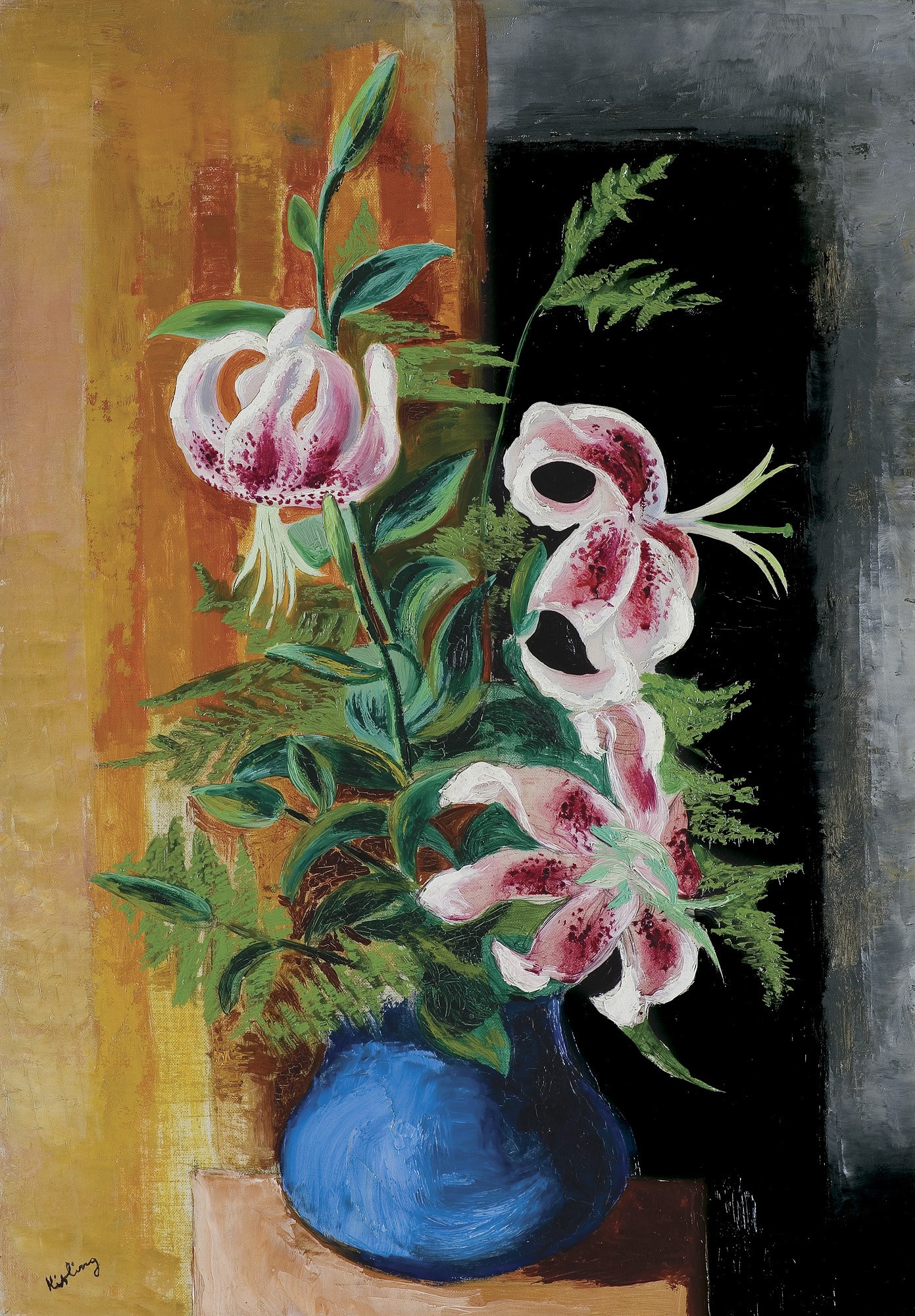
55.2 x 38.1cm - oil, canvas signed l.d.: Kisling
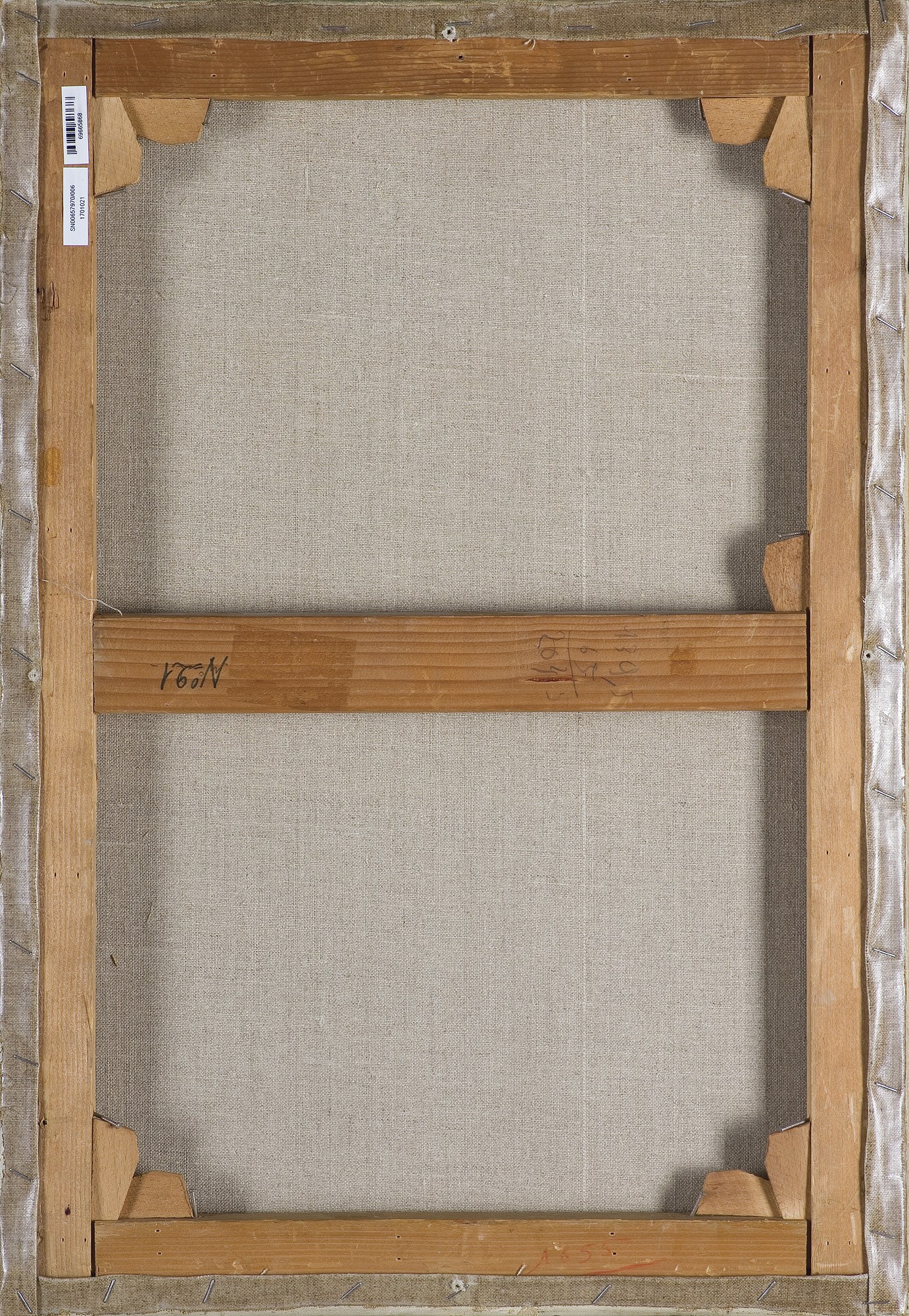
On the left strip of the painting loom two Christie's stickers with inventory numbers and bar code; on the cross strip (in pencil): No. 21, on the lower (red crayon): No. 55.
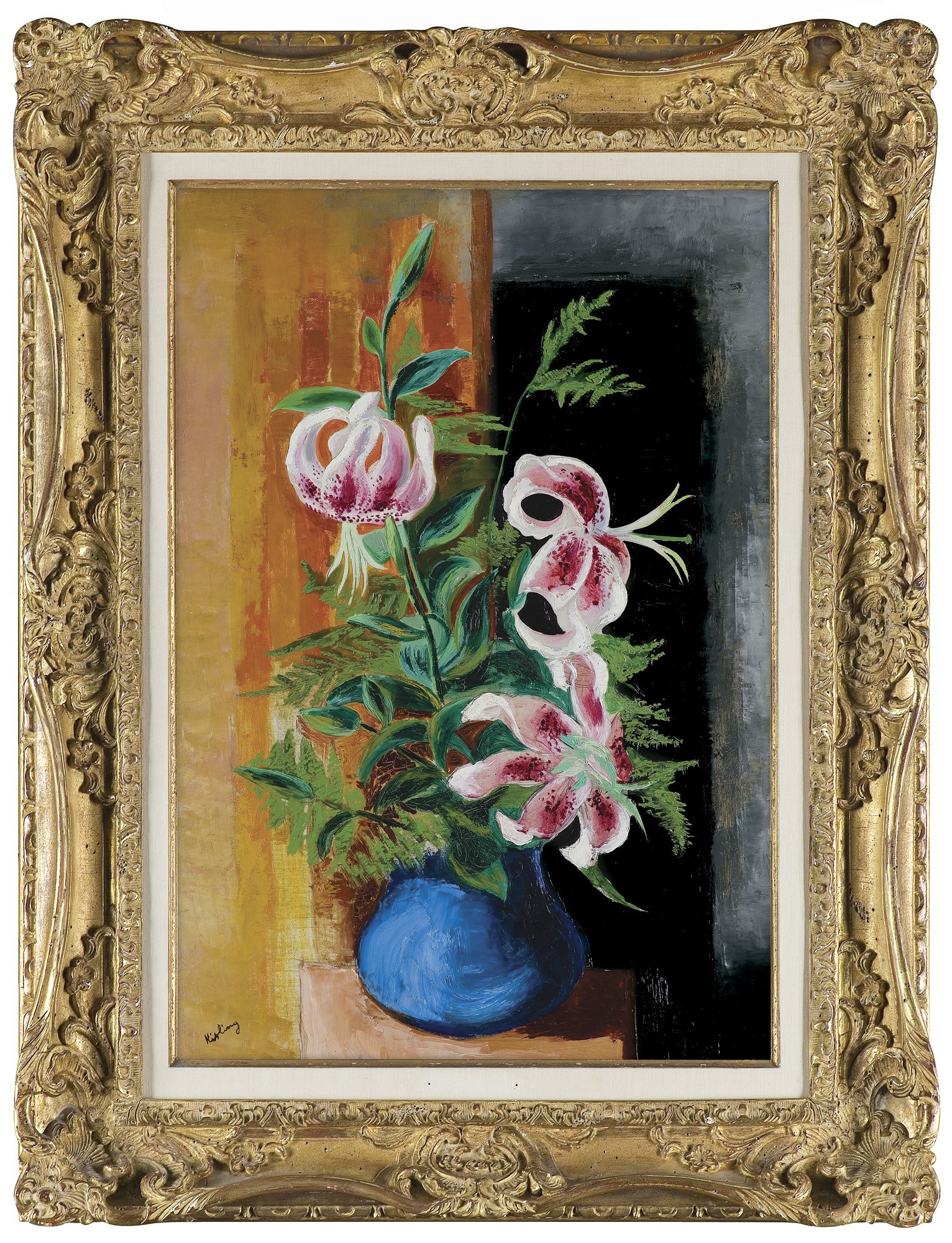
Attached to the frame hanger is a Christie's label with catalog number and auction date, as well as inventory numbers and barcode; on the side slats of the frame, Christie's stickers with auction date and catalog number; on the upper slat, a circular sticker with the inscription: Kisling | No 21, above - brass plate with engraved inscription: KISLING.
Provenance:
- Auction at Hôtel Rameau, Versailles, December 3, 1967, cat. no. 70.
- Impressionist and Modern Art Day Sale auction, Christie's New York, V 2023, (acquired by current owner).
According to information in the Christie's catalog, the work will be included in Volume IV (supplementing Volumes I, II and III) of Moses Kisling's catalog raisonné by Marc Ottavi (in preparation).
Cubism, expressionism, pure cubism - these are literary themes. I don't recognize any directions, what matters to me is whether the painting is good or bad. The French, having the ability to strictly formulate their observations, do not speak of a painting other than: "C'est mal fait" or "C'est bien fait." In this one word "fait" lies the secret of painting," said Moses Kisling ("Literary News" 1926, no. 46, p. 1).
In his early work, the artist succumbed to the influence of Cézanne, and later the Cubists. However, he quickly developed his own style, which was characterized by pure colors, neutral backgrounds and smooth, shiny surfaces, as well as decorative linearism, especially present in still life and floral compositions. Kisling's paintings, whose unique moodiness was explained by reminiscences of seventeenth-century Dutch painting, very quickly gained critical acclaim: For joyful is not only the creative will but also Kisling's painterly knowledge, a thoroughly painterly knowledge, eminently painterly, since it operates primarily with color, which is characterized by an extremely wide scale of color tones and strikes with an intense glow of luminous intensity. Kisling's women, trees, flowers or fish always have the same "epidermis" of decisive pigmentation, with a glassy sheen - his paintings breathe with the sensual vibrancy of the old Dutch tinkers (Z. St. Klingsland, Kisling, "Literary News" 1935, no. 38, p. 8).
Moses Kisling studied with Jozef Pankiewicz at the Academy of Fine Arts in Cracow in 1907-1911. On his advice, together with Szymon Mondszajn, he left for further studies in Paris. There the critics André Salmon and Adolf Basler became interested in his work, and he also received a scholarship from an anonymous patron from Russia. During World War I, he fought in the Foreign Legion. He was wounded while fighting at the front, and was discharged from the army in 1915. Probably then he received French citizenship. From about 1920 he began to spend summers steadily in Sanary-sur-Mer, where he bought a house. He also maintained contacts with the country. During World War II, he joined the French army. In 1940, via Spain and Portugal, he went to New York. After the war, around 1946, he returned to Sanary-sur-Mer. He was one of the most prominent representatives of the Ecole de Paris of the interwar years. He had many solo exhibitions, and often participated in group exhibitions abroad as a Polish artist. He also took part in domestic artistic life, including the First Exhibition of Polish Expressionists (later Formists), Krakow 1917. He was friends with Tadeusz Makowski. In his early period he painted cubic landscapes and still lifes. Portraits were a constant theme in his painting, including numerous likenesses of artists, critics and people from artistic circles, making him a chronicler of the Ecole de Paris socialite. His portraits of women and nudes are characterized by a special stylization, with idealized faces with big eyes, assuming studied poses.













Nesen skatītās
Piesakies, lai redzētu lotu sarakstu
Iecienītākie
Piesakies, lai redzētu lotu sarakstu