


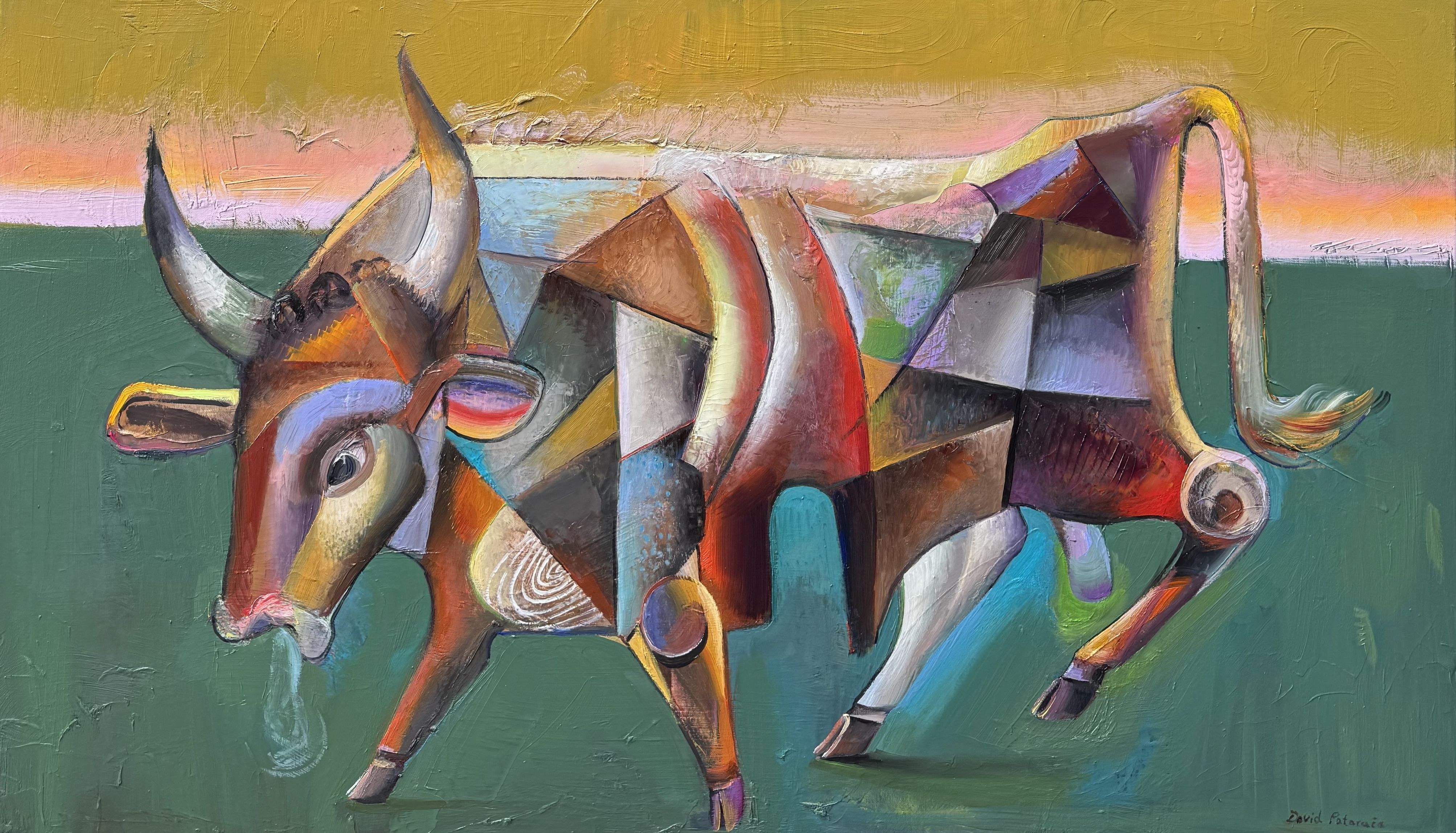
oil on canvas, 70 x 120 cm, signed lower right: David Pataraia
He was born in 1971 in the small Georgian village of Kwemo Chibati. His grandfather, Markiane Pataraia, was the oldest shepherd in all of Georgia, tending cows and sheep on the mountain slopes far from the Black Sea coast, where ancient Colchis once lay. His father transported tea to the city in his well-maintained truck, while his mother picked tea leaves and took care of the house and garden. David’s brother has a family of his own. No one at home was interested in art—except for his grandfather, who carved beautiful teaspoons from cherry wood.
As early as preschool, his teachers noticed that the circles he drew were remarkably symmetrical. He quickly realized that he could turn the circles he drew into kisses, and he skillfully copied animals from picture books—for which his loved ones began calling him “Leonardo,” playfully patting him on the head—which David didn’t like. This experience inspired him to make a vow: “I swear to myself that I will be a better painter than the enigmatic Leonardo”—about whom he knew nothing at the time.
His first serious work, created at the age of thirteen, was a painting of his mother’s metal pot. The art club at the local community center was led by Tamazi Chkhaidze—a sculptor who encouraged David’s parents to send him to art school. Later, in Tbilisi, he graduated from the Jakob Nikoladze School of Fine Arts, while simultaneously being admitted to the Academy of Fine Arts in the graphic arts department. After his first year of studies, in 1991, he left for Poland quite by accident with a group of manual laborers. He was supposed to stay for two months, but he has remained there ever since. He currently lives in Warsaw with his wife and children.
About the Artist
David Pataraia was born in Georgia in 1971; he has been living and working in Poland for over 24 years. He studied at the Academy of Fine Arts in Tbilisi and continued his studies at the academies of fine arts in Warsaw, Poznań, and Kraków. He has had dozens of exhibitions, both solo and group shows, and his works are held in private and museum collections around the world.
He is an artist endowed with exceptional sensitivity and imagination. His work is characterized by remarkable diversity: in addition to colorful pieces dedicated to children, he creates nudes, abstracts, paintings featuring bulls and roosters, as well as works thematically linked to the traditions and culture in which he grew up. David Pataraia is also an outstanding portraitist.
All his works are characterized by a richness of color—saturated, intense hues—through which the artist infects viewers with his optimism. In his world, the viewer and the artwork enter into close, personal contact; it is difficult to maintain a distance when the artist himself invites you to join in the fun and experience.
He uses a variety of techniques and materials—wood, metal, and plastic—to create 3D images. The combination of different textures and materials allows viewers to “touch” the reality created by the artist.
The artist’s wife is Katarzyna Królikowska-Pataraia.
Artistic Biography
He was born on May 6, 1971, in Lanczchuti, Kwemo Chibati, Georgia. He graduated from the Jakob Nikoladze Secondary School of Fine Arts in Tbilisi. He studied in the graphic arts department under the guidance of Prof. Dawid Uruszadze, Goga Cereteli, and Tamazi Chkhaidze. He continued his studies in Poland in the departments of graphic arts (Warsaw) and painting (Poznań, Kraków).
Exhibitions (selected)
1990 – Illustrations for the book *Fantomass*, translated into Georgian
1991 – Animation project for the program “Warianty,” Warsaw
1991 – Galeria na Kole, Warsaw
1992 – Galeria na Kole, Warsaw (a series of paintings inspired by H. Purcell’s opera “Dido and Aeneas”)
1992 – Museum in Wola, “Exotic Georgians,” Warsaw
1993 – Department of Graphic Arts, Academy of Fine Arts in Warsaw (academic year)
1993 – Series of drawings inspired by Krzysztof Penderecki’s opera “King Ubu”
1993 – Artistic scholarship from the Stefan Batory Foundation, Warsaw
1993 – Museum of Independence, Warsaw
1993 – Designer of the poster for Shakespeare’s “A Midsummer Night’s Dream,” Nowy Theater, Warsaw
1994/1995 – Department of Painting, Academy of Fine Arts in Poznań
1994 – Gallery in Tarnowskie Góry
1994 – Powszechny Theater, Warsaw
1994 – EPEO Museum, Nocara, Province of Cosenza, Italy
1995 – Grand Theater in Poznań, interpretation of drawings for “Tasso and Cervantes”
1996 – Arka Gallery, Warsaw
1997/1998 – Academy of Fine Arts in Kraków, Department of Painting (one semester)
1997 – Galeria na Kole, Warsaw (portraits)
1997 – Solo exhibition at Michał Bristiger’s home
1998 – Poster for Shakespeare’s “King Lear,” Teatr Nowy, Warsaw
1998 – Arka Gallery, Warsaw
1998 – Wilcza 22 Gallery, Warsaw
1999/2000 – Ran the “Atelier D&G” Artist-Owned Gallery, Warsaw
1999–2004 – Drawing school, Warsaw
2000 – Wierzynek Restaurant, Kraków
2000 – Millart Gallery “Giełda/Praga,” Warsaw
2001 – Arka Gallery, Warsaw
2004 – “Piękny Świat” Gallery, Warsaw (“In the Footsteps of Fantasy”)
2004 – Oslo, Norway
2005 – Museum of Contemporary Art, “Portrait of Akhmatova” exhibition, Warsaw
2005 – Wola Park, Warsaw
2006 – Luksfera Gallery, Warsaw
2007 – M25 Club, Warsaw
2008 – Abdank Polska Foundation, Warsaw
2008 – University of Warsaw, exhibition “Portrait of St. Gregory Peradze”
2009 – Exhibition at St. Gregory Peradze University in Tbilisi
2010 – Klitka Gallery, Warsaw (“Me Here, You There”)
2011–2013 – Ran the “Czibateli” Art Studio in Koneser, Warsaw (with support from Hubert Sylwester)
2012 – Solo exhibition at Dorum Art, Koneser, Warsaw
2011 – Symfonia Warsovia / De Muzyka – “The Passenger,” based on the film by Andrzej Munk, Warsaw
2012 – Kontynent, Warsaw
2012 – Polish Jazz Association, Warsaw
2012 – Praga Night, Warsaw
2011–2013 – Night of Museums, Czibateli Studio
2013 – ArtPistols Gallery, Warsaw
2013 – GWP in Warsaw, charity auction (the painting “Hossa” sold for 25,000 PLN)
2013 – Piaseczno Artists’ Colony
2013 – “Lorca” Stage at the Museum of Contemporary Art Laboratory
2013 – Sofitel Hotel, charity auction (painting sold for 25,000 PLN)
2014 – ArtPistols Gallery, Warsaw
2014 – Warsaw Stock Exchange (solo exhibition)
2014 – Marriott Hotel, auction (paintings sold for 25,000 PLN and 12,000 PLN)
2015 – Żurawina Restaurant, charity exhibition
2015 – Museum Night, David Pataraia Gallery opening, Warsaw
2015 – University of Warsaw, charity auction to aid flood victims in Georgia
2015 – Belotto Gallery, Warsaw
2015 – Sinus Sports Club, Zawady, Warsaw
2015 – Gallery 87, Łódź
2015 – Kookaburra Gallery, Łódź
2015 – Ran his own gallery, “David Pataraia Gallery,” in Warsaw for 11 months
“The One Who Lives Between a Dot and a Smudge”
In a certain world that existed between the palette and a dream, someone was born who had no single form. Not because he was lost—but because he was too aware of what he could be. People in this world carried labels like passports. Some were “Sculptors,” others “Philosophers,” and still others “Athletes,” “Mothers,” or “IT Workers.” But he… didn’t want to be just one thing. They told him:
“Choose. Paint the same thing. Write in one style. Get your act together, because the world doesn’t like ambiguity.”
And he would reply:
“But blurriness is a place where you can breathe.”
He was like light that refuses to fall on a single object, preferring instead to hover between them, tickling their edges. He was like an embryo of emotion that hadn’t yet decided whether it would be anger or ecstasy. He was like a painting that didn’t fit in a frame, and so became a corridor. So he began to create—not art, but states of being. Not for recognition, but for those who, too, don’t know who they are. Those who felt too much, too expansive, too diverse came to his world.
They didn’t fit on a resume; they didn’t fit into the system; they had too many colors within them, all vying for space on the canvas.
Dato—for that was his name—would simply tell them:
“You can be anything, but you don’t have to be everything at once. You can be nobody, but not always. And the most beautiful things happen when no one is watching, and you create anyway.”
Over time, he no longer needed to sign his paintings. People knew it was him—by how they felt. Not by the style, not by the color, but by the fact that something inside them began to breathe where it had previously been constricted. And then they understood:
He doesn’t create to survive. He creates to remind us that survival isn’t enough.










Nesen skatītās
Piesakies, lai redzētu lotu sarakstu
Iecienītākie
Piesakies, lai redzētu lotu sarakstu