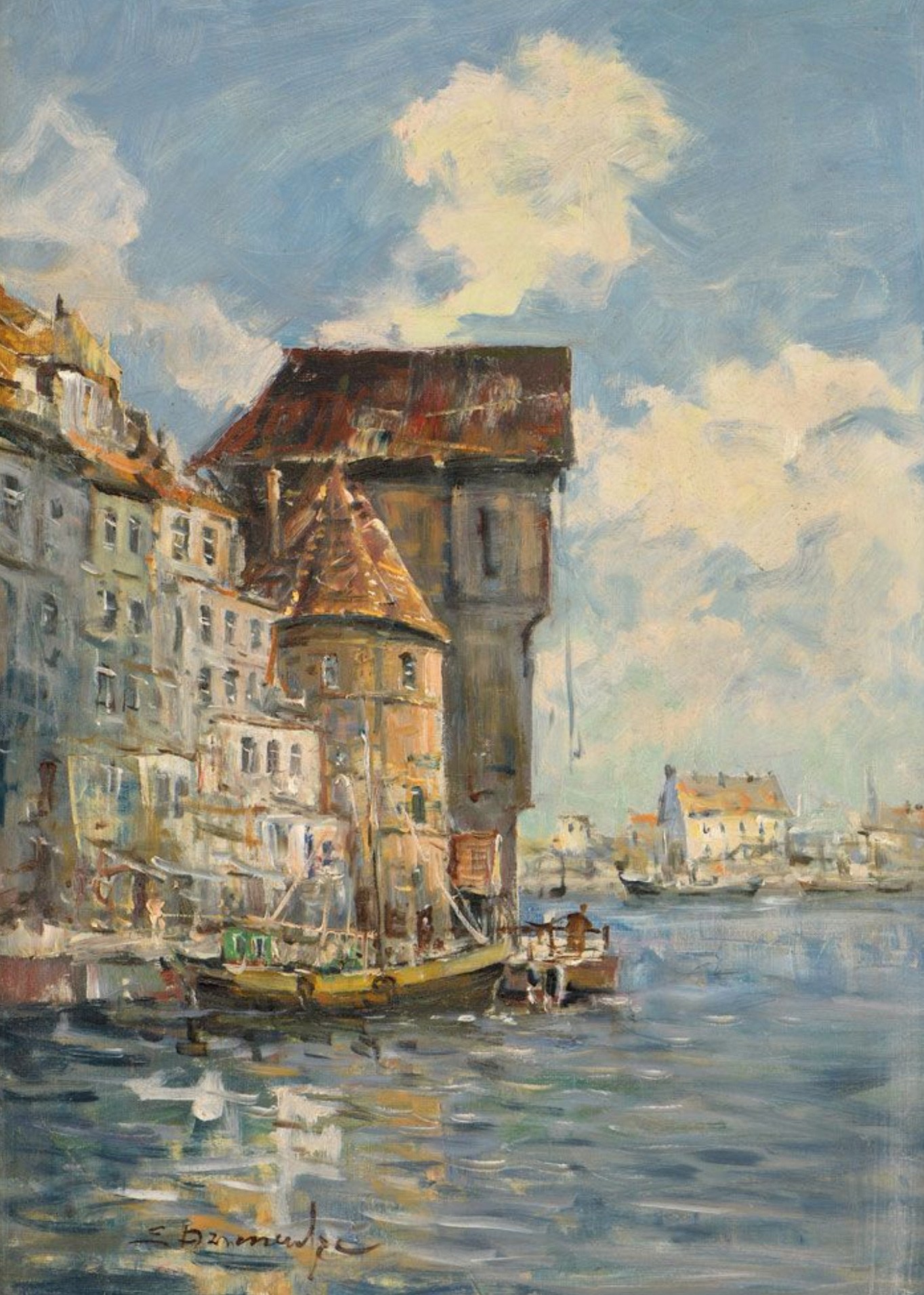
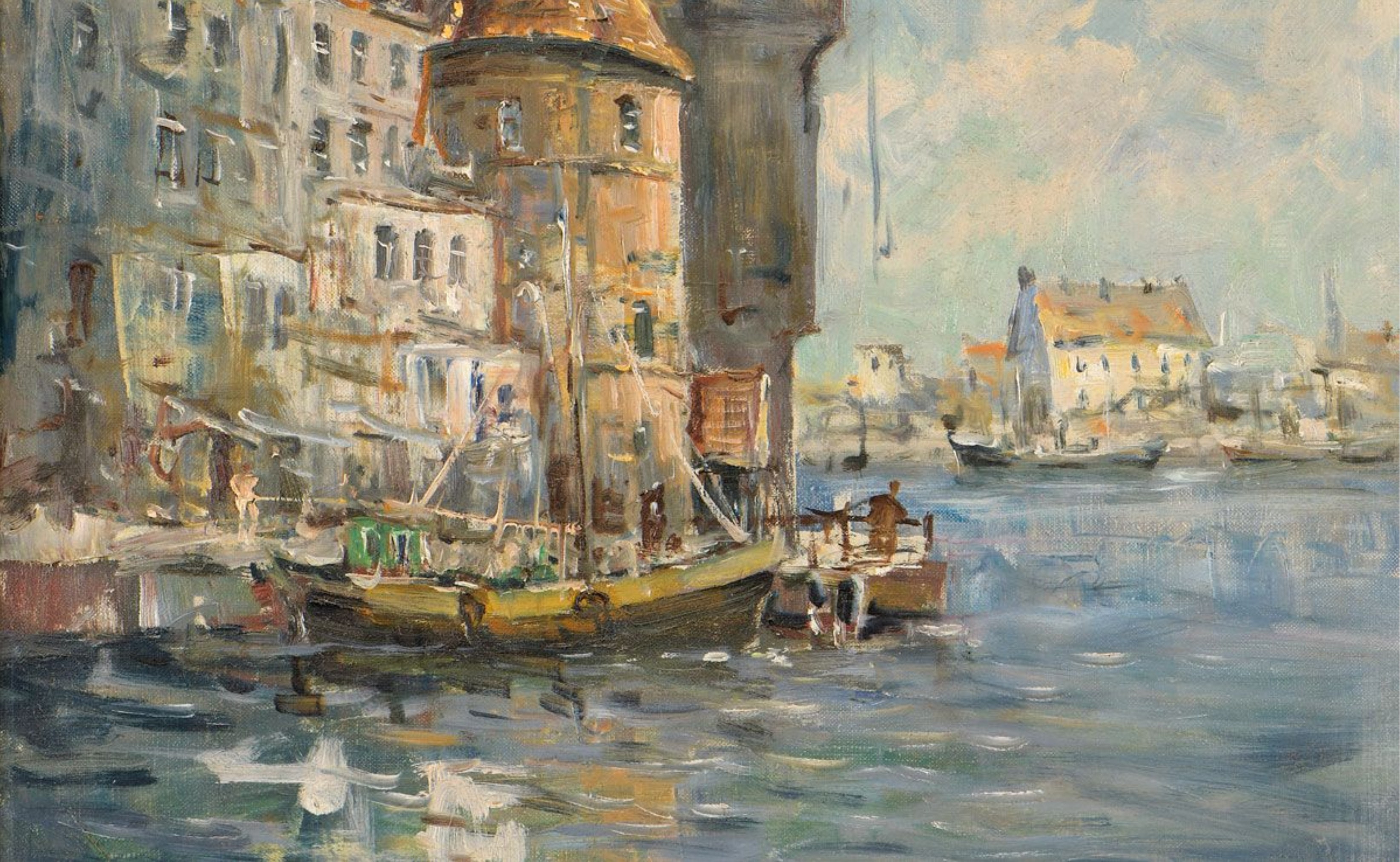
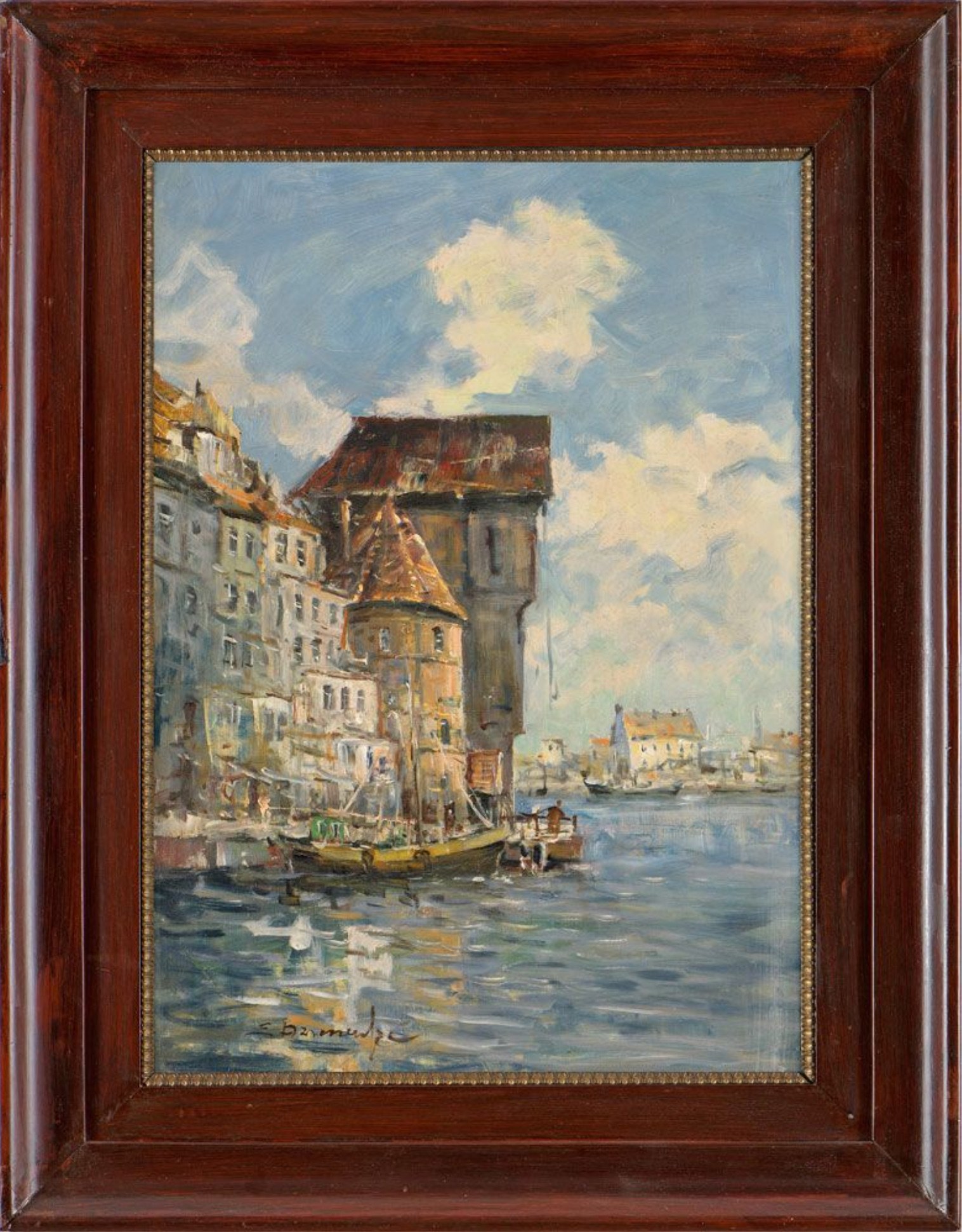
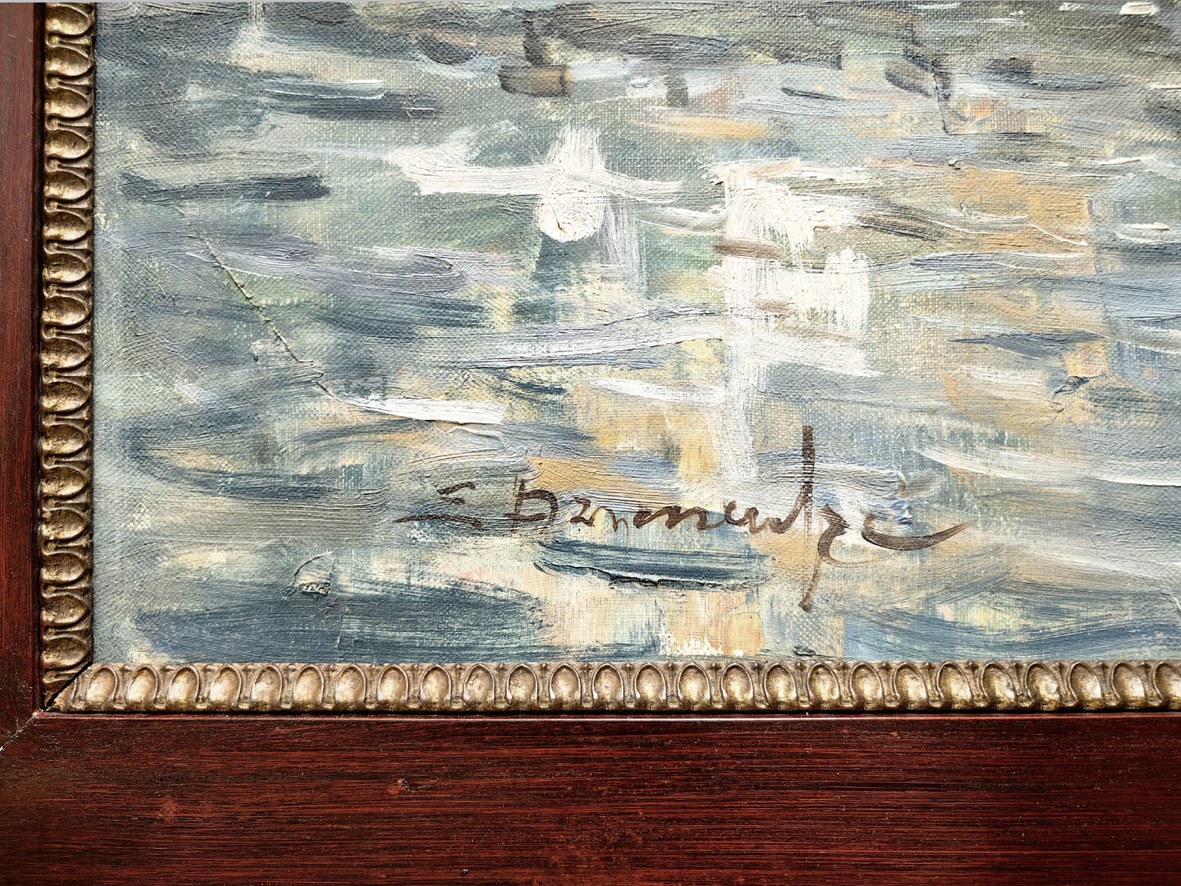
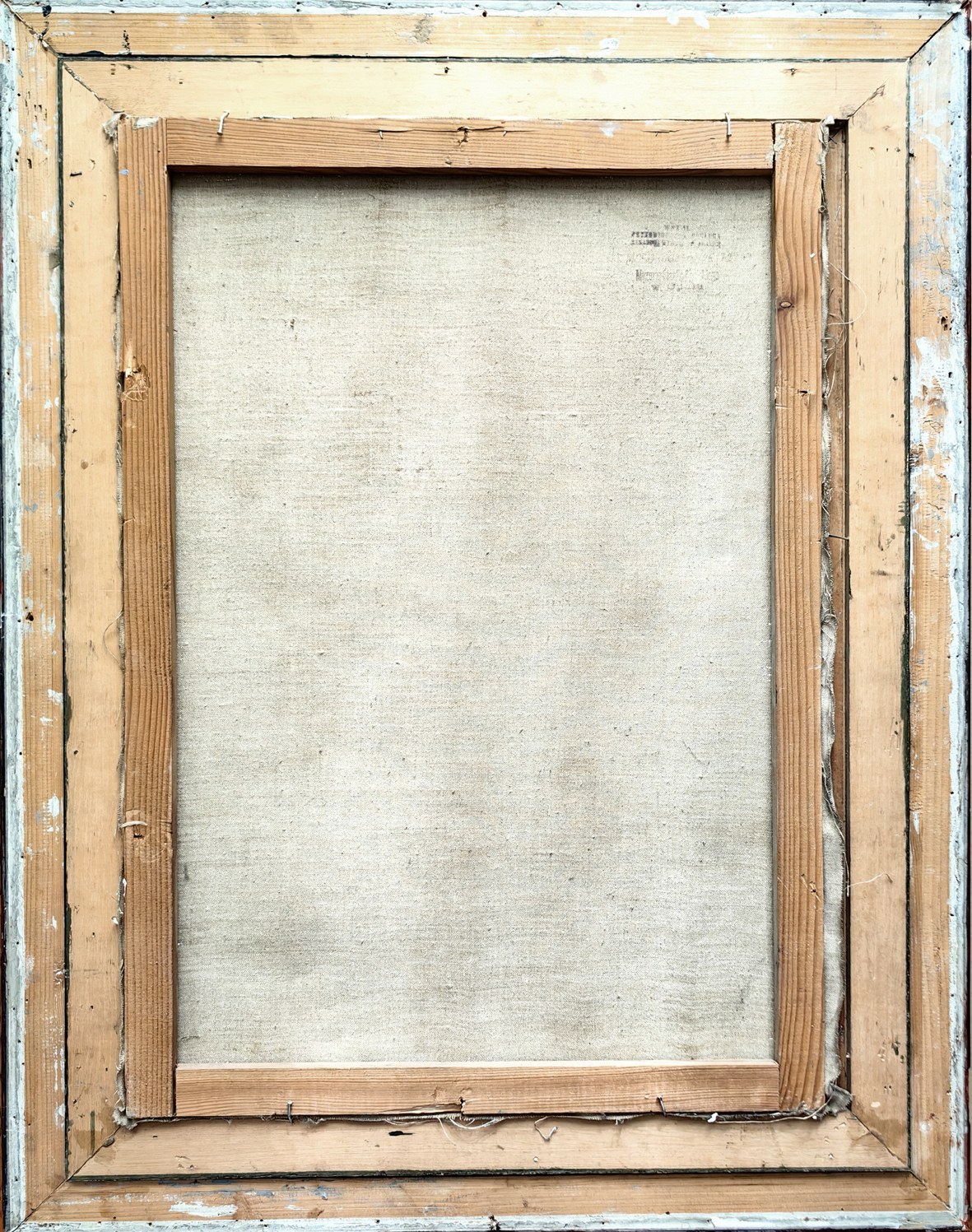
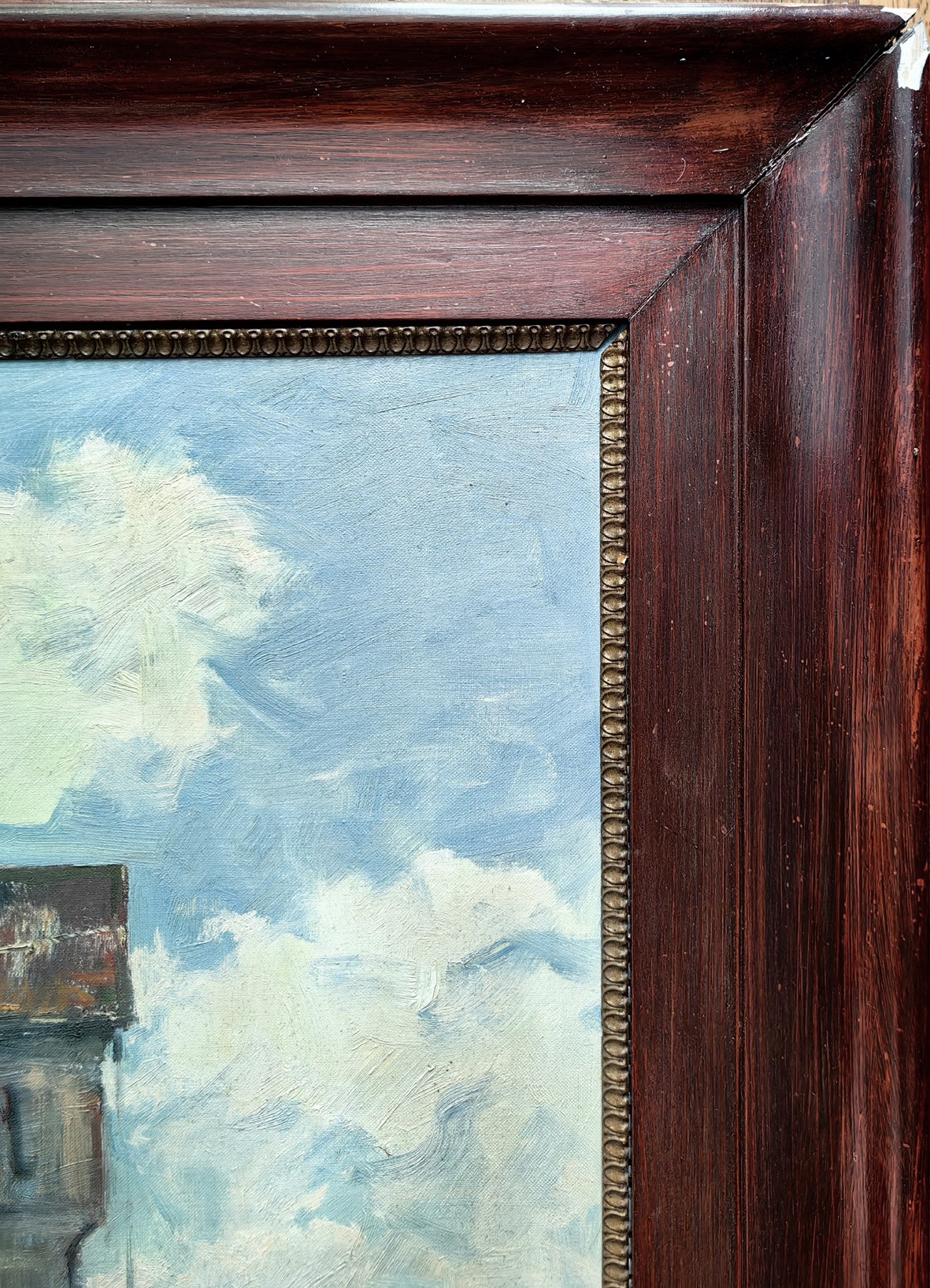
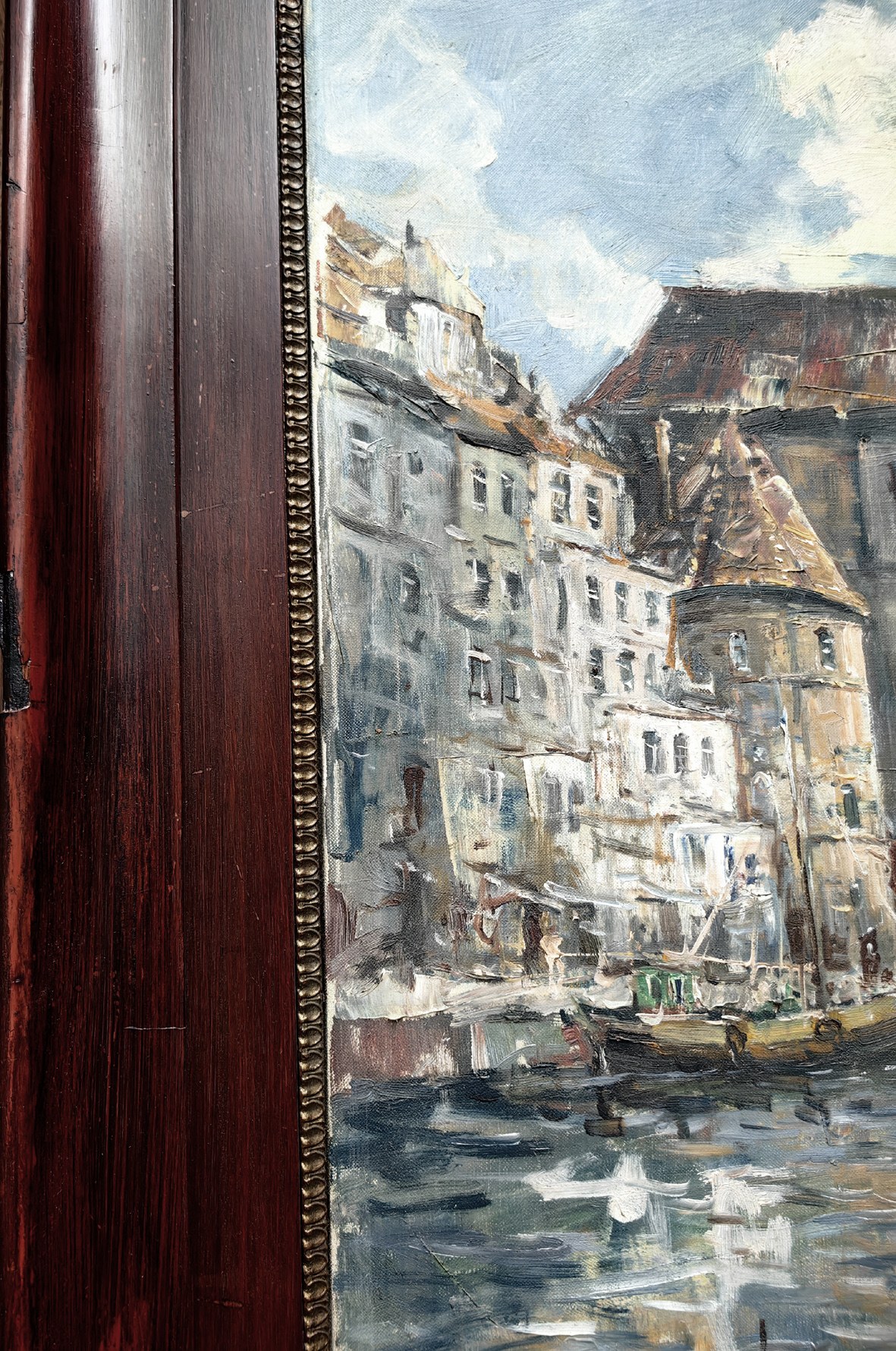
Large painting in a solid wooden frame.
Technique: Oil, canvas
Dimensions: 68 x 48 cm, 87.5 x 68.5 cm (with frame)
Signature: l.d.: E. Dzierzencki
The work is framed in a brown frame (slight losses)
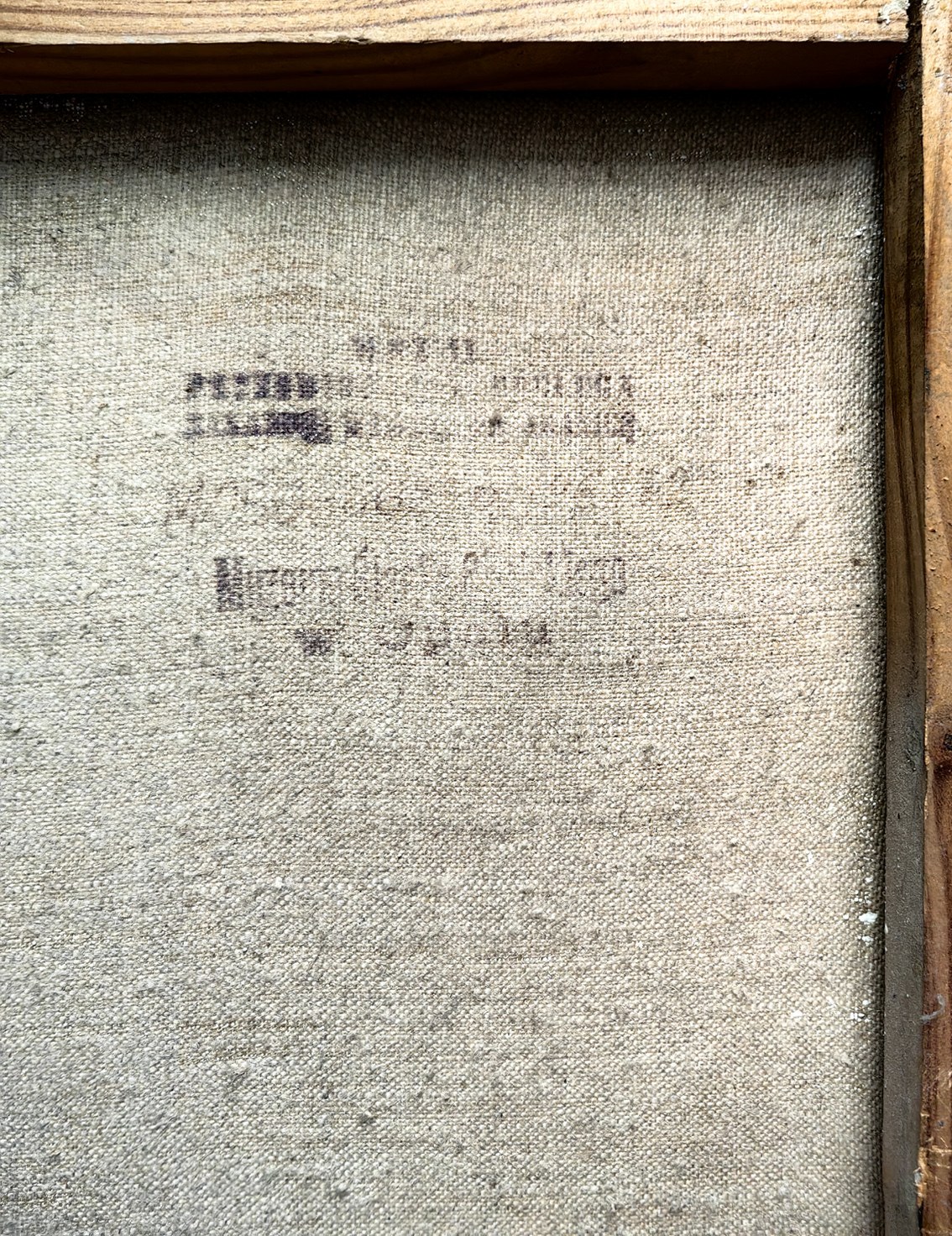
On the back stamp (illegible: Museum ...)
Eugeniusz Dzierzencki (1905 -1990), graduated from the Warsaw Academy of Fine Arts under Leon Wyczółkowski and Władysław Skoczylas. Before 1939, he was associated with the Coast, taking up marine themes in his works, painting motifs from Sopot and Gdansk. After World War II, he settled permanently in Sopot and founded the Association of Artists on the Coast. He is considered the second Polish marine artist, next to Marian Mokwa. Numerous works by this artist decorated ships sailing under the flags of France, Great Britain, the USA, Brazil or Norway. He has exhibited in many Polish cities, as well as in New Zealand, Germany and Japan.
The Gdansk Crane is a unique European example of a medieval port crane and the only surviving example of a double-towered gate in Gdansk.
The first mention of a wooden crane-gate at the exit of what is now Szeroka Street dates back to 1367. After the fire of the oldest building, a new structure was erected in 1442-1444 - the brick western facade was not built until 1483. The crane was the largest water gate of Gdansk. In the ground floor there were rooms adapted for cannon fire, on the upper floors - shooting ranges for small arms. The main mechanism of the crane consisted of drums mounted on a common shaft, on which a rope was wound. Initially, one pair of drum wheels functioned, then - in the 16th or 17th century. - two pairs of such wheels were already in operation. Each drum was driven by four workers, known as cranes, walking around the inner circumference of the wheel. With the help of the device, a weight of up to 2 tons could be lifted (the lower pair of wheels allowed to lift goods to a height of 11 m, the upper pair - to a height of about 25 m). The crane not only performed loading functions, but was also used for erecting and lowering masts. Since it was city property, it was administered by an official called a crane master. From the beginning of the 17th century, the building began to lose its military significance (documents from 1605 already bring information about dwellings inside), and at the end of the 17th century its role as a crane also began to diminish (it was used to a limited extent until 1944). In 1945, the wooden central part with the mechanism burned down, while the perimeter walls were destroyed in approx. 60%. In 1957-1969 the building was rebuilt, and in 1962-1965 it was adapted into a museum and the crane mechanism was reconstructed.