


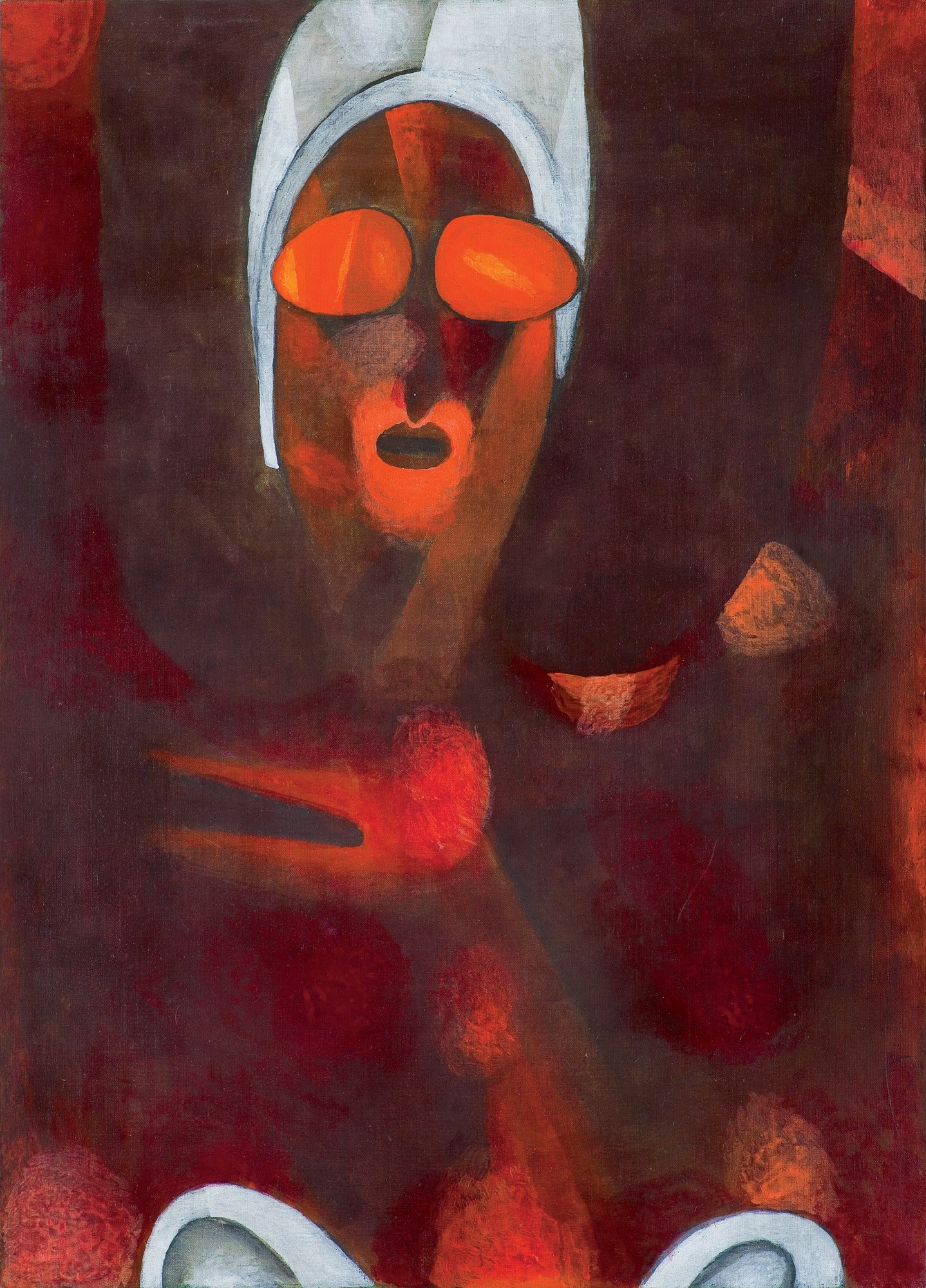
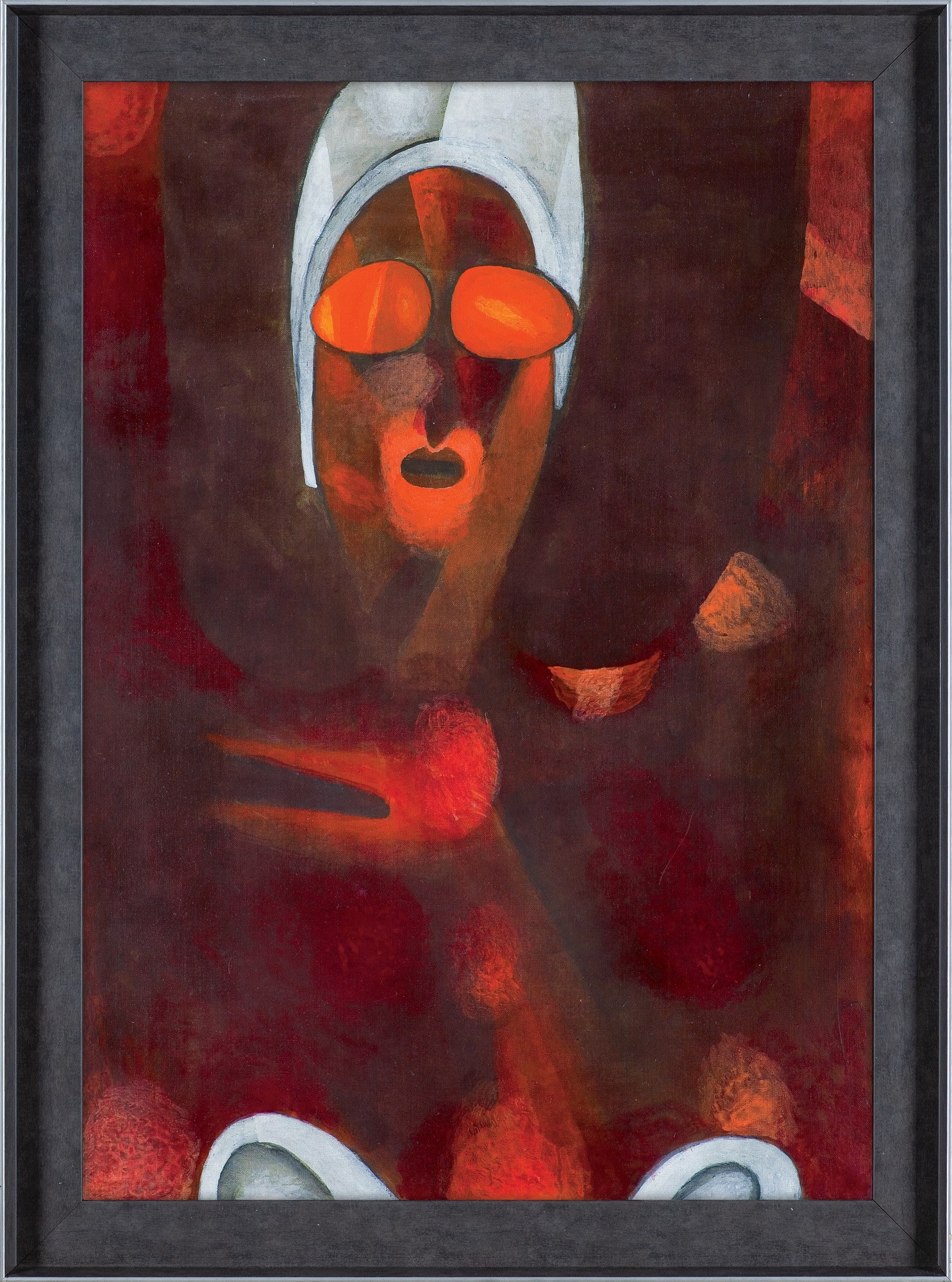
70 x 50 cm - oil on canvas
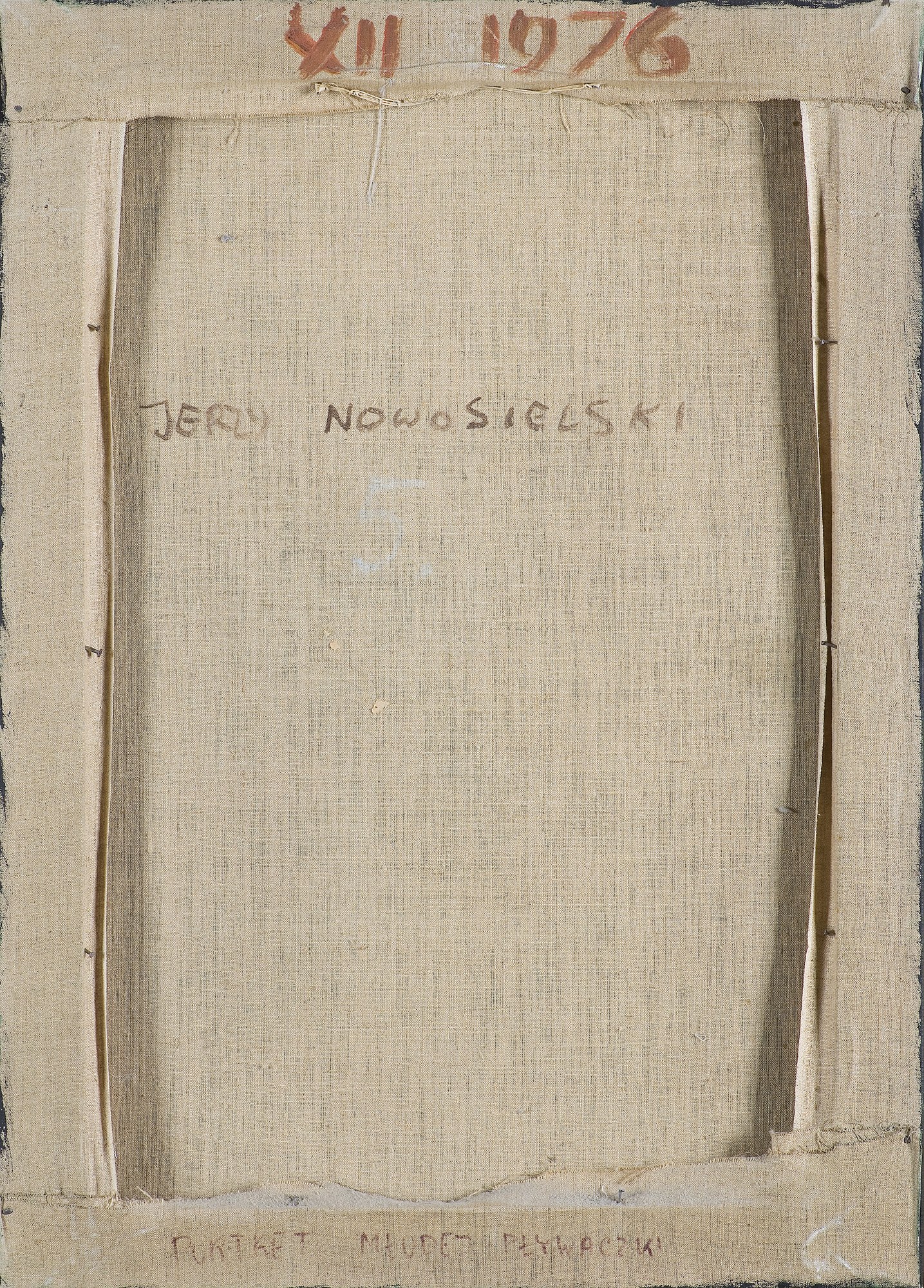
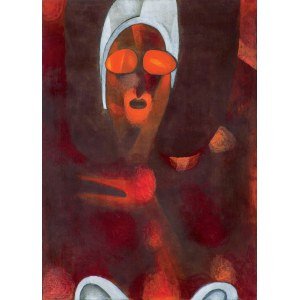
signed on the reverse: XII 1976 | JERZY NOWOSIELSKI | PORTRAIT OF A YOUNG SWIMMER, in white paint, center: 5.
Expert consultation: Andrzej Starmach, Nowosielski Foundation, Kraków.
Jerzy Nowosielski’s work from the 1970s represents one of the most interesting and highly regarded periods in his career as a painter. An important turning point on this path was 1971, when the artist presented his famous “black nudes” at the Krzysztofory Gallery in Kraków. Descriptions of the paintings spoke of “eschatological fervor,” “burning eroticism,” and “luminist mysteries.” In these works, Nowosielski employed a deep, nocturnal color palette, and the bodies hidden in the darkness were subtly illuminated by an expressive neon line. While the beginning of the decade was characterized by restraint and synthesis, the portraits and nudes created in the second half of the 1970s gained a new expressive power. In works such as, for example: *Semi-Nude* from 1976 from the collection of the Jacek Malczewski Museum in Radom, *Semi-Nude* from the Silesian Museum in Katowice, or *Portrait of a Young Swimmer* featured in the catalog, the artist combines figuration with elements treated in an almost abstract manner. This distinct formal transformation was aptly described by art critic Magdalena Hniedziewicz when characterizing the paintings from this period: “The same patterns, the same canons. The same color palette, the same compositional principles. And yet there is something different about them.” Greater intensity, greater restlessness. They are more aggressive; their expression is more legible” (Magdalena Hniedziewicz, “Goodness Tested by Beauty,” *Kultura*, no. 38, September 18, 1977).
The Portrait of a Young Swimmer perfectly fits this description. The head, rendered in saturated, vibrating shades of red and brown, contrasted with the smooth, flat patches of the orange goggles, defies literal interpretation. Here, Nowosielski creates an immaterial, unsettling, and ambiguous vision.
Nowosielski presented the painting to Halina Makowska, the wife of Jerzy Klinger, an Orthodox theologian and philosopher. Klinger played a significant role in the artist’s life. He was not only his friend but also his spiritual and intellectual mentor.
The painting has been exhibited, mentioned, and reproduced in, among others: Exhibited:
– Zapiecek Gallery, Warsaw, September 5 – October 1977;
– 4th International Triennial of Contemporary Art, New Delhi, February 1978.
♣ Droit de suite: ♣ A fee resulting from the right of the artist and his heirs to receive remuneration in accordance with the Act of February 4, 1994, on Copyright and Related Rights (droit de suite) will be added to the Purchase Price.
Jerzy Nowosielski (Kraków 1923–Kraków 2011) began his studies at the Kunstgewerbeschule in Kraków in 1940. In 1942, he spent less than a year at the Lavra of St. John the Baptist near Lviv. There, he studied painting and the history of icons. After returning to Kraków in 1943, he reestablished contact with the circle that would become the Kraków Group. After the war, he continued his studies at the Academy of Fine Arts in Kraków under the supervision of Prof. Eugeniusz Eibisch (1945–1947). At the First Exhibition of Modern Art in Kraków in 1948–49, he exhibited paintings in the style of geometric abstraction. During the era of Socialist Realism, he did not exhibit his work, instead focusing on set design and painting Orthodox and Catholic churches. In 1955, he presented his first solo exhibition in Łódź, and in 1956, he participated in the 28th Venice Biennale. From 1957 to 1962, he taught at the State Higher School of Fine Arts in Łódź, and subsequently at the Academy of Fine Arts in Kraków, where he lectured in the Department of Painting until his retirement in 1993. In the second half of the 1950s, he developed a distinctive style for his nudes, landscapes, and figurative interior scenes, which he owed to his fascination with icons and his experience with sacred art. In 1976, he resumed work on monumental projects, creating, among other things, murals, Stations of the Cross, and stained-glass designs for the Church of Divine Providence in Wesoła near Warsaw (1976–1979). The artist was widely recognized as an authority in the field of art rooted in spiritual values.
Jerzy Nowosielski died on February 21, 2011, in Kraków.











Nesen skatītās
Piesakies, lai redzētu lotu sarakstu
Iecienītākie
Piesakies, lai redzētu lotu sarakstu