


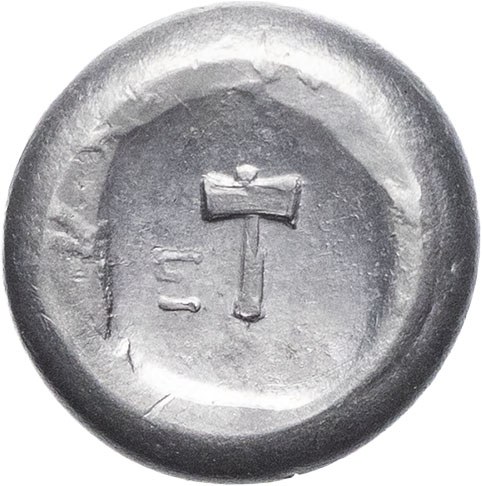
Hill, *Becker the Counterfeiter*, 1924, p. 99; Pewter - 2.34 g - 10.5 mm - 9 h
Superb, in mint condition.
By Karl Wilhelm Becker. Born in Speyer in 1771, Becker worked as a goldsmith in Mannheim, where he married in 1806. After falling victim to Baron von Schelm, who sold him a counterfeit Roman gold coin, he began to take an interest in the art of coin engraving and quickly became skilled enough to produce aureus dies. Settling in Offenbach, he became an antiquarian with a reputation for having a large inventory, attracting European collectors including the Prince of Isenburg, who became his patron, and Goethe, who described him in glowing terms. From 1815 to 1825, he engraved approximately 600 dies for 133 Greek coins, 136 Roman coins, 25 Visigothic coins, 1 Merovingian coin, 19 Carolingian coins, 7 medieval coins, and 9 siege coins. The first to expose Becker as a counterfeiter was Sestini in 1825. Until then, Becker had managed to deceive his customers by using metal of the correct fineness and the correct weights, and he did not hesitate to age the coins by transporting them along roads in a box lined with nails. He died on April 30, 1830, and went down in history as a counterfeiter of great artistic talent. Becker’s dies are preserved in Berlin.










Nesen skatītās
Piesakies, lai redzētu lotu sarakstu
Iecienītākie
Piesakies, lai redzētu lotu sarakstu