


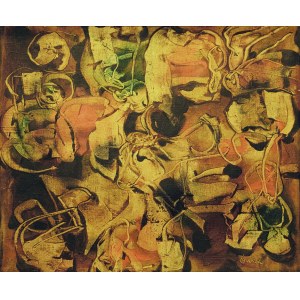
oil/canvas, 54 x 65 cm
signed p.d.: Lenica
signed, dated and described on the back: A. Lenica | 1965 | "Ways of Being" | 54 x 65 and stamp on canvas
Desa | Gallery of Contemporary Art | "Zapiecek"
Participant of the Modern Art Exhibition in Krakow in 1948. In 1947-1948, he developed an original version of Tashism. Controlled accident and subconsciousness, the automatism of the painterly gesture and the metaphor contained in the titles of his works played an important role in his surrealistic work. As Bożena Kowalska wrote: "Undeniably his own kind of painterly expression, with which Alfred Lenica passed into the history of art, occupying a prominent place in it, was achieved by the artist shortly before 1960, when [...] he returned, as it were, to continue his exploratory experiments of the late 1940s" (B. Kowalska, Alfred Lenica. Painter of reverie, elements and music, [in:] Alfred Lenica, Collective work edited by Beata Gawrońska-Oramus, Wrocław 2014, p. 24).
The presented painting belongs to the most important decade in Lenica's work, according to Kowalska. It is the realization of a fully mature concept of his painting. The researcher described in detail the technique used by the artist: "He covered the canvas with several successive layers of paint of different colors: from the lightest valor to the darkest. The last, top layer was usually black or dark brown. The artist also prepared peculiar "tools" cut out of cardboard or thick paper, with which he used a precisely sensed method of picking up the intended layers of paint and uncovering shallower or deeper layers of paint" (Ibid., p. 25). In the case of Alfred Lenica, a trained musician, pointing out the analogy between painting and musical composition is most legitimate - in 1965 the painter said: "My transition from time-filling music to painting silence in space was not sudden. Music made it easier for me to get acquainted with color and sound" (quoted by A. Nakov,Lenica's work: a look from the West, [in:] Alfred Lenica, op. cit. p. 38). Alfred Lenica's surrealist painting is an extremely poetic variant of Tashism, thanks to a technique that makes it possible to bring out fanciful forms and achieve sophisticated color effects. In turn, the philosophical, often enigmatic titles refer the viewer beyond the physicality of the canvases.





Nesen skatītās
Piesakies, lai redzētu lotu sarakstu
Iecienītākie
Piesakies, lai redzētu lotu sarakstu