


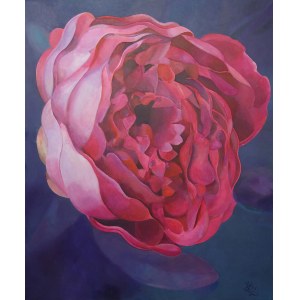
acrylic/canvas, 120 x 100 cm
signed p.d.: monogram KLZ
signed, dated and described on the back: Katarzyna Lubicz Zaleska | 2015 | Portrait of Silence | ' Pink Flower ' | acrylic on canvas | mounting hint
The artist graduated from the Academy of Fine Arts in Warsaw. She received her diploma in 1980 in the studio of Prof. Henryk Tomaszewski. She works in painting, drawing and illustration. As an illustrator, she has collaborated with well-known magazines and publishing houses. In 2004 she was awarded the prize of the Polish Society of Book Publishers for her illustrations in the competition for the best book of the year.
The painting by Katarzyna Lubicz tells us that nature never ceases to inspire artists. It also reveals a kind of tension between individual perception and artistic convention. When we look at the huge "portrait" of a flower, Karl Blossfeld's photographic enlargements of plants come to mind, which made it possible for the first time to take a close look at a variety of species, including common and therefore seemingly familiar ones. In Blossfeld's case, a section of a plant, magnified many times, was shown against a neutral background, allowing the photographer to expose shapes and textures. However, these photos have the chill of objectivity - they are, after all, a photographic document for scientific classification. On the other hand, we can refer to the paintings of Georgia O'Keeffe, depicting flowers in close-up, sometimes fragmentary, in a very sensual, often openly erotic manner. The American modernist's paintings provide pure viewing pleasure. They also foster fantasizing, thus sending us beyond the subject of the painting. And in this respect Lubicz is definitely closer to O'Keeffe. The flower, precisely reproduced by her, has been scaled up and fills almost the entirety of the large-format composition. The optics adopted by the artist gives the effect of uncanny, unreal object. It is worth noting that David Hockney, who has been creating large-format landscapes in recent years, invariably returns to the conclusion that every painting, including those with traditional subjects such as still life, landscape or portrait, is invariably a reflection on seeing.










Nesen skatītās
Piesakies, lai redzētu lotu sarakstu
Iecienītākie
Piesakies, lai redzētu lotu sarakstu