


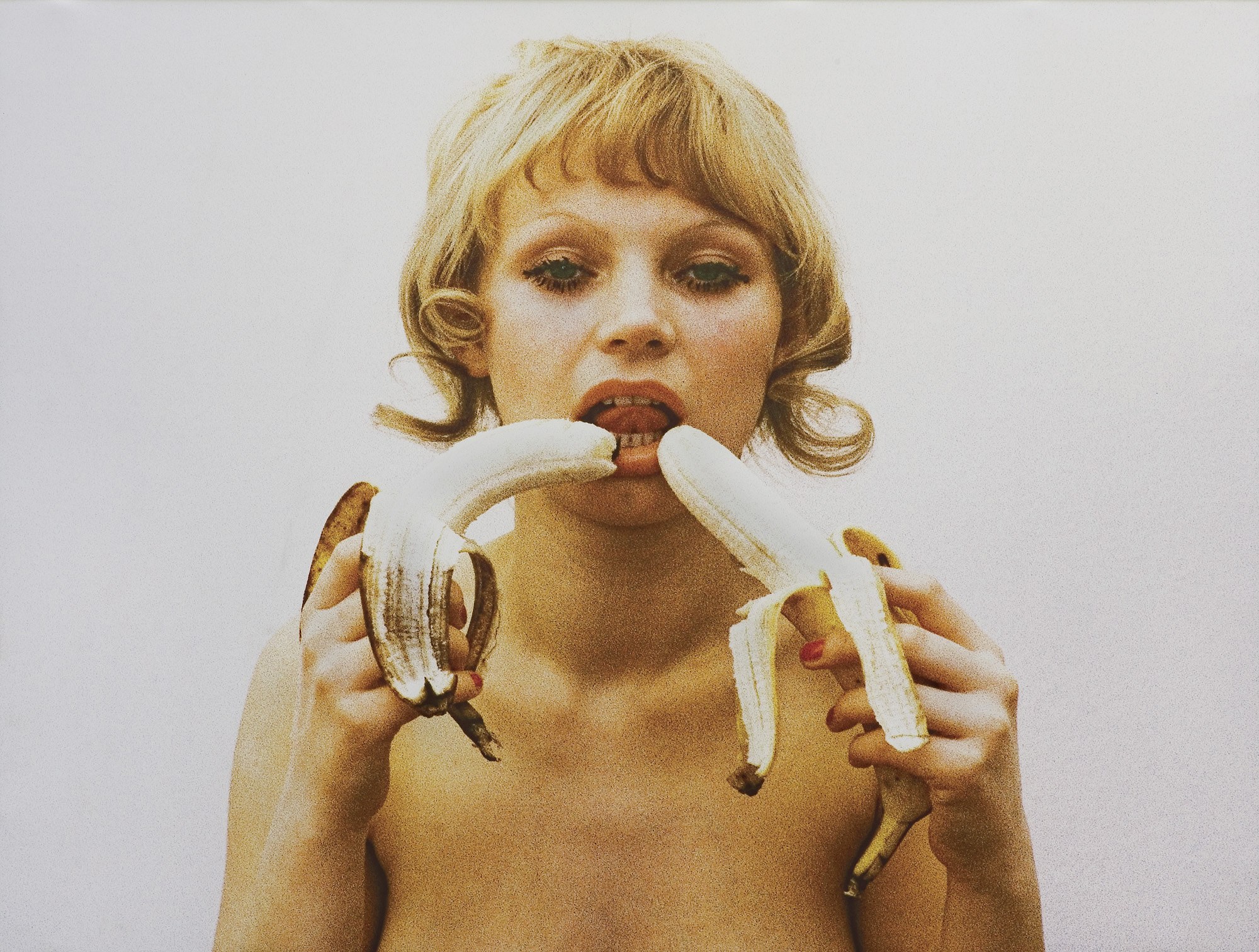
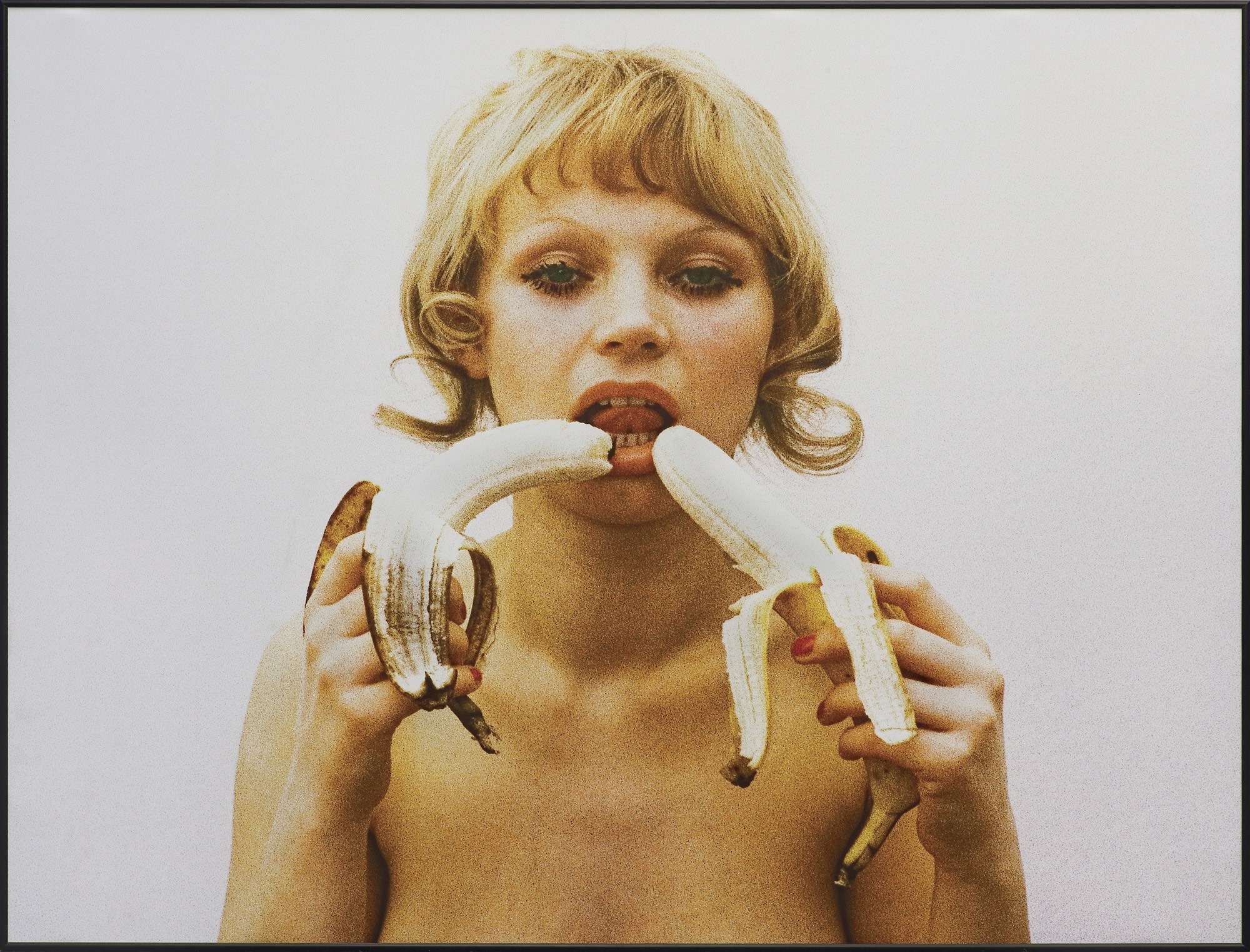
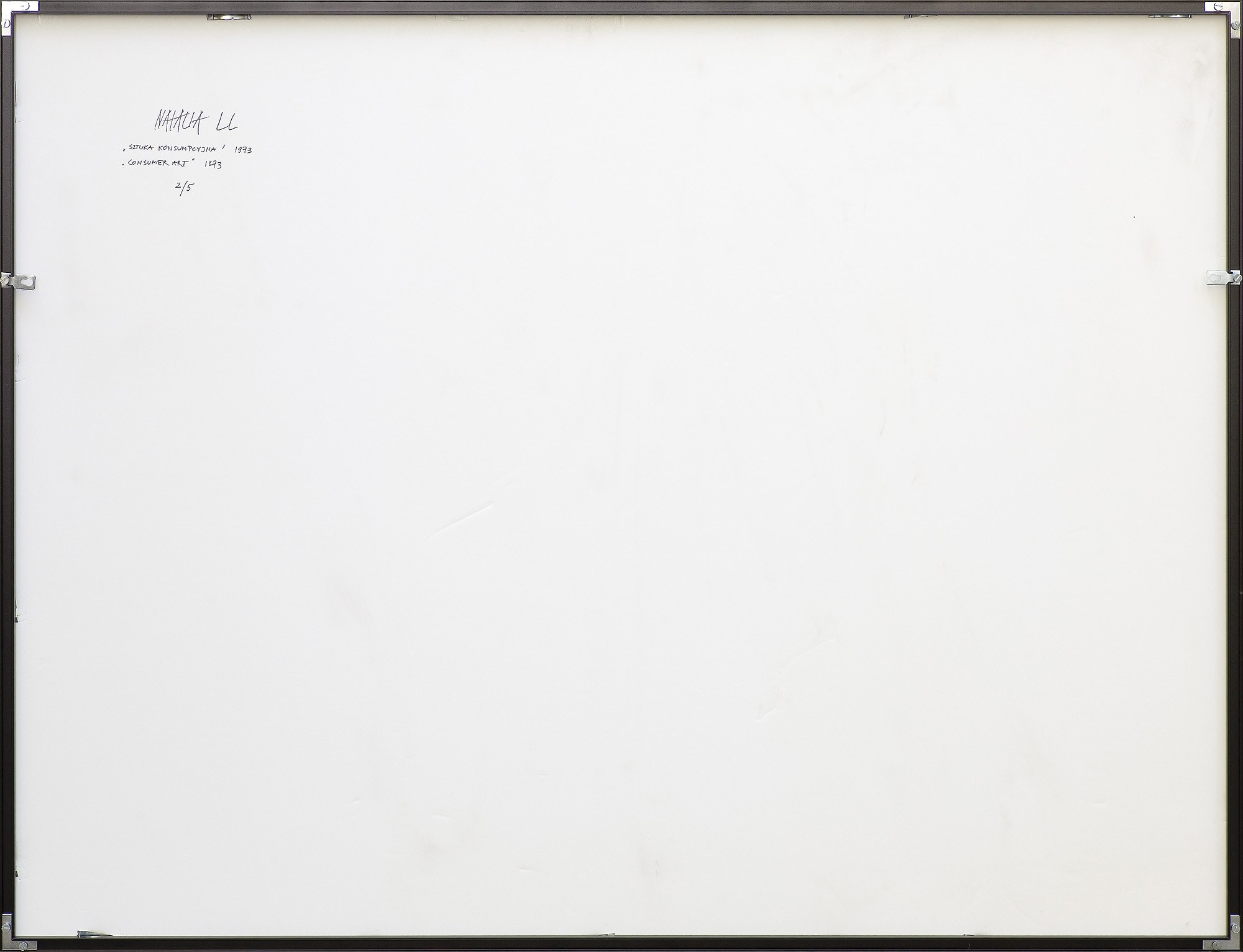
100,0 x 129,0cm - digital print, foam signed on the back l.g.: NATALIA LL | "CONSUMER ART" 1973 | "CONSUMENT ART" 1973 | 2/5
Provenance:
Purchase from the artist's studio (2009-2012).
The idea was this: in the 1970s, I wrote a text that I would write down, record ordinary things - what a person does every day, that is, eating, talking, sitting, sleeping, jumping, touching.... And among other things, this consumption appeared. The girls-models were consuming, I was registering it. It was a registration of consumption, which suddenly turned out to be terribly erotic, because they consumed differently. So on the one hand it was erotic, and Western critics said and wrote that it was critical art, demonstrating the fact that in communist Poland there was nothing, and those sausages and those bananas. Because actually there was none of that. So it was critical art that exposes the PRL. (...) In Poland, this work was very negatively received, highly criticized. On the other hand, the West bought it immediately and it was shown on the covers of "Flash Art," "Art Press" and other French magazines. So that she lived more in the West, while here a little less. Although, of course, they have already recognized her, they don't criticize me so much anymore at least [laughs].
Natalia LL, statement in the film, interviewed by Agnieszka Sural, realized by K. Luka, W. Lejewski, 2015
https://culture.pl/pl/wideo/natalia-ll-o-sztuce-konsumpcyjnej-wideo
The slogan of consumption appeared in Natalia LL's work in 1972-75, in the titles of a series of works. Consumption Art, and in 1975 Post-Consumption Art, is a collection of black-and-white and color photographs and films showing the faces of women ostentatiously eating various products: bananas, sausages or kisel. (...) The strategy [of the "Permafo" group, active since 1970, consisting of: A. Lachowicz, Natalia LL, Z. Dlubak, A. Dzieduszycki] was to refer to subjects related to common situations, which were documented as directly as possible. This concept was associated by critics with pop art, especially the poetics of Andy Warhol's films. In the case of Natalia LL, the association was legitimate, since artists associated with pop art referred to the visual patterns of mass culture and took up the themes of capitalist prosperity and the propaganda of universal consumption. However, it seemed doubtful that it made sense to take up such issues in Poland at the time, where there was a socialist economy of scarcity. For this reason, Natalia LL's works were denied critical value. (...) In order to bring out the critical dimension of Natalia LL's works, scholars pointed out the erotic nature of her photographs. Piotr Piotrowski (...) considered the work critical of the carefully masked anti-women policy of the authorities during the communist era, which was, incidentally, one manifestation of a larger problem - the negative attitude toward women deeply rooted in Polish culture. (...) Agata Jakubowska, on the other hand, in her interpretation (...) adopted the perspective of Lacanian psychoanalysis (...) - the female model in the photographs always assumes an active role, while the male element, the phallus, is reduced in them to a symbolic object of consumption. The active role of the woman is accompanied by the instrumentalization of the man, so there is a reversal of traditional social and cultural roles.
M. Wróblewska, Natalia LL "Consumer art", culture.pl
♣ to the auctioned price, in addition to other costs, a fee will be added, resulting from the right of the artist and his heirs to receive remuneration in accordance with the Act of February 4, 1994 - on Copyright and Related Rights (droit de suite)
Natalia Lach- Lachowicz (born Zywiec 1937- 2022) - from 1957 to 1963 studied at the State Higher School of Fine Arts in Wroclaw under Prof. Stanislaw Dawski, and received her diploma in 1963. She works in painting, photography, drawing performance art and video. In 1970, she co-founded the Permafo Gallery in Wroclaw. Since 1975, she joined the international feminist art movement, participated in numerous symposia and exhibitions. in 1978-81, she served as a commissioner of the 1st and 2nd International Triennial of Drawing in Wroclaw, and in 1989- 1995, she was vice-president of the 4th and 6th Triennials. She received scholarships from the Kosciuszko Foundation in New York (1977), "Verein Kulturkontakte" in Vienna (1991) and Pro-Helvetia in Switzerland (1994).








Nesen skatītās
Piesakies, lai redzētu lotu sarakstu
Iecienītākie
Piesakies, lai redzētu lotu sarakstu