


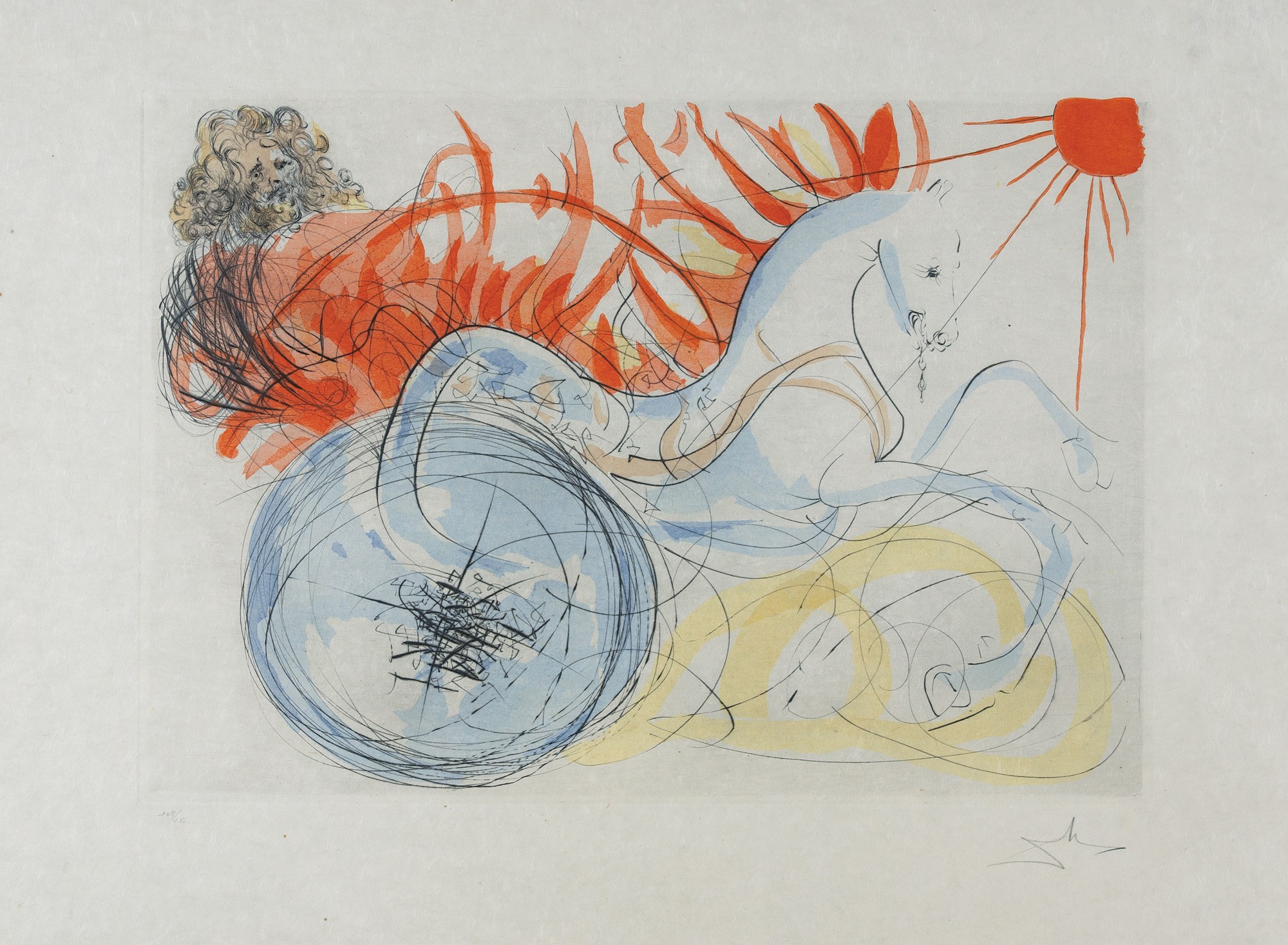
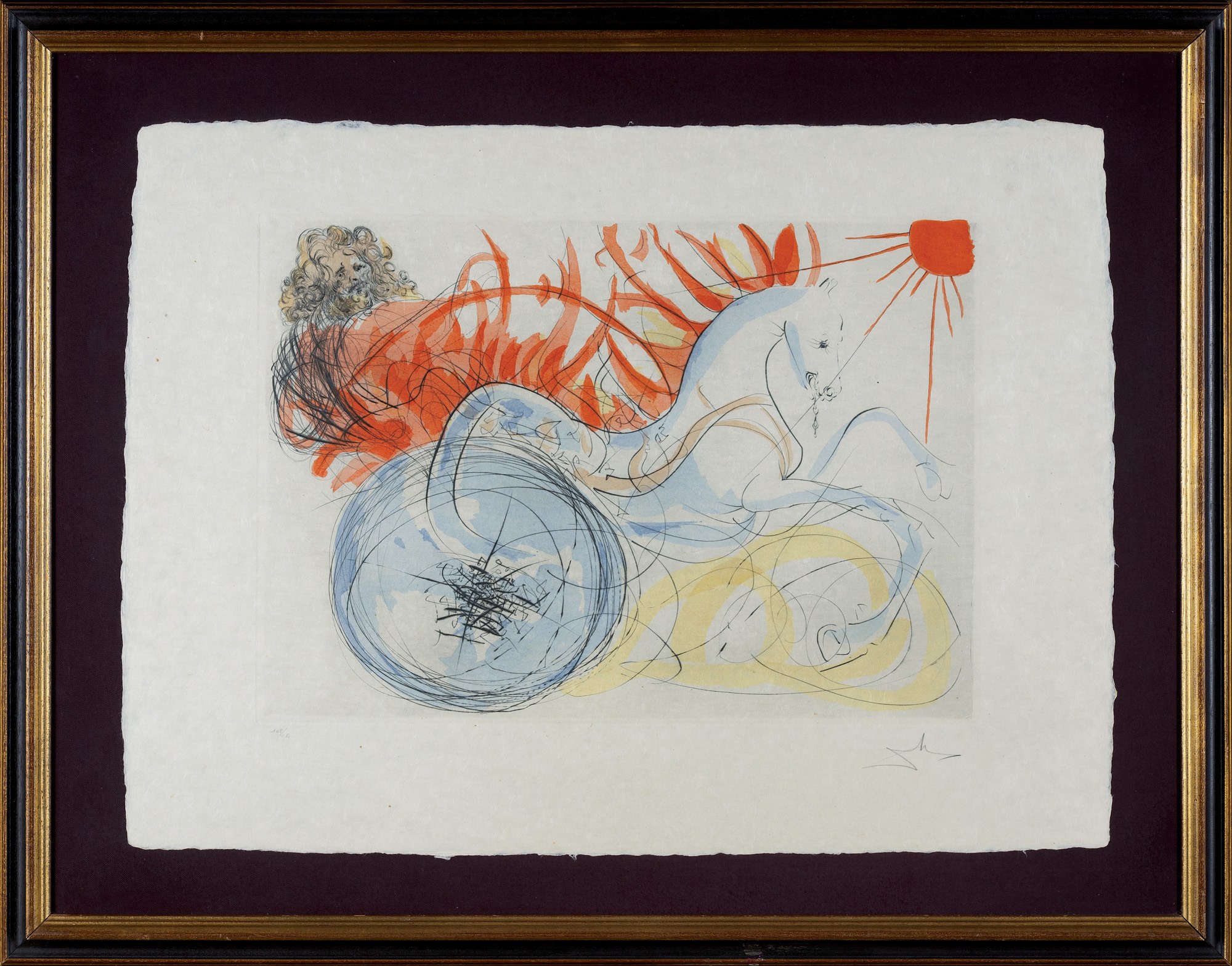
40 x 56.5 cm - drypoint, stencil, Japanese paper with irregular edges
40 x 56.5 cm (plate impression), 57 x 78 cm (paper)
signed in lead below the image: Dali, inscription in lead on the lower left: 108/250
The work has been exhibited, mentioned, and reproduced in, among others: The work is mentioned and reproduced in the primary catalogs of Salvador Dalí’s oeuvre in the field of printmaking:
– Salvador Dalí. Catalogue Raisonné of Etchings and Mixed-Media Prints 1924–1980. Edited by Ralf Michler and Lutz W. Löpsinger, Prestel, Munich–New York 1995, cat. 758, ill.; ibid., Appendix, p. 262;
– The Official Catalog of the Graphic Works of Salvador Dalí, authorized by Dalí, by Albert Field, The Salvador Dalí Archives, New York 1996, p. 101, cat. 75-4J, ill.
♣ Droit de suite: ♣ A fee resulting from the right of the artist and his heirs to receive remuneration in accordance with the Act of February 4, 1994, on Copyright and Related Rights (droit de suite) will be added to the Purchase Price.
Salvador Dalí (Figueres, May 11, 1904 – Figueres, January 23, 1989) began his studies in 1921 at the San Fernando Academy in Madrid, which he attended intermittently until 1926, when he was expelled (not for the first time) for his anarchist views and eccentric behavior. His friends from his student days included Federico García Lorca, Luis Buñuel, and Rafael Alberti, among others. Dali was passionate about new trends in art; he began exhibiting in 1925 and also wrote extensively for art magazines. In 1926, he traveled to Paris for the first time, where he met Picasso; he returned there in 1928 and this time met Tristan Tzara and the group of Surrealists centered around André Breton. In 1929, together with Buñuel, he made the film *Un Chien Andalou*. That summer, he met and began a relationship with Gala Eluard, who would remain his lifelong muse. During the 1930s, he devised and put into practice his own method, known as the “paranoiac-critical” method; it was also during this time that he created his most famous works, such as *The Persistence of Memory* (1931). This small painting, exhibited that same year in New York at a Surrealist exhibition, became a symbol of the movement and paved the way for the artist’s career in the American style. Dalí and Gala stayed in the U.S. on numerous occasions, most notably from 1939 to 1948, after fleeing civil war-torn Spain and, subsequently, Paris, which was under threat of German occupation. Upon his return to Spain, a “mystical period” began in Dalí’s work, during which he created large-scale compositions based on religious iconographic canons (“Madonna of Port Lligat,” “The Last Supper”). In 1964, he published *The Diary of a Genius*. The artist’s final years were marked by travel and extravagance. After Gala’s death in 1982, Dalí remained in voluntary seclusion until the end of his life.








Nesen skatītās
Piesakies, lai redzētu lotu sarakstu
Iecienītākie
Piesakies, lai redzētu lotu sarakstu