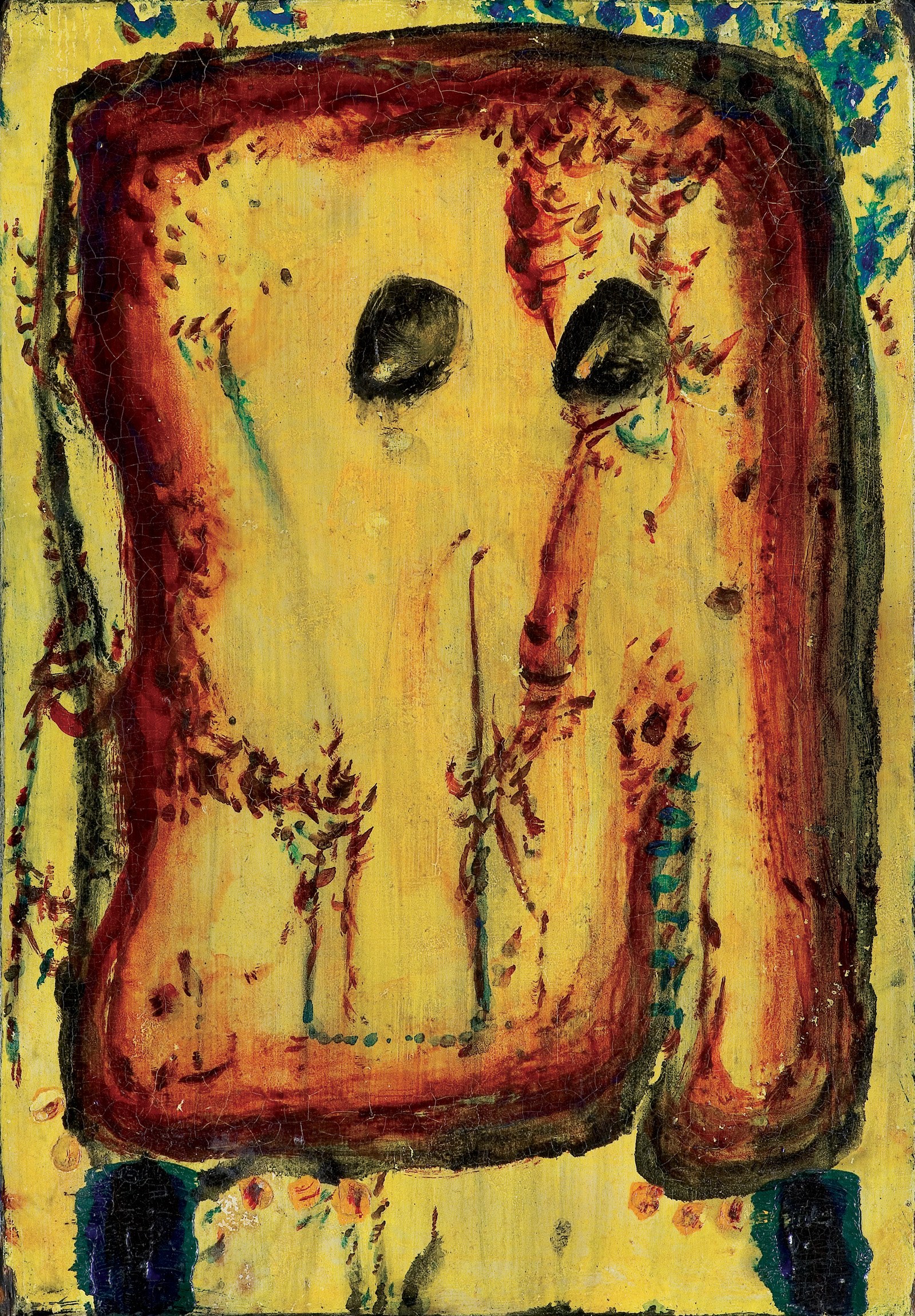
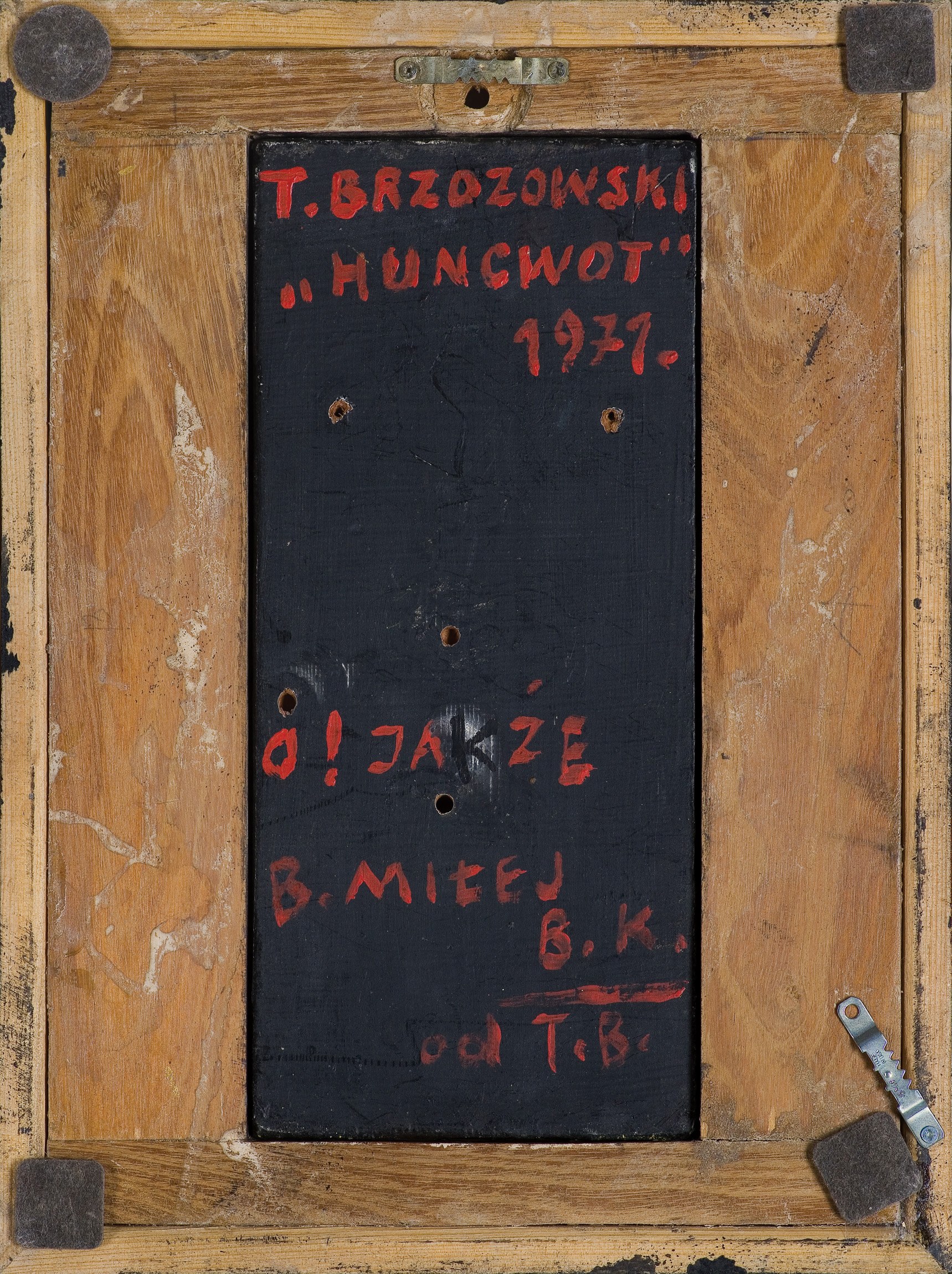
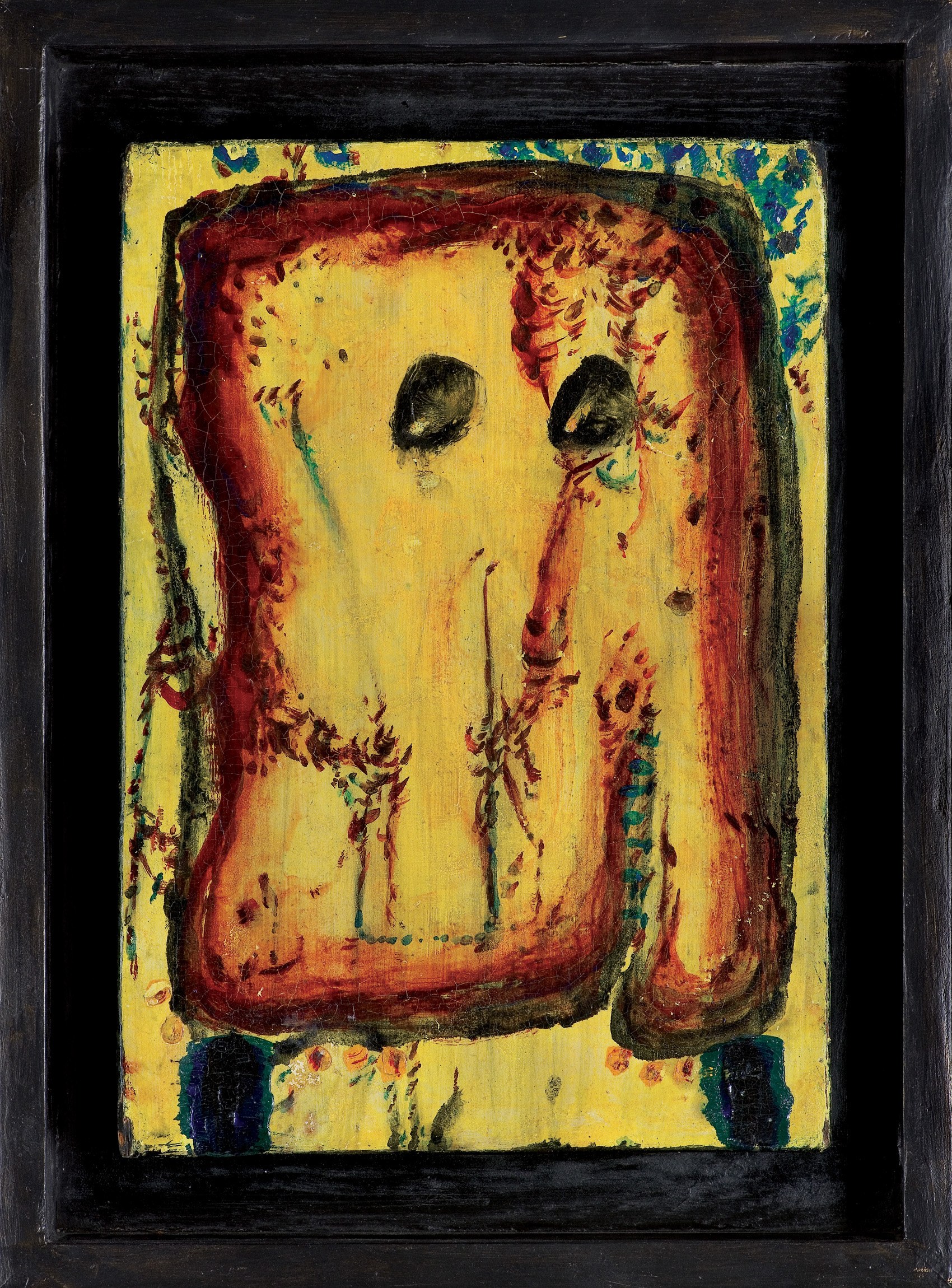
28.00 x 19.60 cm - oil, board , signed on the reverse: T. BRZOZOWSKI | "HUNCWOT" | 1971, below dedication: O! HOWDY | B. LITTLE B.K. from T.B.
Image described in the artist's oeuvre catalog:
-Tadeusz Brzozowski 1918-1987, edited by A. Żakiewicz, National Museum, Warsaw 1997, p. 234, item 240 (as property of Barbara Komarnicka, USA).
Tadeusz Brzozowski was famous for giving his works intriguing, often archaic or dialect titles (such as pryncypał, raptus, świekra). The "huncwot" of the title (i.e., a sassy, naughtier, urchin) suggests a certain perversity and perversity that is reflected in the composition itself. This composition, like others from this period, reflects the artist's fascination with the human condition - its frailty, complexity and hidden emotions, dressed up in the form of a visual riddle. The artist himself said: Through my canvases I would like to say important things - the truth about man, the human condition, its disability and the fact that this disability can be overcome (Tadeusz Brzozowski, quoted by Krystyna Czerni, Tadeusz Brzozowski. Great Painters. Their Life, Inspirations and Work, No. 116, p. 7).
Tadeusz Brzozowski (Lviv 1918 - Rome 1987) - studied painting at the Academy of Fine Arts in Lviv from 1936, continuing in 1940-1942 at the Kunstgewerbeschule, established in place of the Academy. During the occupation, he was associated with Tadeusz Kantor's Underground Theater - he played in Balladina (1943) and the leading role in The Return of Odysseus (1944). During this period he was also involved in art conservation, which proved fruitful for his own painting technique in the future. In 1945 he finally graduated from the Academy of Fine Arts in Cracow. Until 1948, he exhibited with the Group of Young Visual Artists, participating in the most important exhibitions of the young art movement, until the authorities imposed Socialist Realism as the prevailing style of painting. From 1950 to 1955, he did not participate in official artistic life, occupying himself during this time with painting church polychromes, conservation and teaching drawing at the Faculty of Architecture at the Cracow University of Technology (until 1954). In 1954 he moved to Zakopane, where he took up teaching work at the Kenar School. He worked there until 1969, and lived in Zakopane as director from 1959-1961 until the end of his life. During this period, in the course of independent trials and experiments, he became a virtuoso of painting technique. Color, texture, the play of glazes and values, all the "alchemy" he used in his paintings made up the unique phenomenon of abstract painting, which was capable of "telling" by its very form. In 1955, he returned to participating in exhibitions, participating in numerous shows in Poland and abroad, also holding many solo exhibitions. In 1957 he became a member of the reactivated Cracow Group. Since 1958, he co-organized the "March Salons" in Zakopane. In 1959, in Paris, he became associated with the international "Phases" movement. From 1962 to 1979 he was a teacher at the State Higher School of Fine Arts in Poznań (from 1977 a professor), and from 1979 to 1981 a professor at the Academy of Fine Arts in Cracow. He received many national awards and decorations and, among others, the Alfred Jurzykowski Foundation Award (1983). Among the artist's retrospectives during his lifetime are an exhibition at the National Museum in Poznań (1974) and an exhibition of drawings at the District Museum in Radom (1986). A major posthumous exhibition was exhibited at the National Museum in Warsaw, followed by museums in Zakopane, Wroclaw and Cracow in 1997-1998, accompanied by a catalog of the artist's oeuvre in painting and drawing: Tadeusz Brzozowski 1918-1987, edited by Ay Żakiewicz, National Museum, Warsaw 1997.