


Dimensions: 71 x 71 cm
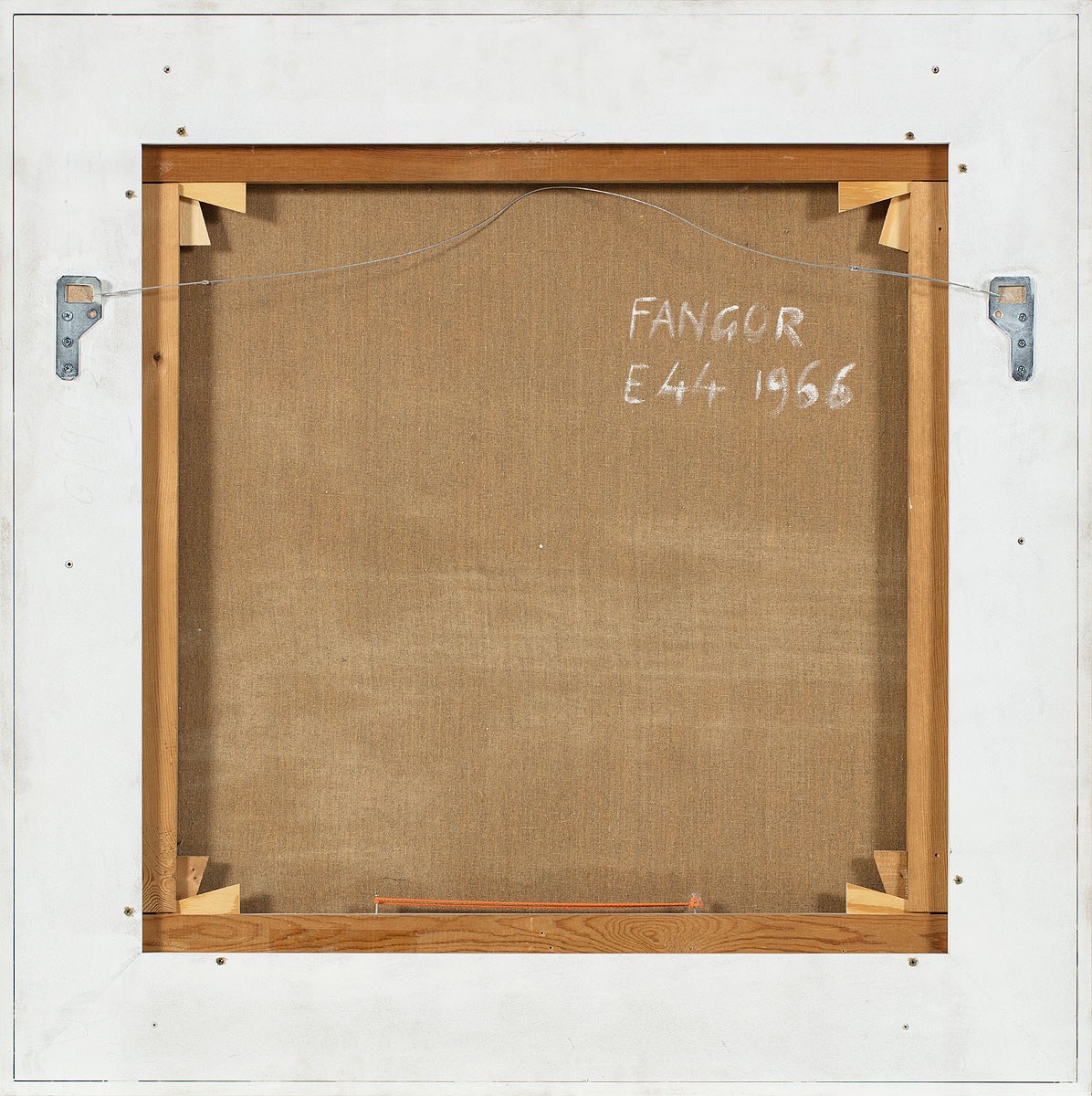
Signature: signed on the reverse: FANGOR / E44 1966
Provenance
Warsaw, Polswiss Art private collection, auction 16.10.2018, item 78 Warsaw, Piękna Gallery, auction 07.12.2016, item 62 Newbury, UK, Dreweatts, auction 13.06.2016, item 93 Corsham Hall (UK), collection of Clifford and Rosemary Ellis owned by the artist
Exhibited
Radom, Mazovian Center for Contemporary Art Elektrownia in Radom, Wojciech Fangor. Optical Vibrations, 18.05-31.08.2018.
Reproduced
Catalogue raisonné, website of the Wojciech Fangor Foundation, item 527.
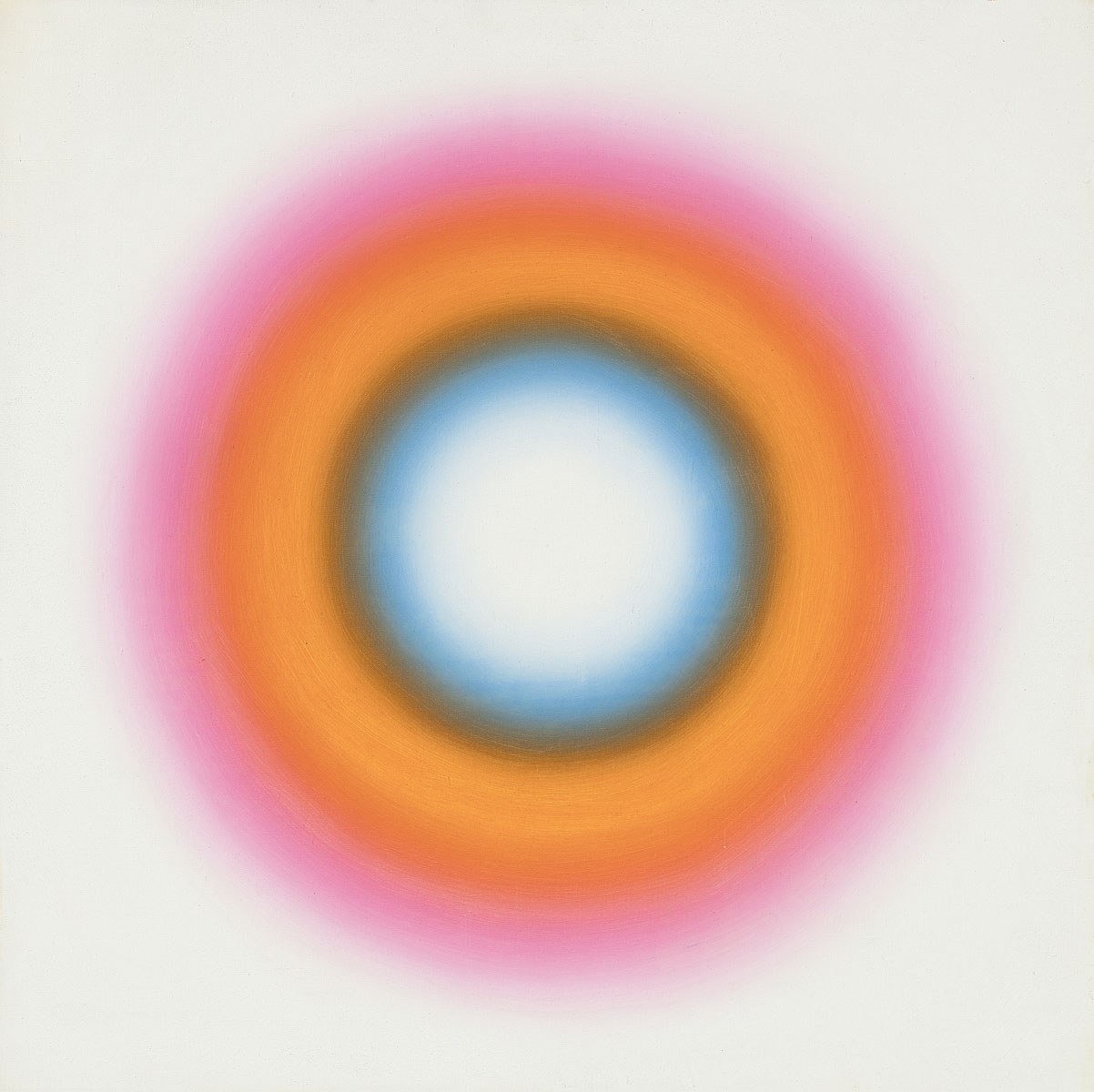
The offered painting "E44" from 1966 is an outstanding example of Wojciech Fangor's research on space, light and movement, which he began in the late 1950s, creating a trend that was absolutely innovative not only in Polish art, but also in world art. The symbolic opening of this groundbreaking stage was the first Polish environment organized in 1958 - together with architect Stanisław Zamecznik - entitled "Study of Space." The vibrating canvases presented there, maintained in black and white, became a tool for acting on the viewer's perception in a system Fangor called "Positive Illusory Space." Their key feature was a soft, edgeless tonal transition - a technique taken from Leonardo's sfumato, which the artist made the foundation of his further experiments. "The soft, diffuse, edgeless transition between colors (...) became an offbeat field of artistic experimentation - Fangor systematically studied under what conditions it achieves the best visual effect. The results were 'circles', 'waves' and amoeboid paintings that established his position in op-art and world art" (Szydłowski S., Wojciech Fangor. A small retrospective, [in:] Fangor. Painting [exhibition catalog], published by the Academy of Fine Arts in Gdansk, Gdansk 2015, p. 17).
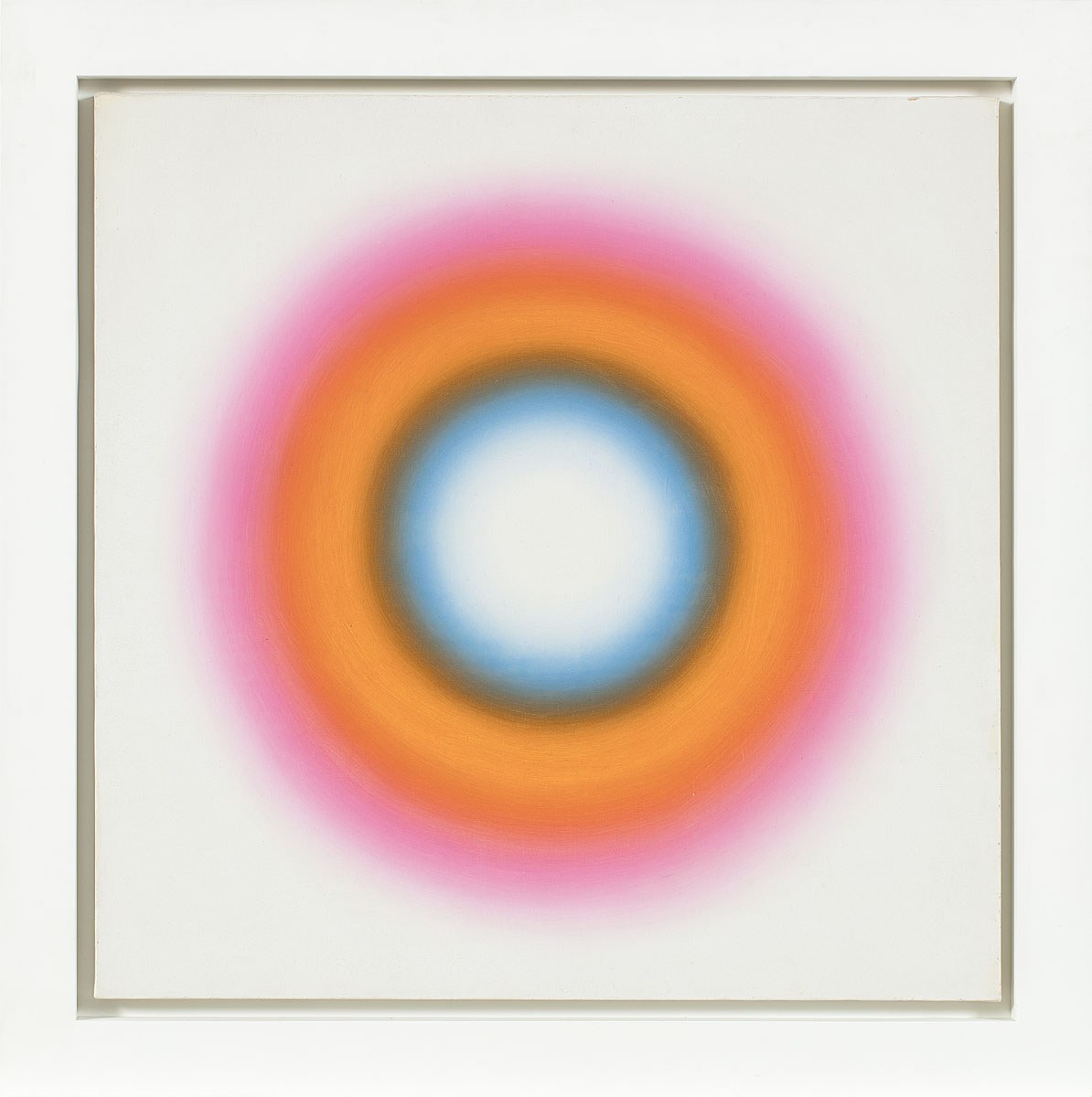
"E44" impresses with the energy of a multicolored, pulsating arrangement of circles in which pink, orange and blue intermingle with extraordinary softness. The graduated, hazy rims seem to vibrate and ripple, creating a suggestion of movement and optical "breathing" of form. Fangor - as John Canaday aptly noted - offers here something more than a showy optical treatment: "(...) this trick actually is more than a trick and appears as a gateway to a new experience of color and space" (Fangor's Romantic Op, "New York Times", 15.02.1970, p. 103).
The surface of the painting has been developed with extreme precision: perfectly smoothed, with no visible brush marks, it enhances the luminosity and saturation of the colors. The color circles cross the boundaries of the canvas, as if extending even further - drawing the viewer into the extra-painting space and making him a co-creator of the visual experience. This painting remains one of the purest examples of Fangor's synthesis of light, color and movement, and a testament to the maturity of his op-art language.


![Wojciech Fangor (1922-2015), Kopia obrazu Pabla Picassa Acrobate à la Boule [Akrobatka na kuli], 1954](https://img1.one.bid/img/10573/3329745_1w.webp?1791644180)










