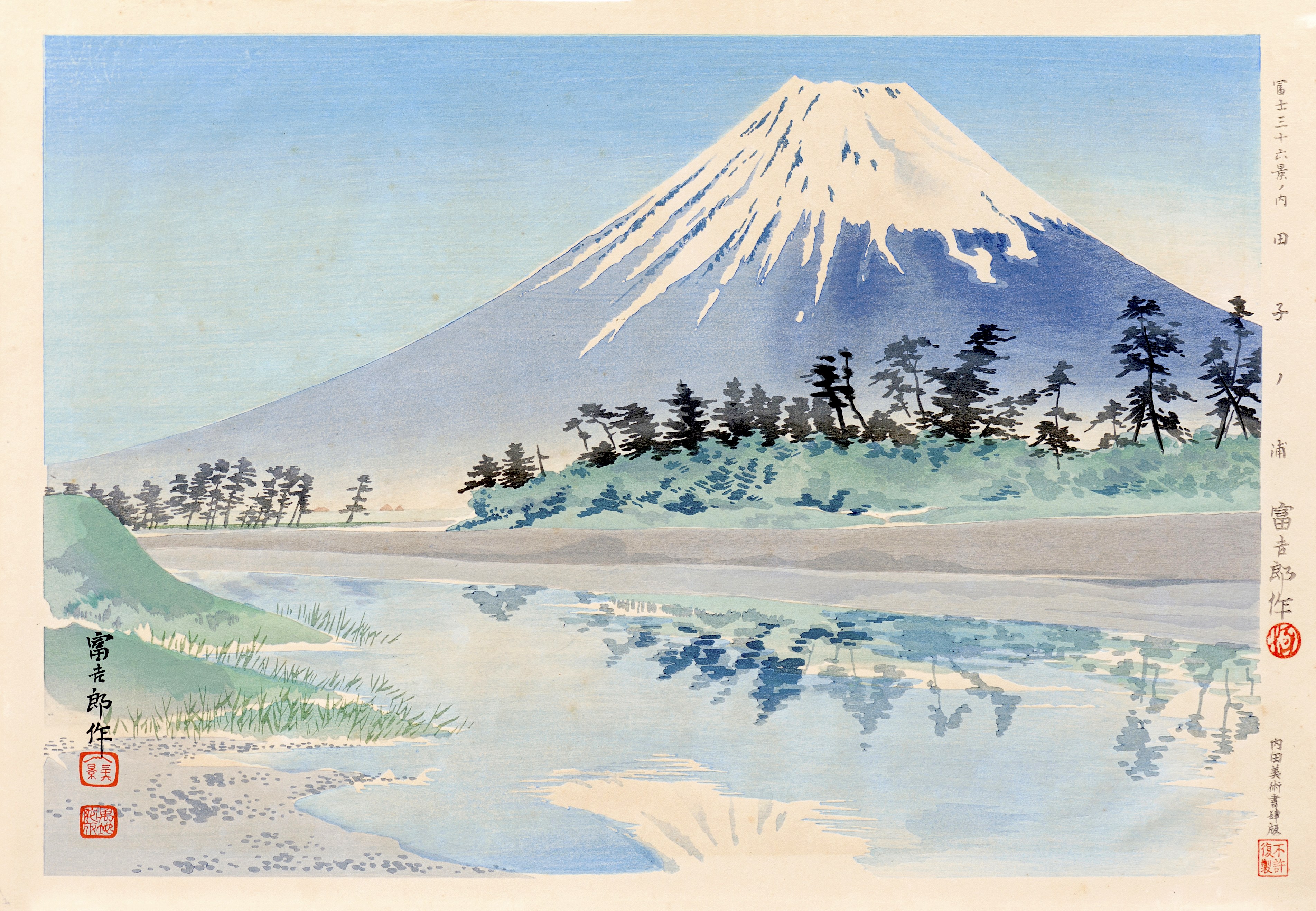
Color woodcut, paper, 28.5 x 41.5 cm, artist’s signature, inscriptions in Japanese on the right margin—the series title at the top, the woodcut’s title below it, and the publisher’s stamp. This is an original woodcut from the first edition, published in 1939–1940. The paper shows slight yellowing.
The dominant element of the composition is the monumental Mount Fuji, with its summit covered by a white cap of snow and a blue-violet base. At the foot of the volcano stretches a belt of dense, green pine forest. The lower part of the print is occupied by the calm, crystalline surface of Tago Bay. Its mirror-like waters picturesquely reflect the inverted outline of the mountain and the dark silhouettes of the coastal pines. On the left is a rocky shore covered with clumps of green grass.
This work is part of the series“Thirty-Six Views of Mount Fuji.” The series consists of woodblock prints depicting Japan’s largest and most famous mountain, Mount Fuji, as seen from various vantage points stretching from Tokyo through Shizuoka to Shinshu (Nagano Prefecture). This series draws inspiration from Hokusai’s well-known series of the same name. In this outstanding series, Tokuriki captured the beauty and majesty of Mount Fuji, Japan’s sacred mountain. The great peak appears at dawn and sunset, in rain and snow, from afar or dominating the horizon, but always as a serene symbol of Japan’s beauty and power. Tokuriki’s magnificent landscapes depict traditional Japanese scenes, yet with a distinctly modern sensibility.
Tokuriki Tomikichirō was a prominent printmaker in the Kyoto art circle of the 20th century. He came from a family with a long artistic lineage. He graduated from the Municipal School of Fine Arts and Crafts, as well as the Kyoto Specialized School of Painting, in 1924. He continued his studies in Japanese-style painting under Bakusen Tsuchida (1887–1936) and Yamamoto Shunkyo (1871–1933). In the late 1920s, he met Unichi Hiratsuka, a key figure in the emerging sosaku hanga art movement. Unichi taught him how to print woodblock prints in the “sosaku” style: independently designed, carved, printed, and published. This pivotal encounter redirected Tokuriki’s focus toward printmaking. In 1932, he became a member of the “Nihon Hanga Kyokai,” an association of sosaku hanga artists. At the same time, he collaborated with renowned ukiyo-e publishers such as Uchida and Unsodo. He designed outstanding prints in the shin hanga style for them. Shin hanga is a significant Japanese artistic movement that focused on traditional themes such as landscapes, portraits of beautiful women, and actors. It drew inspiration from European Impressionism, combining techniques for depicting light effects with individual emotions. The result of this fusion was an art form characterized by technical brilliance, presenting a captivating, luminous, new style of Japanese prints. Before and during the Pacific War, Tomikichiro created numerous series of prints based on traditional themes, such as “Shin Kyoto fukei” (“New View of Kyoto,” 1933–4) and “Tokyo hakkei” (“Eight Views of Tokyo,” 1942). Most of these were published by Uchida of Kyoto. After the war, Tokuriki founded his own publishing company called Matsukyu, which also began teaching woodblock printing to artisans and artists; in later years, many of them were foreigners. Until the 1970s, Tokuriki remained active as a teacher and writer, producing a long series of articles on printing techniques for the magazine *Hanga geijutsu*.
Tokuriki Tomikichiro died in 2000 in his hometown of Kyoto at the age of 98. In the art world, particularly among ukiyo-e collectors, he is regarded as a master of Japanese printmaking in the shin hanga style.