


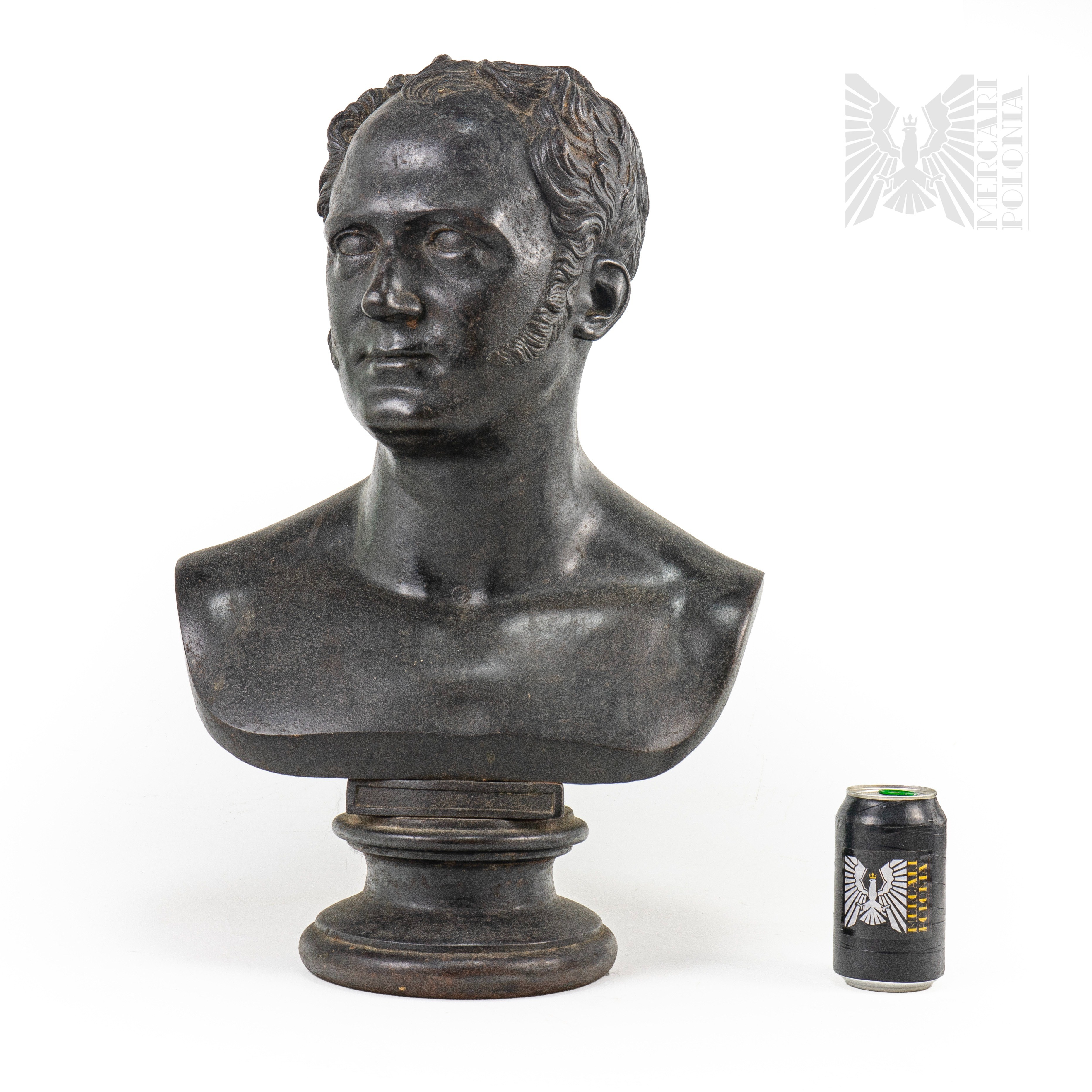
Dimensions: 55 cm x 38 cm
Material: Cast iron
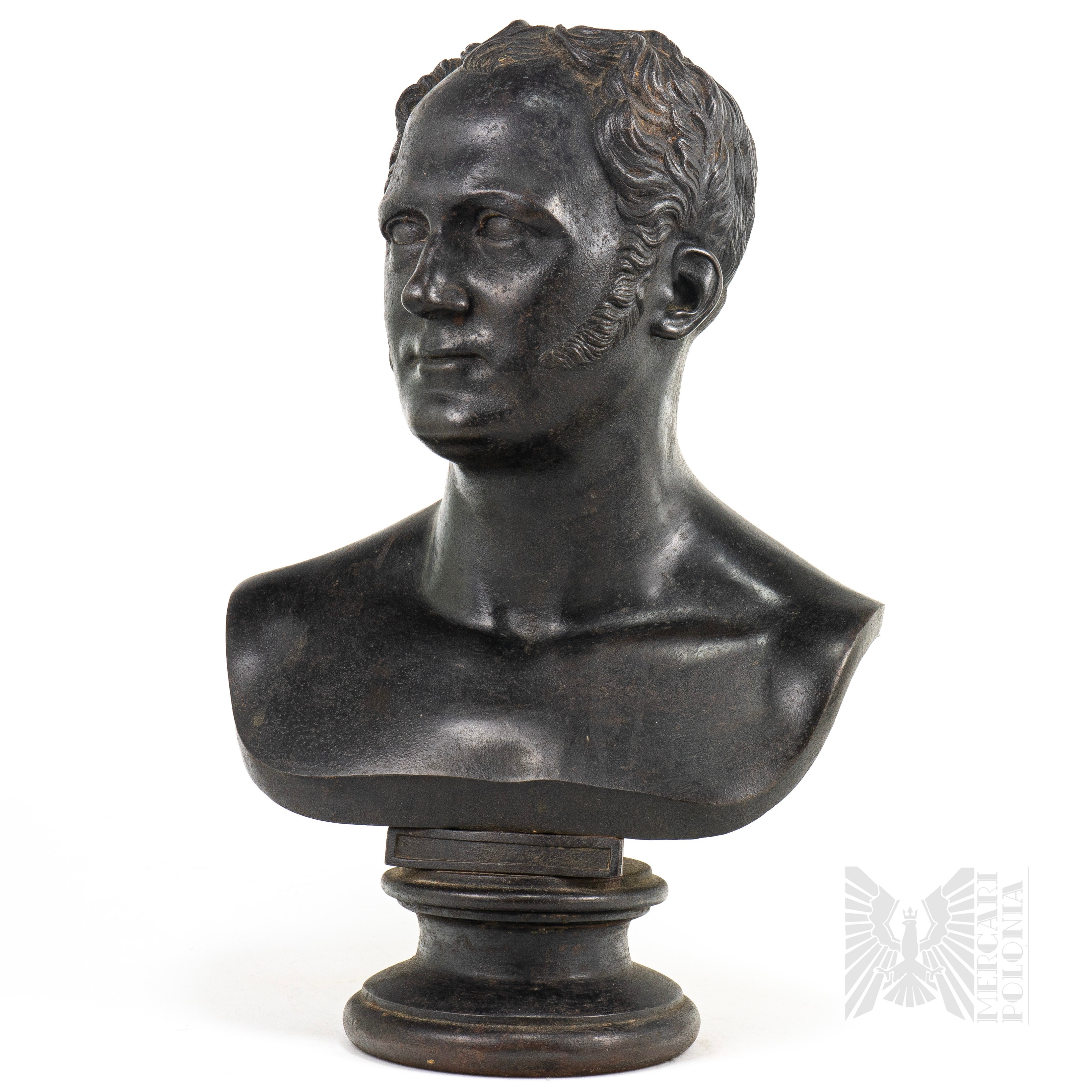
The bust depicts Alexander I Pavlovich, Tsar of Russia and, from 1815, King of Poland. In the context of the Kingdom of Poland, his images held official and political significance: they were associated with the beginning of the post-Congress order, state administration, and the cult of the monarch as the sovereign of the newly established Kingdom of Poland.
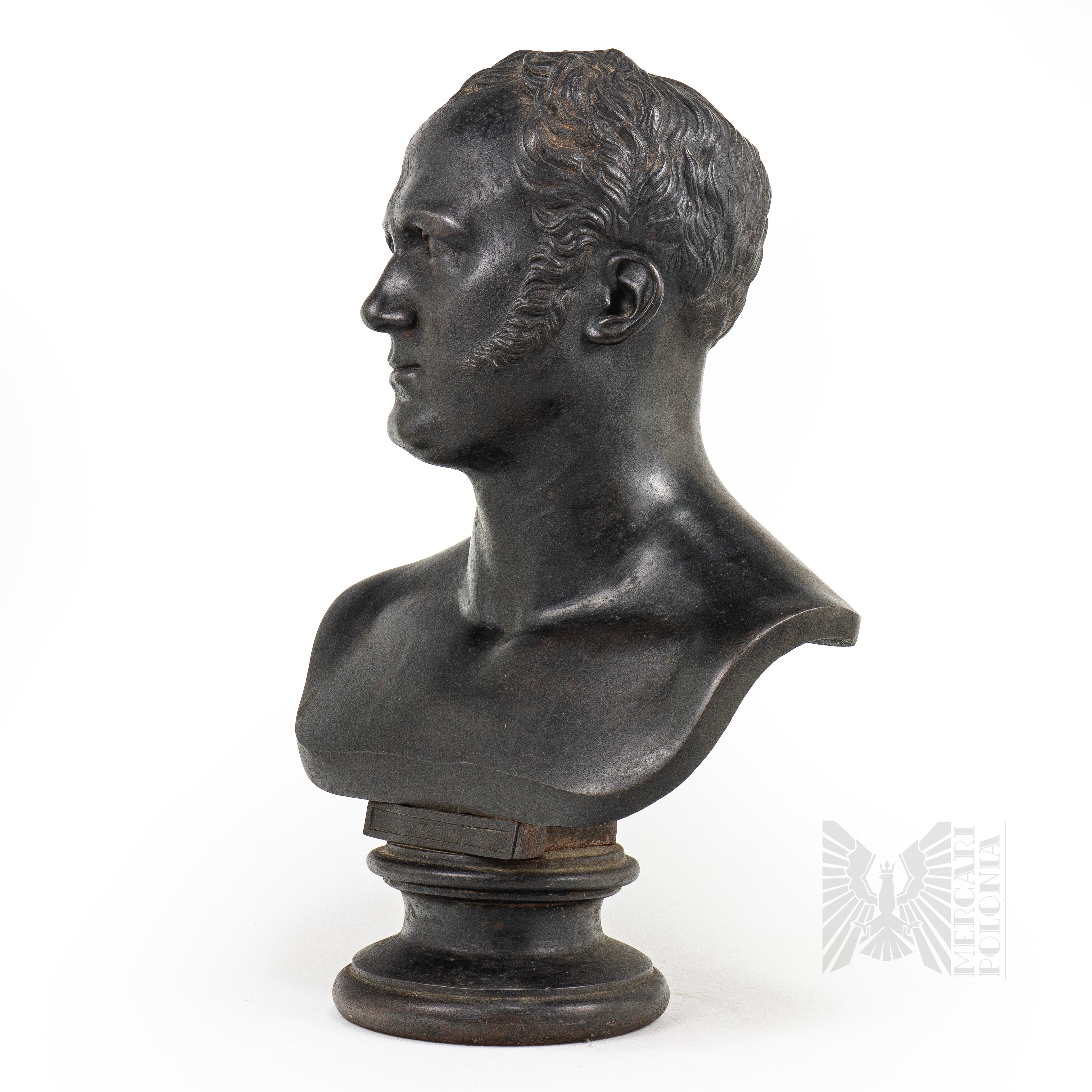
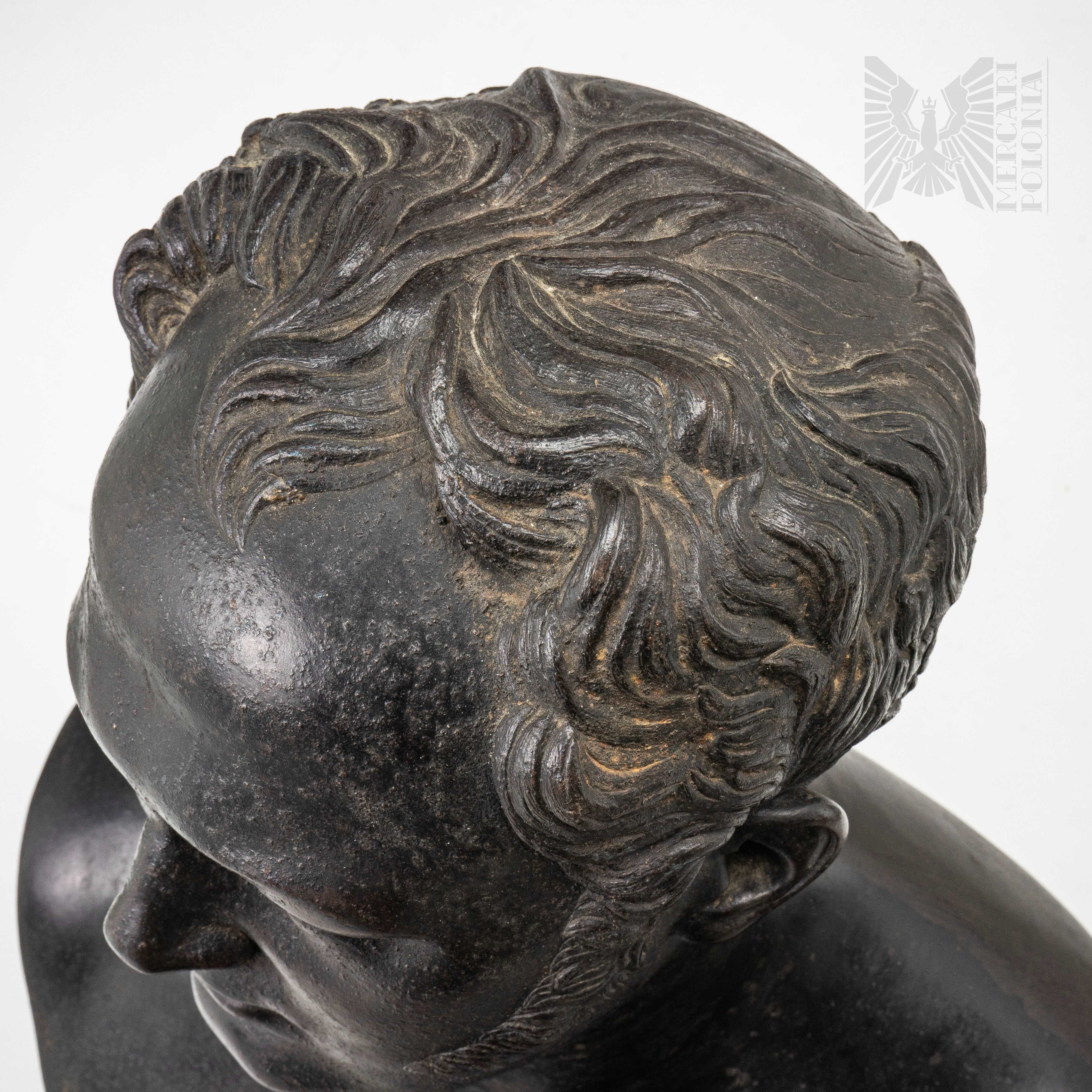
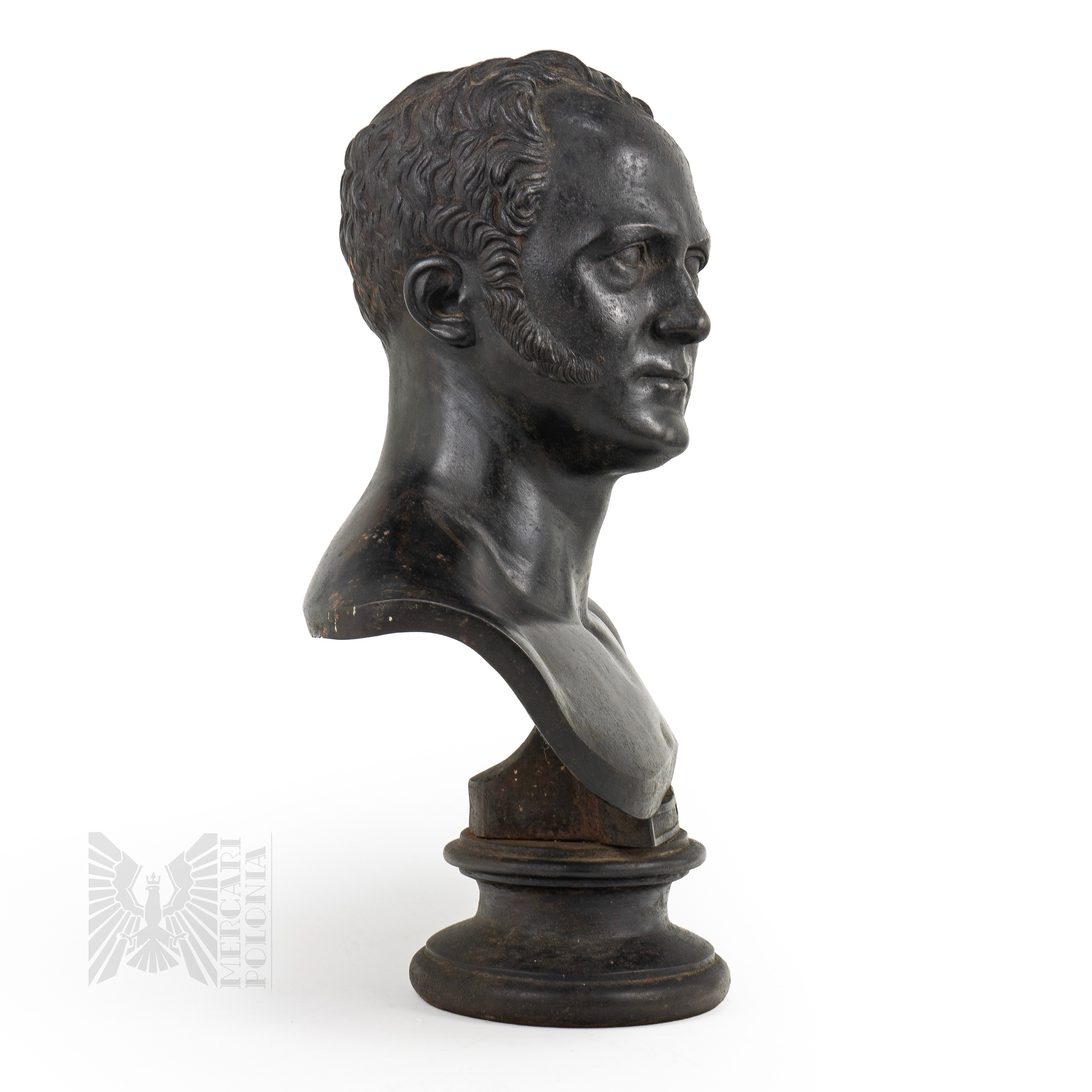
The sculpture depicts a bust of a man shown in profile, facing left. The head rests on a strong, elongated neck and a broadly rendered torso. The face has regular, classicizing features: a straight nose, a distinctly marked forehead, a closed mouth, and a calm, official expression. The hair is short, combed forward, and rendered in fine, rhythmic relief. Distinctive sideburns are visible near the cheek.
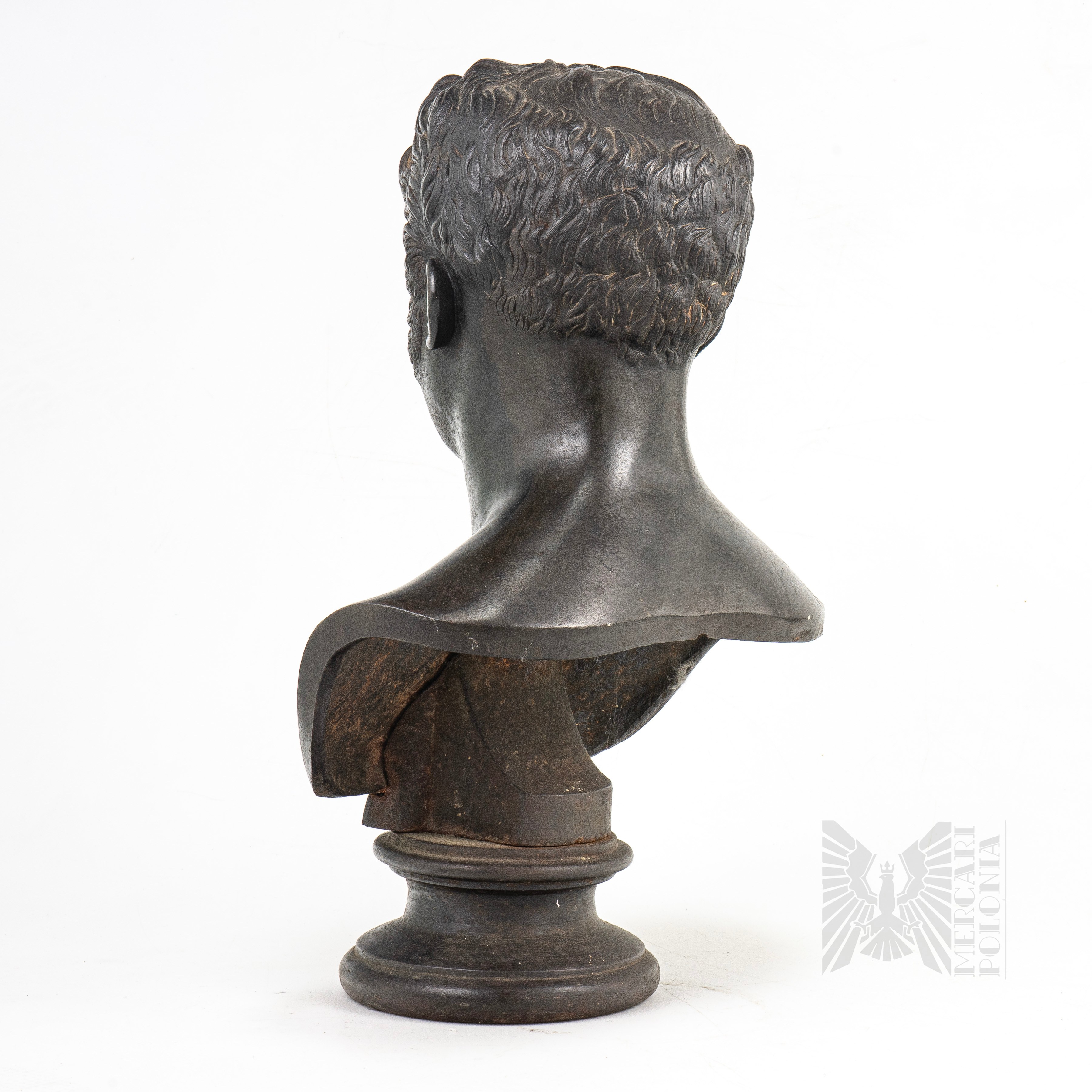
The torso is unclothed, rendered in the style of an antique-inspired heroic portrait. The shoulders are cut off with a soft, undulating line, and the entire upper part of the bust rests on a short connector and a round, contoured base. The pedestal is cylindrical in shape with several distinct rings, which lend the object stability and classical elegance.
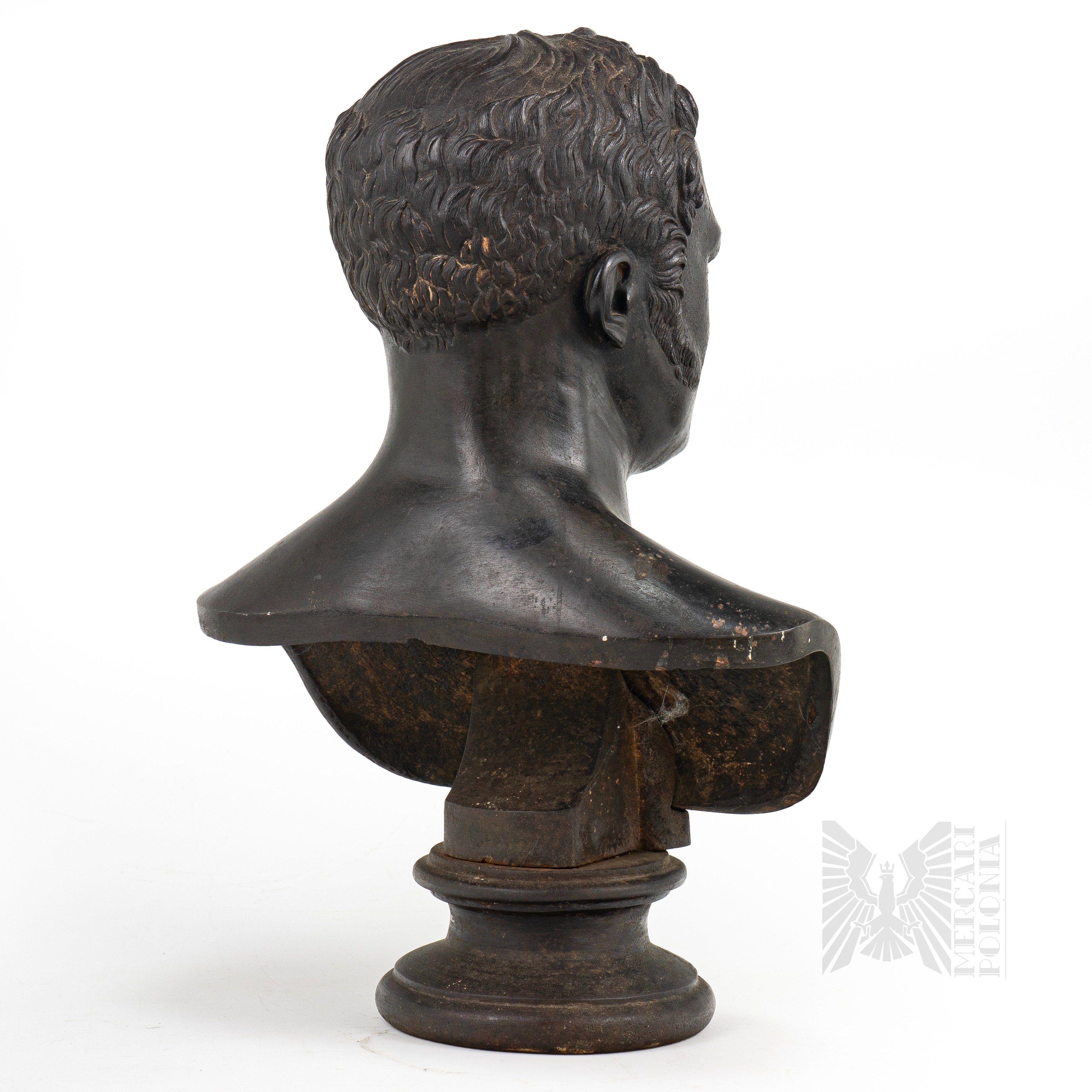
The metal surface is dark, almost black, with subtle brown and graphite tones. A natural patina and signs of age are visible in the recesses of the hair, near the ear, on the neck, and on the base. The modeling is meticulous, particularly in the areas of the face, hair, and ear. The piece has the character of a representative study sculpture, intended for display in an office, residential, or collector’s setting.
Of particular interest is the possible attribution to the Aleksander Smelter in Białogon. This facility was established on the initiative of Stanisław Staszic as a modern non-ferrous metal smelter; construction began in 1814, and production started in 1817. The smelter’s name commemorated Tsar Alexander I, who was then King of Poland.
Białogon, now a district of Kielce, was one of the major industrial centers of the Świętokrzyskie region. Local sources indicate that between 1814 and 1817, the Aleksander Smelter was built there, where copper was extracted, silver coins were minted, and utilitarian objects were manufactured; after the local ore deposits were exhausted, the facility was converted into an iron foundry.
In this context, the cast-iron bust of Alexander I could have served both a representative and a propaganda purpose. It would have been an object combining the portrait of the monarch with local industrial history, as well as symbolizing the beginning of modern metallurgical plants in Białogon
Condition as shown in the photos
Alexander I Romanov (1777–1825)—Emperor of Russia from 1801 to 1825, one of the key figures in early 19th-century European politics. He was the son of Tsar Paul I Romanov and the grandson of Catherine II the Great, who had a significant influence on his upbringing. He received a thorough education in the spirit of the Enlightenment, which shaped his initially liberal views. He ascended the throne in 1801 following his father’s assassination in a palace conspiracy, an event that had a lasting impact on his psyche and his style of governance. At the beginning of his reign, he announced reforms—he sought to modernize the state, limit autocratic rule, and improve the administration. He collaborated, among others, with the reformer Mikhail Speransky.
The most significant event of his reign was his rivalry with Napoleon Bonaparte. Initially, he tried to maintain diplomatic relations with him, but the conflict eventually led to war. This culminated in Napoleon’s invasion of Russia in 1812, which ended in his defeat. Alexander I then played a key role in defeating France and marched his troops into Paris in 1814.
He participated in the deliberations of the Congress of Vienna, where he helped shape the new order in Europe following the Napoleonic Wars. He was the initiator of the Holy Alliance—an alliance of states intended to defend the monarchical order and counteract revolutions.
In 1815, he granted a constitution to the Kingdom of Poland, creating the so-called Congress Kingdom, of which he became king. Initially, it granted Poles certain freedoms, but over time his policies became increasingly conservative and restrictive of autonomy. Toward the end of his life, he partially withdrew from active politics and turned to religion and reflection on his own life. He died in 1825 in Taganrog on the Sea of Azov.
His reign combined elements of liberal reforms with a later shift toward conservatism, and his actions had a profound impact on the shape of Europe after the Napoleonic era.








Nesen skatītās
Piesakies, lai redzētu lotu sarakstu
Iecienītākie
Piesakies, lai redzētu lotu sarakstu