


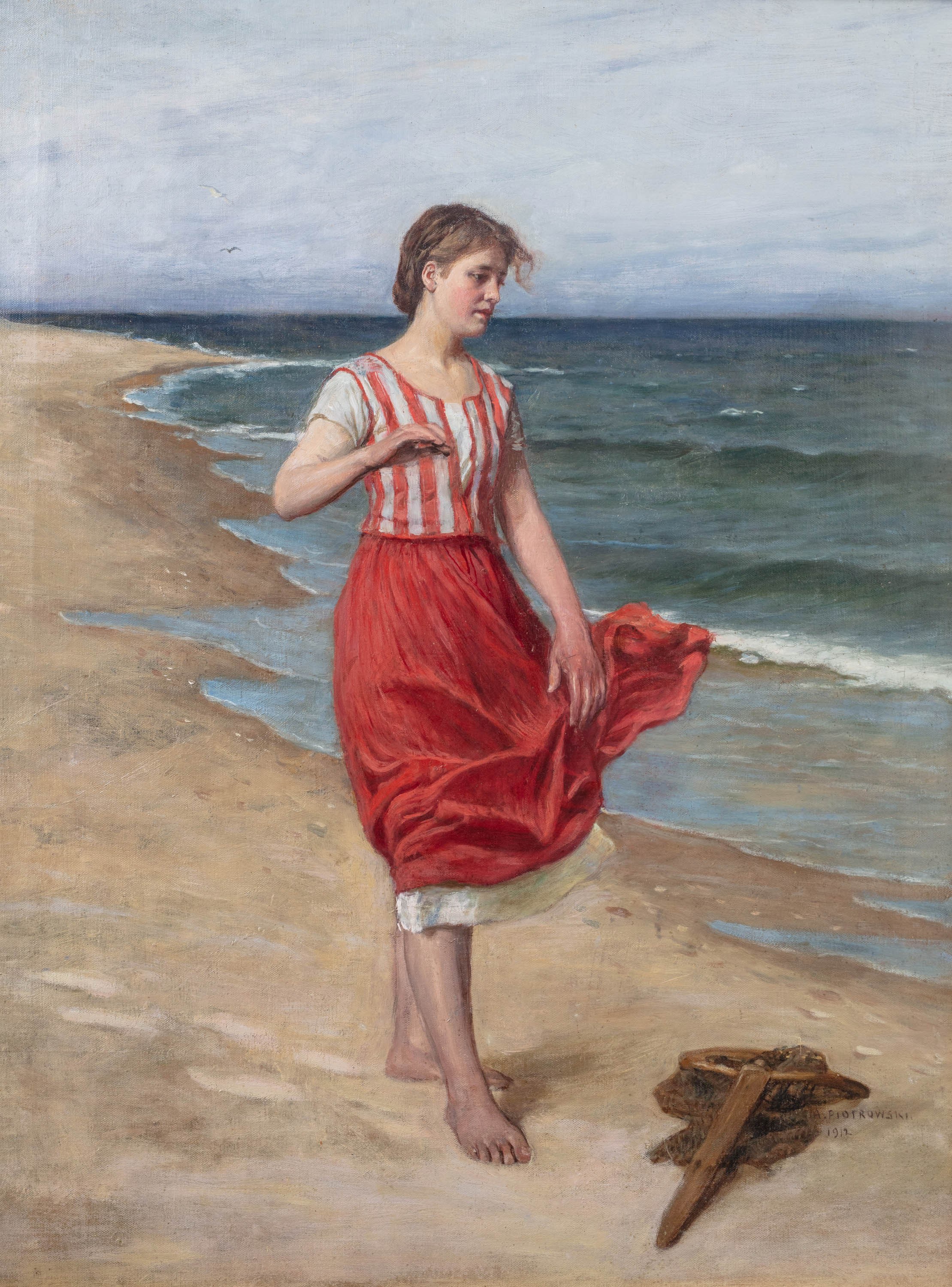
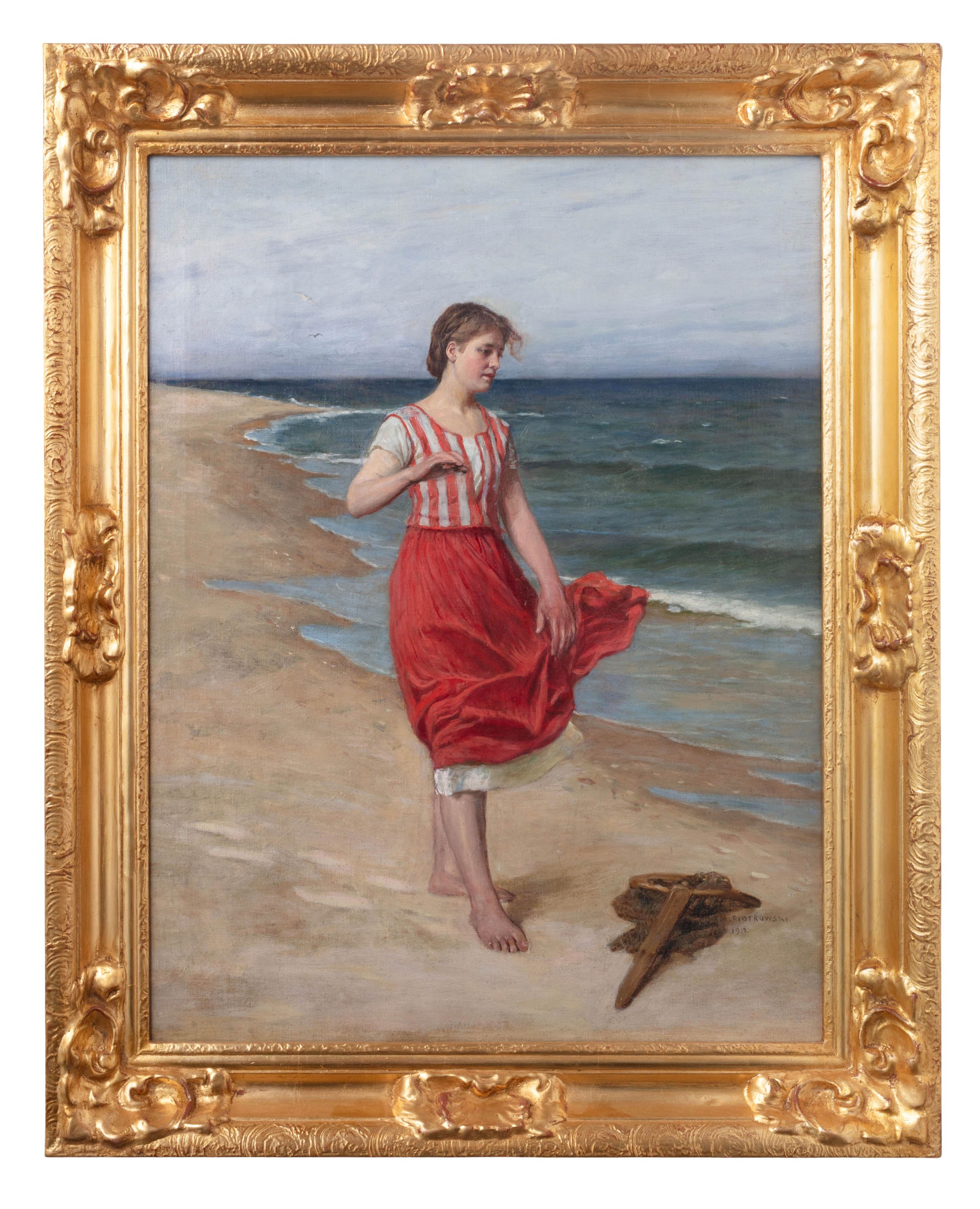
oil on canvas, 83 x 63 cm
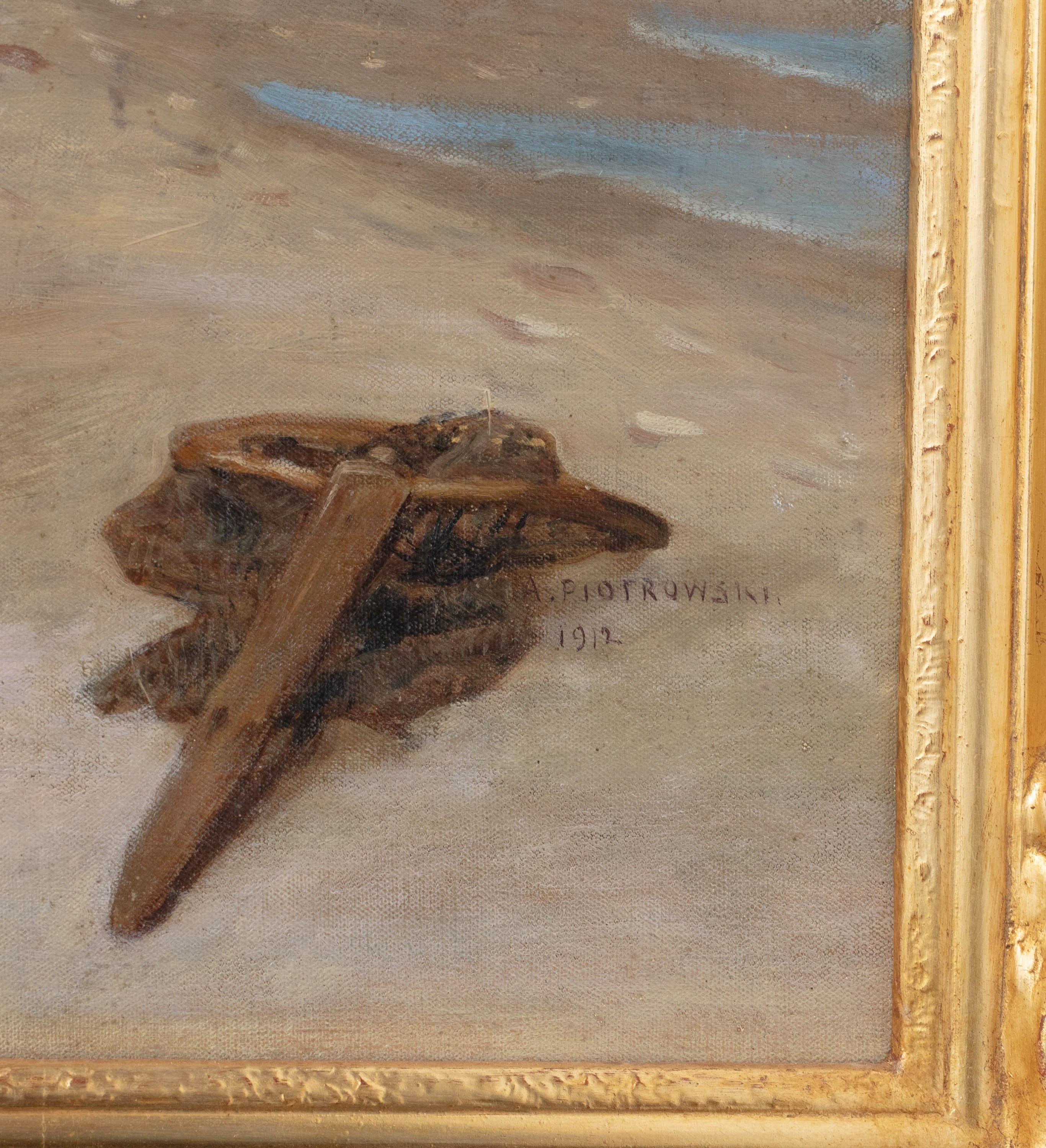
signed and dated lower right: "A.PIOTROWSKI/1912"
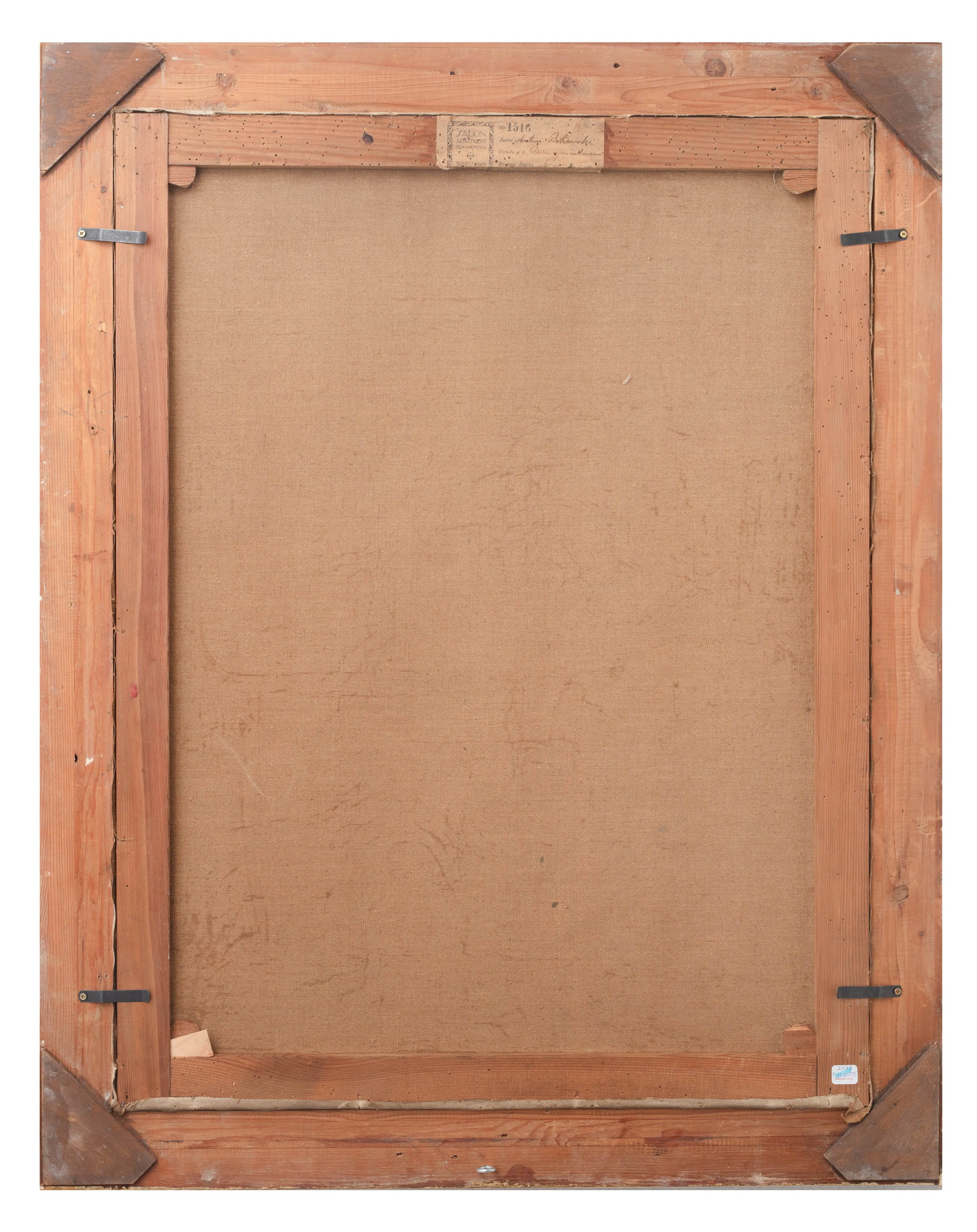
A label on the stretcher from Feliks Richling’s Art Salon in Warsaw, bearing the number 1516 and the title of the work
Exhibited:
- Warsaw, Feliks Richling’s Art Salon, ca. 1912–1914
The composition “Girl by the Sea” certainly belongs to the category of works that can be described as “intriguing.” On the one hand, the artist depicts a beautiful, young woman with porcelain skin and gentle features, standing against the backdrop of a seascape. On the other hand, at her feet lies an object that may carry a certain symbolic meaning and, to some extent, likely constitutes the essence of the work. The girl seems to be staring intently at it, as if what she sees has moved her.
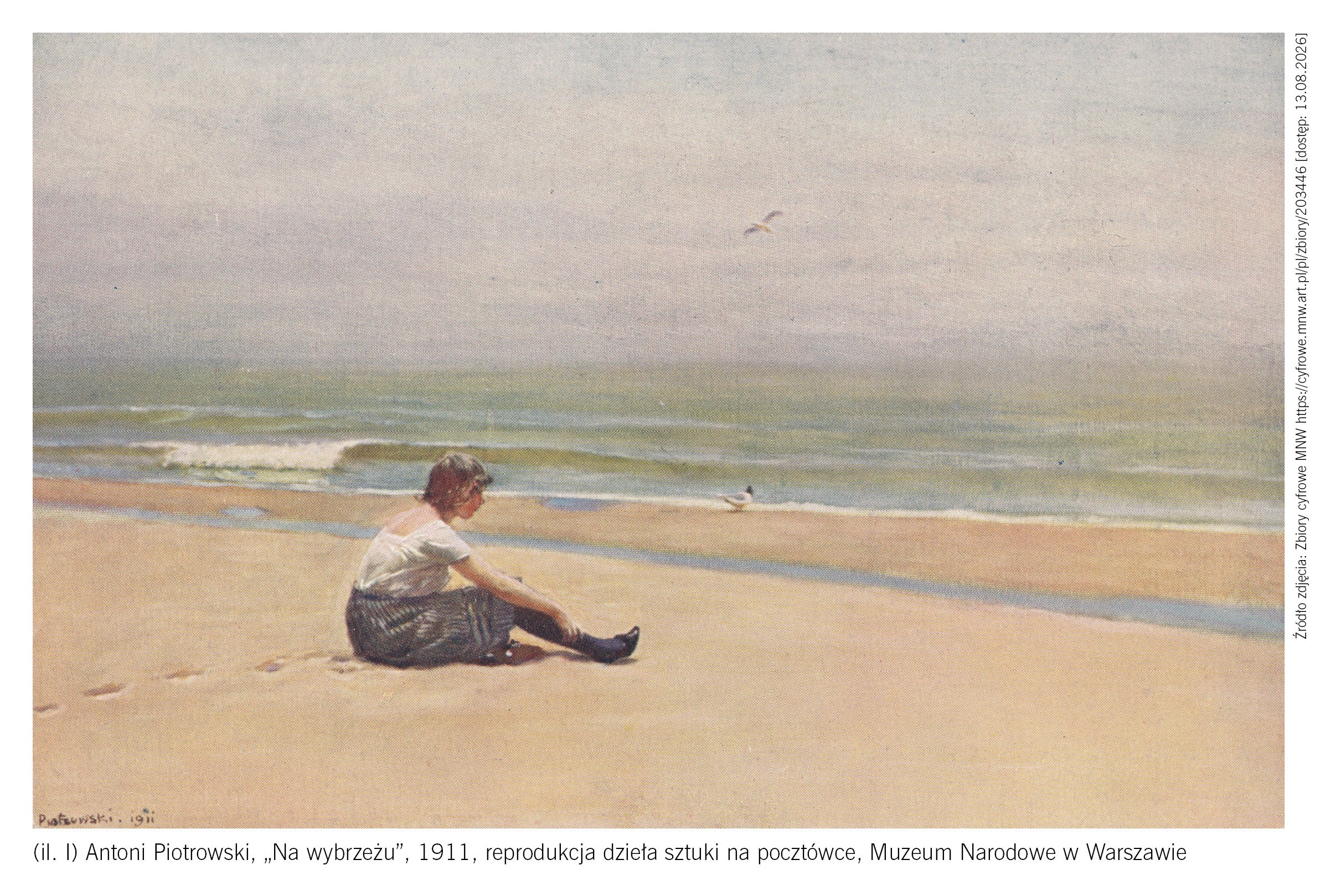
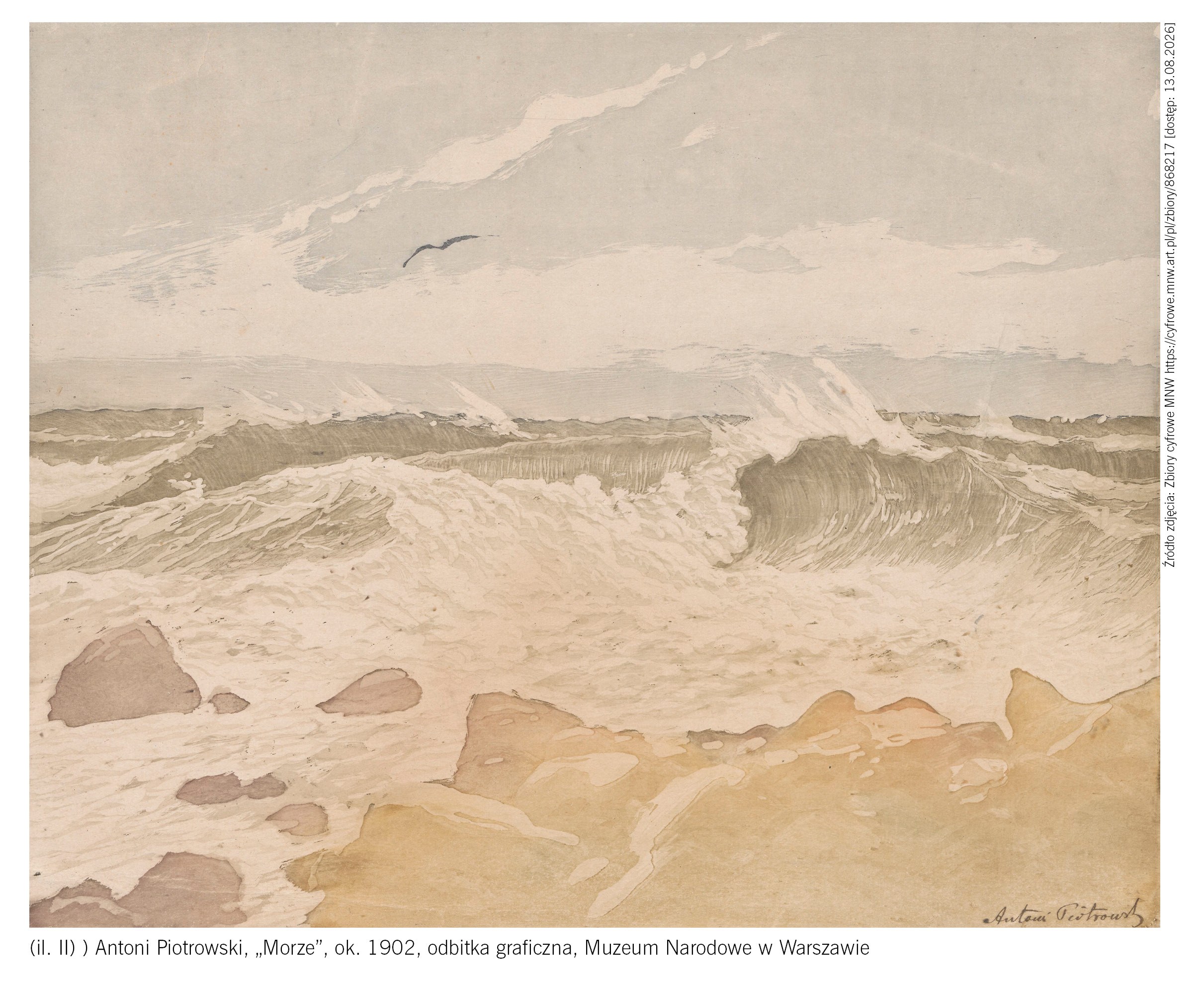
Antoni Piotrowski was an outstanding Polish painter, draftsman, and illustrator. In addition to numerous works on folkloric and battle themes, he also left behind several seascapes. A perfect example of this is the painting presented here, as well as “On the Coast,” created in 1911 (later reproduced on postcards) and a print titled “The Sea” from around 1902, which is a standalone landscape study. Both of these works are currently in the collection of the National Museum in Warsaw (Fig. I), (Fig. II).
The painting on display was created during one of the artist’s most productive periods. By then, Piotrowski had fully developed his technique, and this maturity was evident in the virtuoso ease of his execution. It was also during this time (1911) that the painter began writing his autobiography. “As a painter, Antoni Piotrowski belongs to the now small group of artists representing the finest tradition of the Matejko school and a great love of art, exemplary drawing, exemplary care in the finishing of details, and a talent for discovering the painterly moment even among the most ordinary subjects. The substantial body of work he has contributed to Polish art places his name among the foremost figures in the field.” (W. Prokesch, “Antoni Piotrowski,” [in:] “Contemporary Polish Painting,” vol. VIII, Kraków [no date], p. 14.)
His inspirations, like the trends in art, changed over time; however, Piotrowski remained most faithful to the realist movement in his artistic practice—several decades later, the following was written about him: “P.’s painting, inspired by the work of Gerson and shaped by the influence of the Warsaw and later Munich circles close to him, belongs almost entirely to the realist movement. The artist took particular delight in rendering landscape backgrounds, usually depicted on a grand scale, showing vast views of nature, reminiscent of the landscapes of Maksymilian Gierymski. Idyllic paintings […] featuring meadows and realistically drawn human figures […] The fantastical elements that appeared in Piotrowski’s paintings at the turn of the century did not alter his realistic approach to depicting the world nor did they prompt a search for new means of expression. In 1911, the artist wrote in his “Autobiography”: “I am from a different era; I do not understand many of the things happening around me in painting… what is being done today is decadence.” (U. Leszczyńska, “Piotrowski Antoni,” in: “Dictionary of Polish and Foreign Artists Active in Poland Who Died Before 1966: Painters, Sculptors, Graphic Artists,” Vol. VII, Pe-Po, Warsaw 2003, pp. 214–215.)







Nesen skatītās
Piesakies, lai redzētu lotu sarakstu
Iecienītākie
Piesakies, lai redzētu lotu sarakstu