


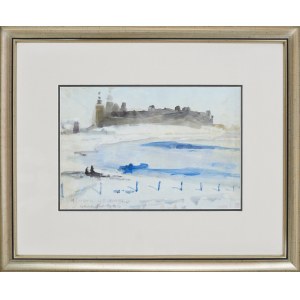
watercolor / 19 x 28 cm [świetle passe-partout]
39 x 47 cm, dimensions with frame
signature l.d.: 'HENRYK UZIEMBŁO KRAKÓW 1940'
inventory number: UK/as/10/4/2020/e
ORIGIN:
private collection, Bielsko-Biala
Henryk Uziembło, coat-of-arms Sulima (b. February 27, 1879 in Krzy, d. August 3, 1949 in Cracow) - Polish painter, graphic artist and designer.
From 1893 to 1897, he studied at the Faculty of Art Industry of the Higher Industrial School in Cracow, then from 1897 to 1902 at the Kunstgewerbeschule des Osterreichisches Museum für Kunst und Industrie in Vienna under K. Karger. Later he returned to study (1902-1903) at the Cracow Academy of Fine Arts in the studio of T. Axentowicz and S. Wyspianski. In 1903-1904 he stayed for further studies in Paris at the Académie Julian, studying under E. Grasset, L. Simon and R. Prinet. He also trained in interior design in London (1904-1905). In 1906 he organized an exhibition of his works in Vienna, which was very successful. After returning to Cracow, he worked for the metal industry designing lamps, candlesticks and dishes. In 1904-1908 he worked with Włodzimierz Tetmajer on the polychrome in the parish church in Sosnowiec. He designed a stained glass window for the Mortgage Credit Bank building. He was one of the co-founders of the Society of Polish Applied Arts (1901).
He designed, among other things, for the Tarnowski family for the palace in Dzików near Tarnobrzeg, the salon in the sanatorium of Dr. Kazimierz Dłuski in Zakopane (1910), the frieze in the White Room of the Noworolski Café from 1912. In the same year he took part in another exhibition Interior Architecture in the Garden Surroundings. At that time he won a competition for the interior design of the Krakow Hotel in Lviv. He also designed the now defunct interiors for Krakow's "Uciecha" cinema in 1912 and for the "Bagatela" theater in 1918-1919.
He was one of the creators and promoters of the so-called "peculiar style" in Polish ornamentation, characterized by the use of native folk designs. He used a variety of techniques in his artistic work, designing posters, book covers, illustrations, ex-librises and logos.
Called up to the army in 1914 at the age of 35, in October 1915 he was sent to the Cracow Department of War Graves as a lieutenant of the common army. He worked in the Team of Painters and Graphic Artists (Maler-Gruppe Nr. VI) making sketches and designs of cemetery compositions, watercolors of mock-ups and sketches of battlefields (his beautiful watercolor of the cemetery in Gladyszow is well known). In 1916 he arranged an exhibition dedicated to the battles of the Austro-Hungarian army. However, Henryk Uziembło was first and foremost a Pole, an ardent patriot and advocate of the struggle for independence, which strongly connected the artist with the idea of the Polish Legions. He soon stood in the ranks of the artistic chroniclers of the Legions - alongside Leopold Gottlieb, Stanisław Jankowski, Karol Zyndram-Maszkowski, Leon Czechowski, Włodzimierz Konieczny, Wilhelm Wilk-Wyrwiński, Kazimierz Dąbrowa-Młodzianowski, Zygmunt Rozwadowski, Jan Skotnicki, Kajetan Stefanowicz and Leon Wyczółkowski. The first exhibition of works by these artists took place in 1916, and another in 1924 for Konieczny and Wilk-Wyrwiński (posthumous - they died at the front as officers of the Legions) in the building of the Society of Friends of Fine Arts in Cracow. A significant part of these works is in the collection of the National Museum in Cracow. After the war, Uziembło was the author of the artistic setting for the official act of Poland's wedding to the sea, which took place on February 10, 1920 in Puck[1].
From 1922 until the outbreak of World War II, he worked at the State School of Decorating and Artistic Industry in Cracow. He continued to design furniture, textiles, mosaics (facade of the Industrial and Technical Museum) and book graphics. On August 3, 1949, he went to the Słowacki Theater for a performance, during which he fainted. Despite prompt assistance, he died the same day in the hospital. He rests in the Rakowicki Cemetery.










Nesen skatītās
Piesakies, lai redzētu lotu sarakstu
Iecienītākie
Piesakies, lai redzētu lotu sarakstu