Dimensions: 98 × 146 cm
Signature: signature p.d.: JÓZEF CHEŁMOŃSKI / [date illegible].
Provenance
Warsaw, private collection Sopocki Dom Aukcyjny, auction 02.05.2013, item 03 Warsaw, collection of Leon Franciszek Goldberg-Górski (purchase before 1915)
Exhibited
Kraków, National Museum in Kraków, Józef Chelmonski 1849-1914, 08.08 - 30.11.2025. Poznań, National Museum in Poznań, Józef Chelmonski 1849-1914, 07.03- 13.07.2025. Warsaw, Society for the Encouragement of Fine Arts, 1929. Warsaw, Society for the Encouragement of Fine Arts, 1927. Warsaw, Łazienkowski Palace, One Hundred Years of Polish Painting, 1919.
Reproduced
Józef Chelmonski 1849-1914 [exhibition catalog], vol. 2, National Museum in Warsaw, Warsaw 2024, cat. no. 342, p. 393.
Literature
Nowak Z., Collection of Leon Franciszek Goldberg-Górski, "Yearbook of the National Museum in Warsaw", vol. 10, 1966, cat. nos. 24, 25, p. 432. Report of the Committee of the TZSP for the year 1929, M. Garasiński Printing House, Warsaw 1930, p. nlb [43]. TZSP Committee Report for 1927, M. Garasinski Printing House, Warsaw 1928, p. nlb [36]. In the palace of the king-artist, "Tygodnik Ilustrowany", No. 27, 1919, p. 424.
Józef Chełmoński is one of the most outstanding Polish landscape painters of the turn of the 19th and 20th centuries, whose work was shaped by his fascination with nature, the need to experience it intimately and to reflect its elusive essence through painting. After twelve years in Paris, tired of the hustle and bustle of the big city, the artist returned to the country and in 1889 bought an estate called Kuklówka. There he spent the last twenty-five years of his life, devoting himself entirely to creating. "He seemed completely in tune with his surroundings. In the summer, he would walk around in a Łowicz straw hat, and in the winter, he would put on a sheepskin coat, press his cap over his ears, and trudge off into the snow, to see the sparkling world! He often visited the stables of the Arabian horses (...) He also walked in the fields, enjoyed the harvest (...). Seeing all this, one did not want to believe that he could have lived differently - and somewhere else" (Masłowski M., Malarski żywot Józefa Chełmońskiego, Państwowy Instytut Wydawniczy, Warsaw 1965, p. 270).
His landscape became more and more minimalist and sensual over the years, as if it appealed not only to the eye, but also to the spirit. During this period, the artist, withdrawing from social life and delving ever more deeply into mysticism, moved closer to nature, which he experienced as an almost metaphysical reality. Renouncing the strict reproduction of the real world, he somewhat anticipated symbolist attitudes - he operated with a synthesis of forms, light and depth of color mood. His paintings from Kuklówka are full of inner concentration and individual feelings, which was emphasized by his contemporaries, critics and artists: "He is the first to give in his paintings a whole series of certain states of nature with such a feeling that, admittedly, they do not seem new, for we have felt these before, only no one has made us aware of them. (...) There is in this the breath of the general life of nature, there is an understanding of its most essential manifestations, there is a sense of that pulse beating with a congruent rhythm in the universe, that wonderful fusion of the human soul with the soul of existence..." (Schröder A., Józef Chełmoński, "Art", 1912, z. 1, p. 115).
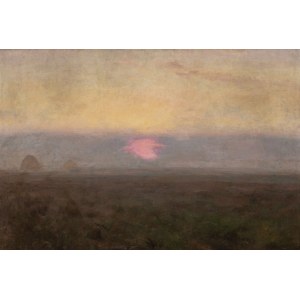
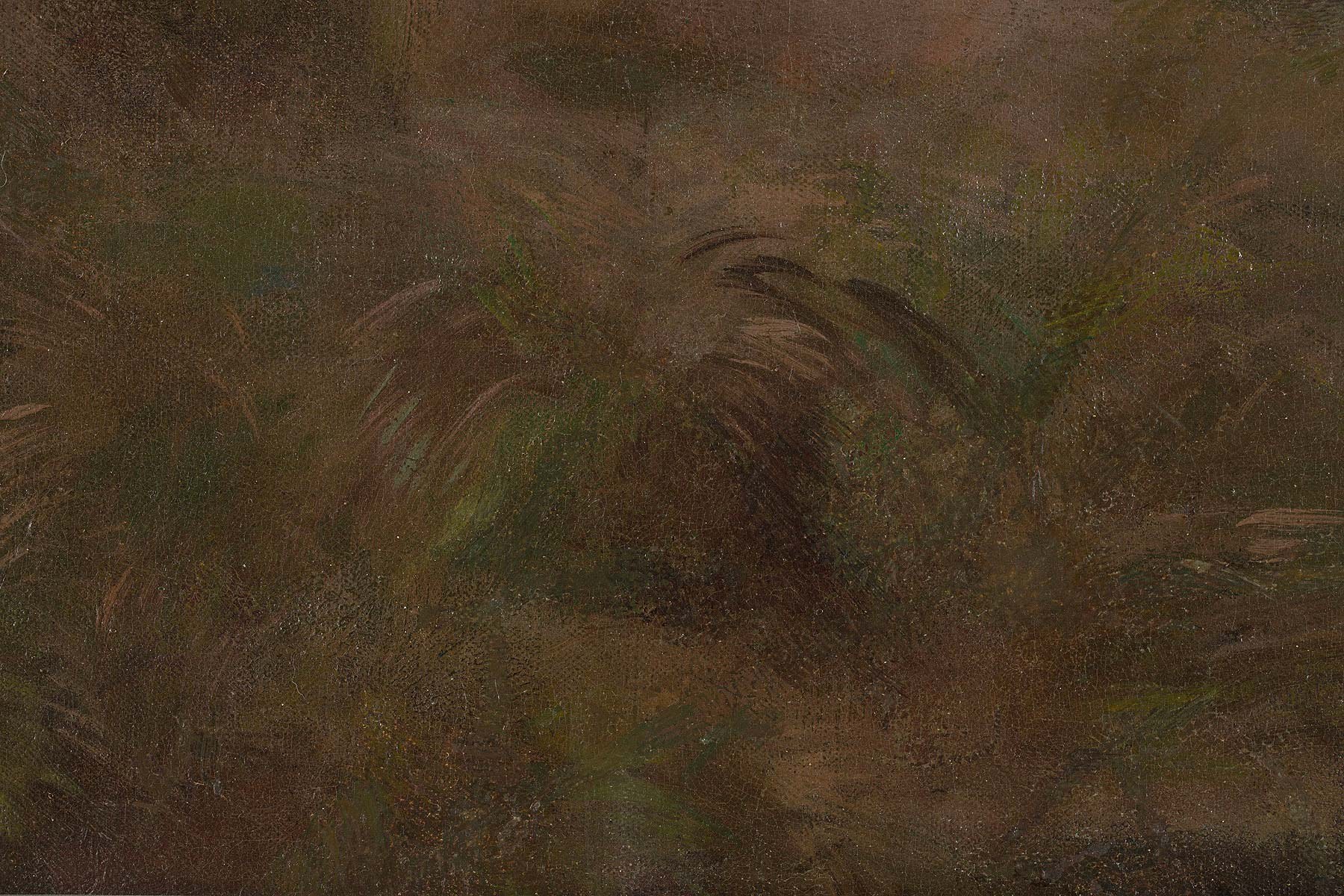
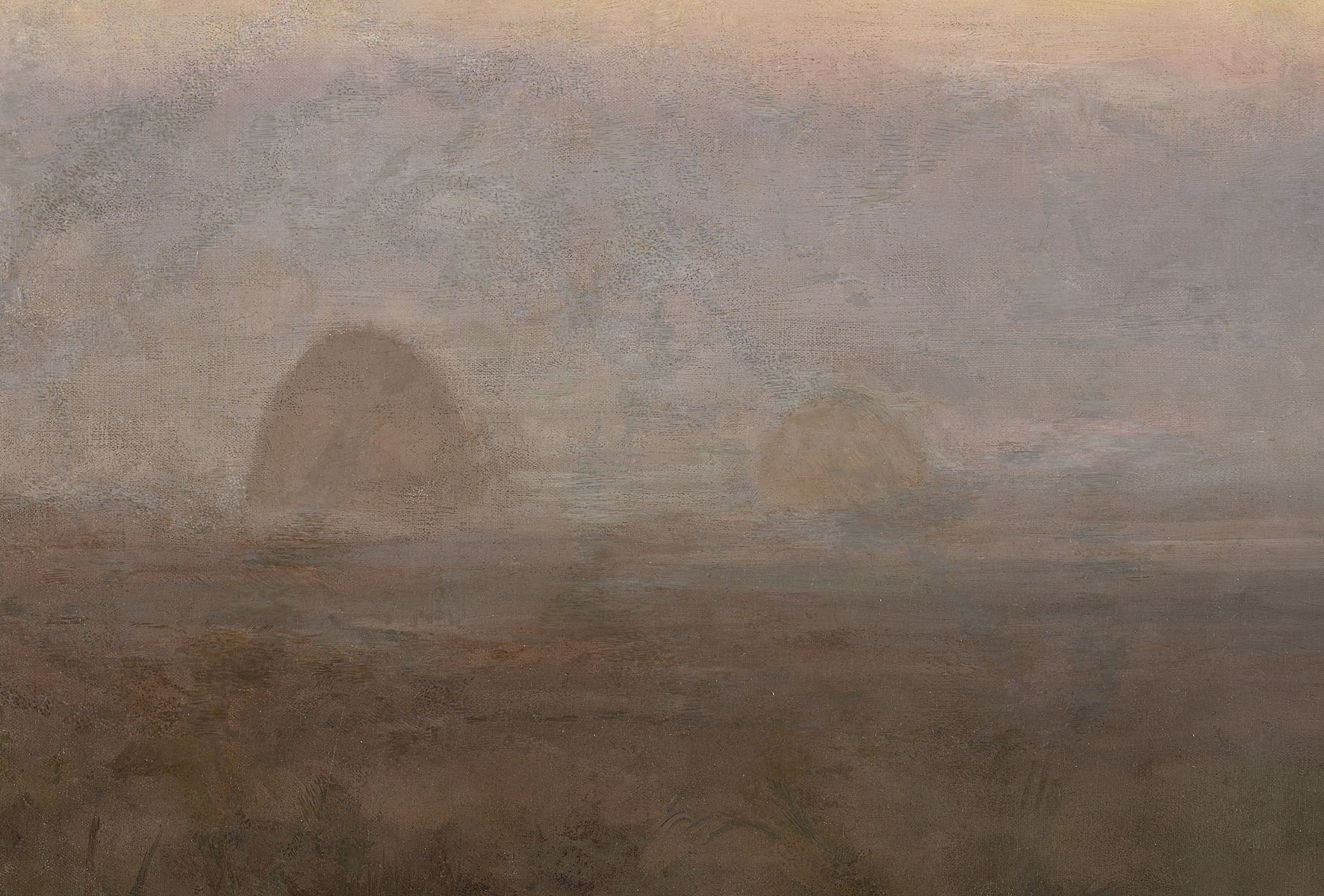
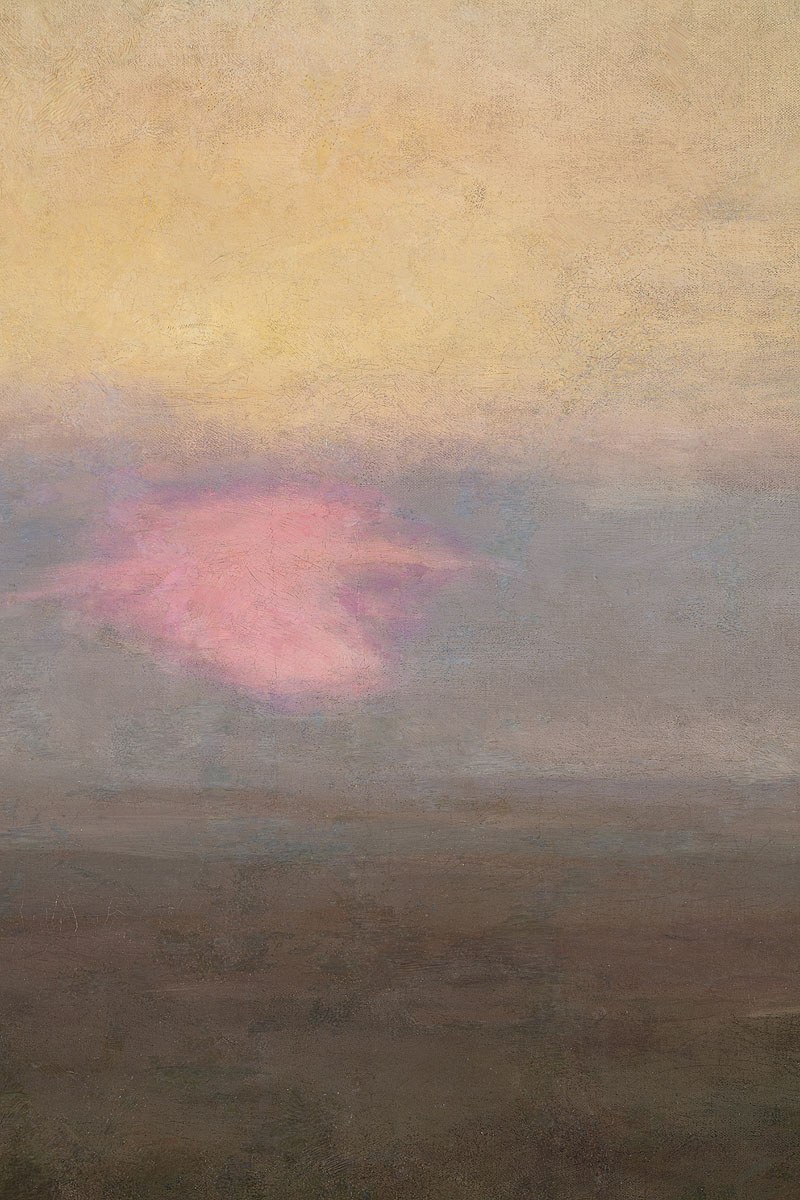
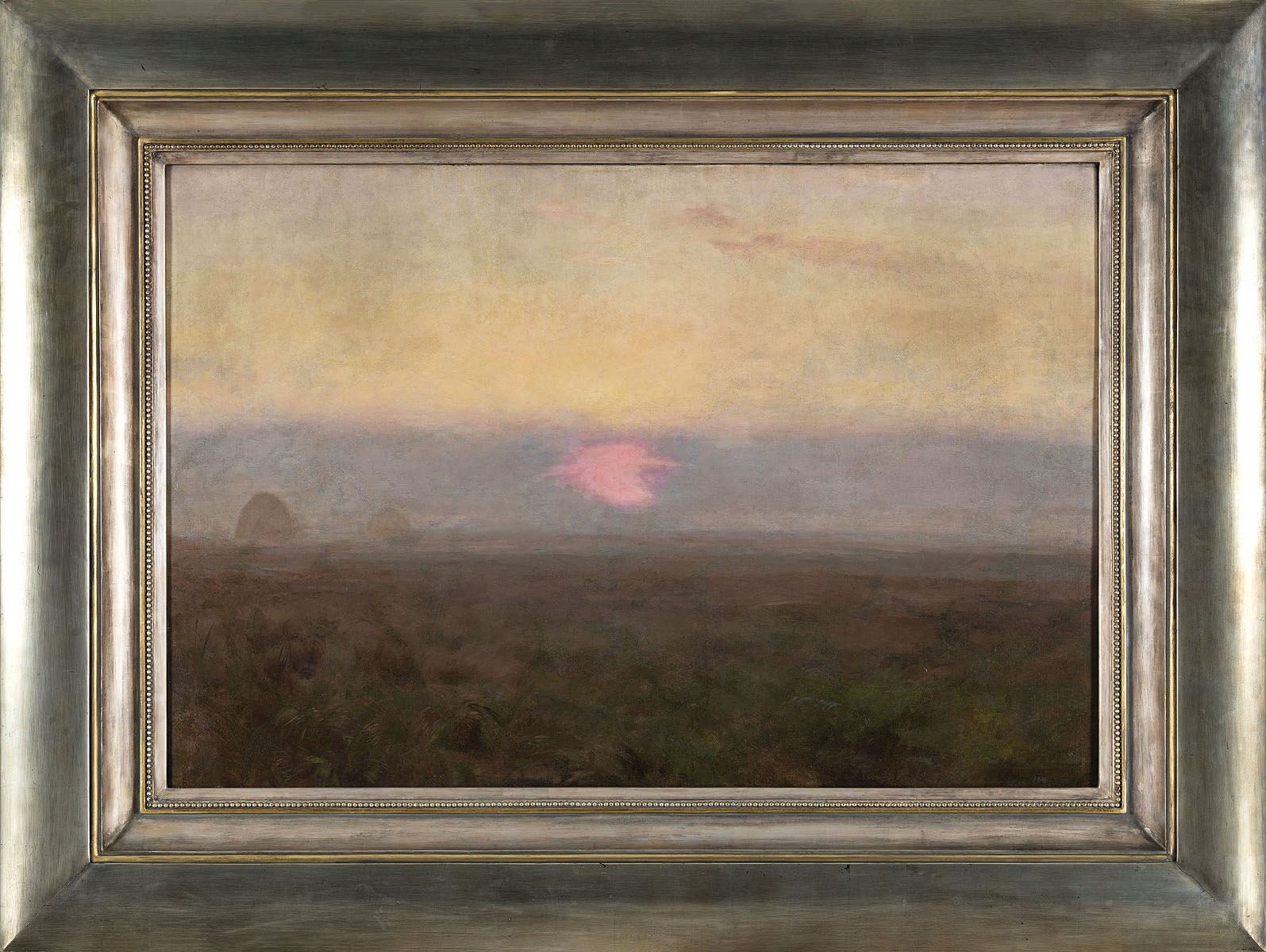
The presented "Dawn" from 1911 is a synthesis of the artist's most mature style. The work shows a panoramic view of a vast plain, shrouded in mist, bathed in the soft pink glow of the waking morning. The wide stripes of the earth and sky zone blur, and the irregular forms of haystacks and grasses blend subtly into the surroundings. The horizon is delineated by warm light, which directs the viewer's gaze toward a distant, infinite space. The open composition is woven with delicate, broad brushstrokes that blur details in favor of impressions and mood. The pure landscape, devoid of anecdotal-figural ballast, speaks only through painterly means. It conveys an element of philosophical simplicity, truth and naturalness. Seemingly economical and almost abstract, it captivates with the poetry of feeling and becomes a monumental reflection on the beauty, permanence and mystery of unchanging nature.