


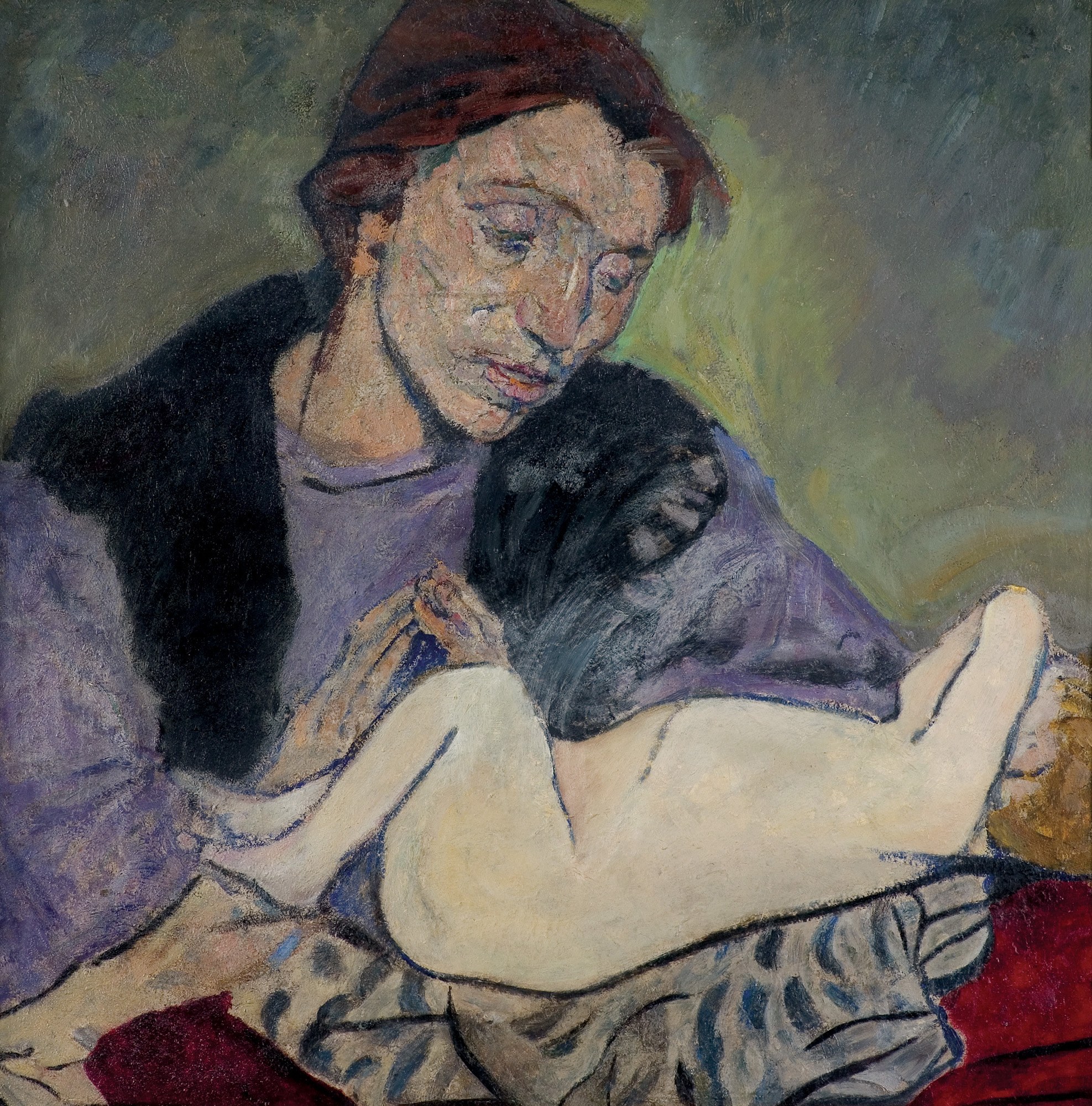
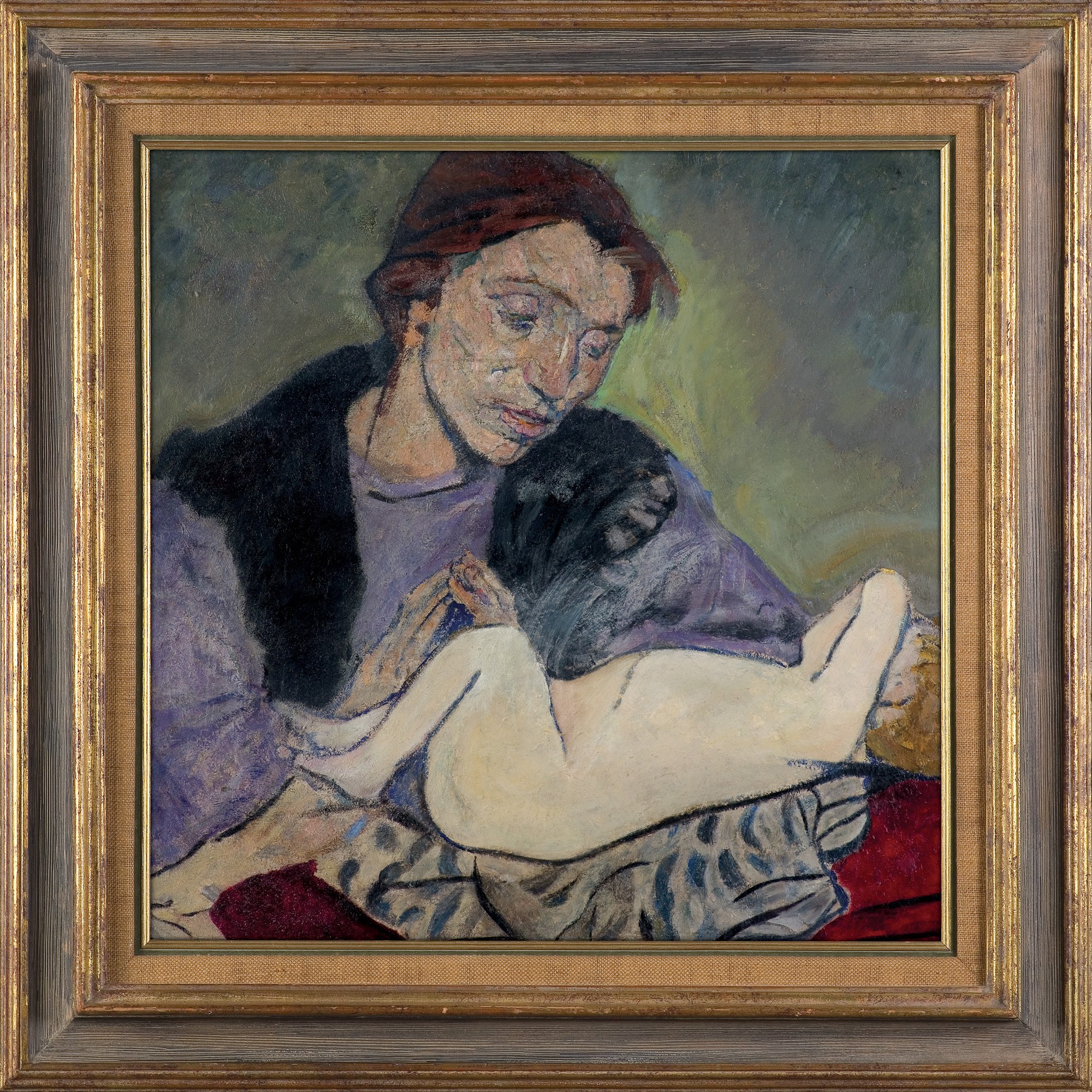
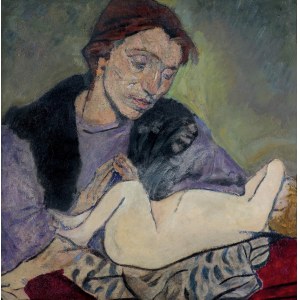
74.0 x 74.0 cm - oil, cardboard glued on board covered with canvas
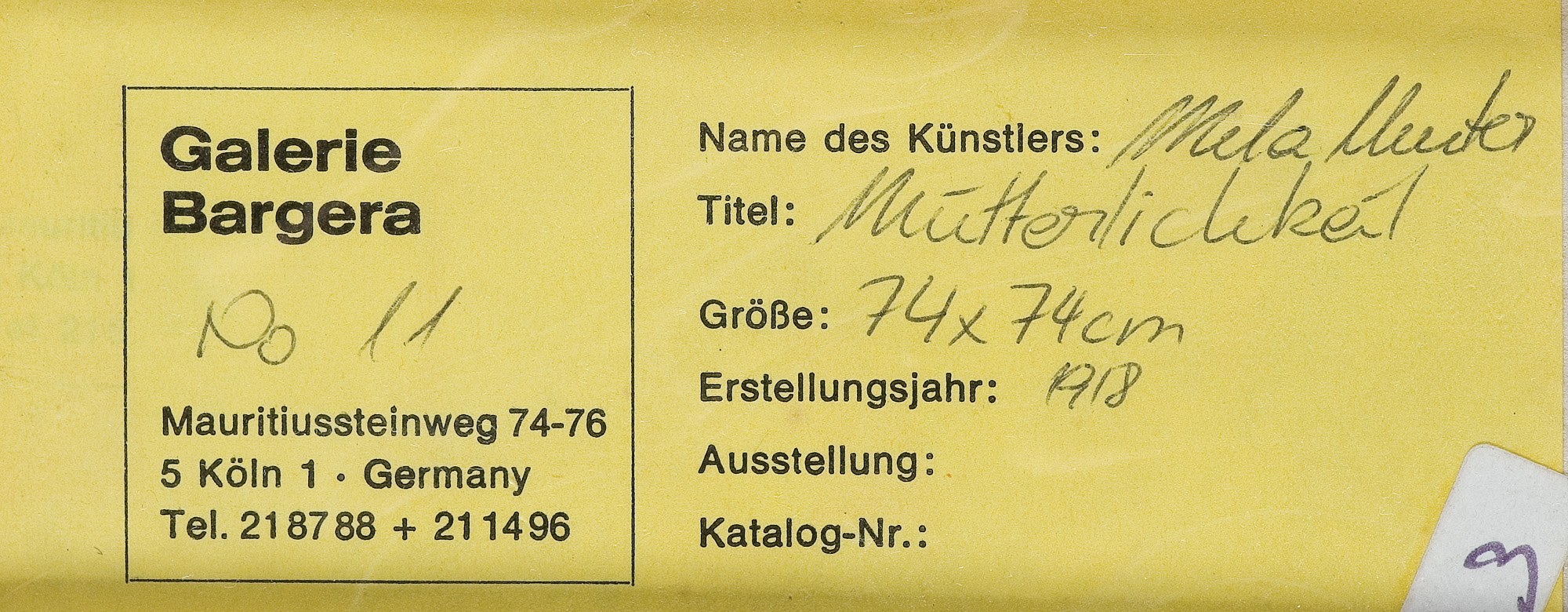
On the reverse: l.g. two stickers of galleries in Cologne:
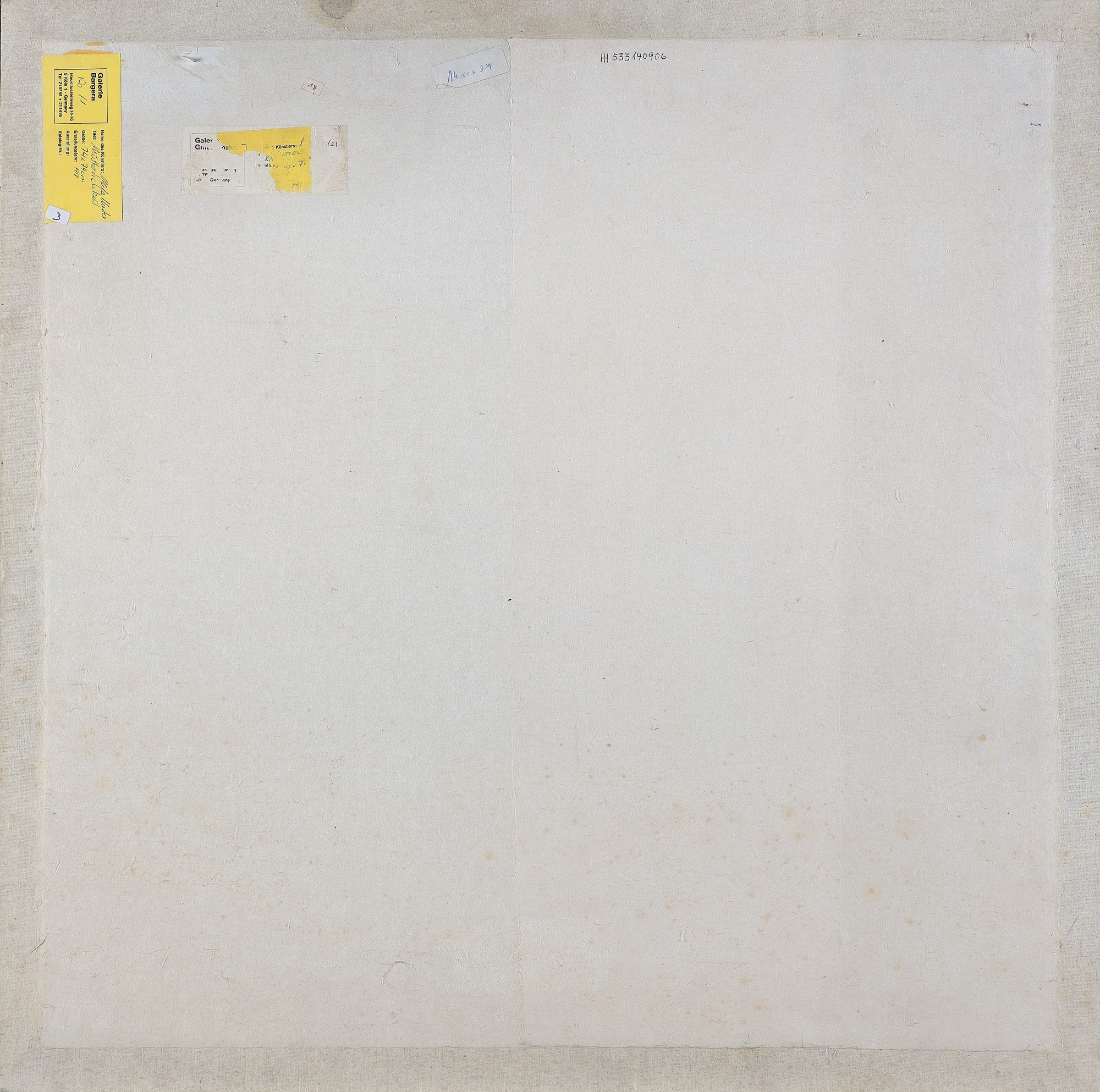
- l.g. sticker of Galerie Bargera in Cologne (print, pen) reading: Galerie Bargera | No 11 | Mauritiusstenweg 74-76 | 5 Köln 1 - Germany | Tel. 218788 + 211496 | Name des Künstlers: Mela Muter | Titel: Mütterlichkeit | Größe: 74 x 74 cm | Erstellungsjahr: 1918 | Ausstellung: | Catalog-Nr;
- l.g. Galerie Gmurzynska sticker in Cologne (damaged);
- two small stickers numbered 3 and 18;
- sticker with price 14,000 DM, next to number (in black pen): HH533140906;
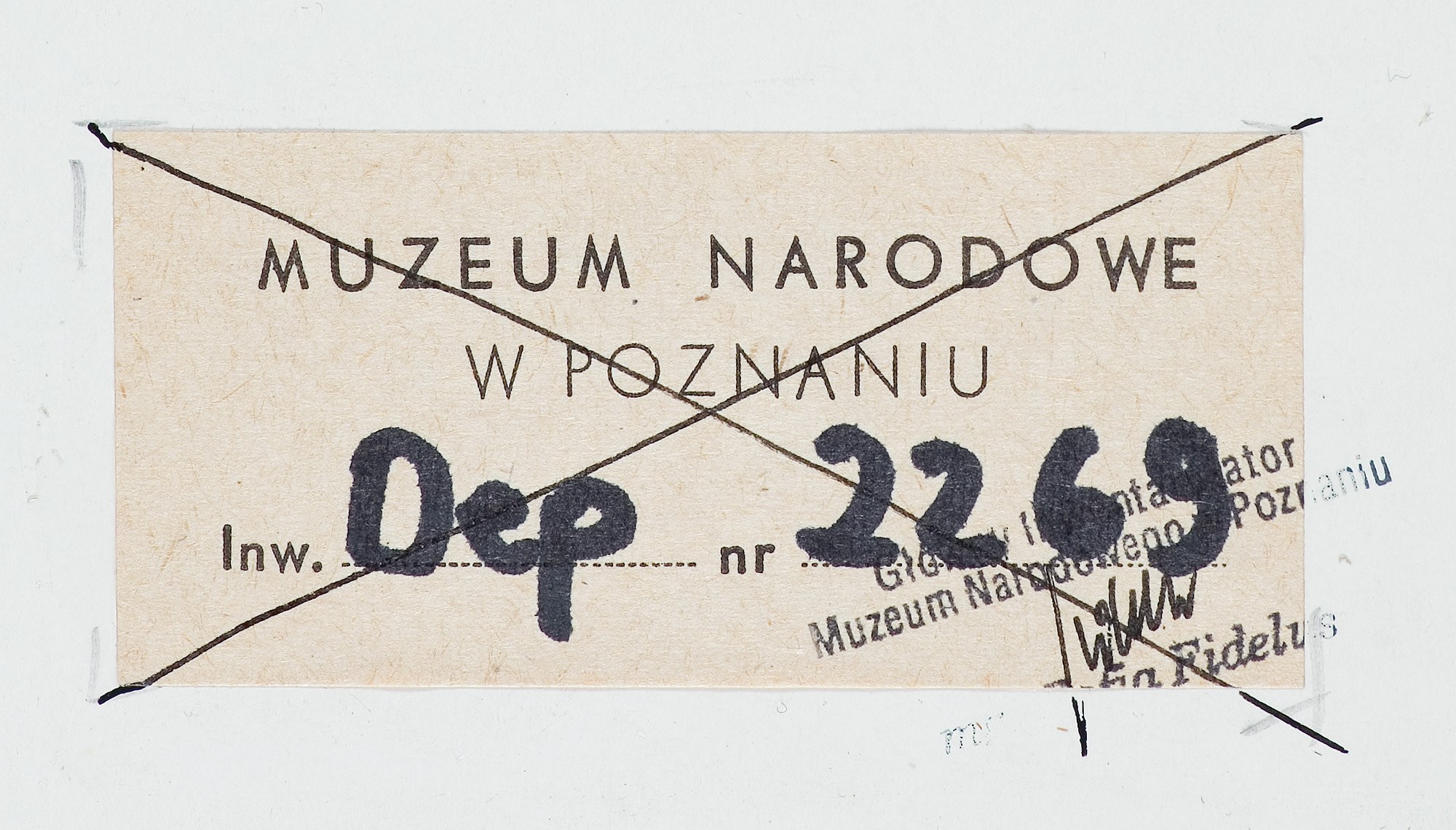
- on cardboard "backing" crossed-out deposit sticker of the National Museum in Poznan (print, black marker): MUZEUM NARODOWE | W POZNANIU | Inv. Dep. no. 2269, stamped by the museum's chief inventory officer;
- on the bottom skirting of the frame, crossed out deposit number of the National Museum in Poznan (in black marker): MNP Dep 2269, stamped by the museum's chief inventor;
- l.g. auction stickers
Provenance:
- Galerie Gmurzynska - Bargera, Cologne.
- Collection of Hans König, Cologne.
- Private collection, Poznan.
- Private collection, Warsaw, Poland.
Image exhibited:
- Mela Muter 1876-1967. Retrospektiv-Ausstellung, Galerie Gmurzynska, Köln 1967, cat. no. 24 (with dimensions 74 x 75 cm, dated 1914).
The motif of motherhood appeared in Mela Muter as early as the Breton period and accompanied her throughout her work. Her canvases are far from candy-colored depictions of happy children in the arms of smiling mothers. Probably this was influenced both by memories of a rather rough relationship with her mother and her own maternal experiences. Susanna Klingsland (the artist's mother) was strict and demanding towards her children. After the death of her only son, she plunged into great pain, closing herself off from relationships with her daughters. Mela tried to be the best possible mother to her only son Andrew, born in 1900, but motherhood is a constant sacrifice. The painter's desire for autonomy sometimes even left her son with his father for several months. Andrew Mutermilch was a sickly child who was diagnosed with bone tuberculosis. Arguably, this disease played a role in his death at the age of 24. These difficult experiences must have affected the tone of Mela Muter's canvases. The artist was also known for her leftist views and commitment to social issues. She used painting as a weapon. With her canvases she made viewers reflect on the hardships of life and open themselves to human suffering. Karolina Prewęcka in her book entitled Mela Muter. Fever of Life writes: Muter's mothers often seem tired of the daily care of existence and children. They treat them like a chore. They find no joy in natural feeding. Their exposed breasts do not swell with food. They are emaciated, crumpled, sagging. The babies in their arms or perched on their laps are not smiling or sweetly sleeping beavers. They have faces frozen in solemnity, similar to the faces of the caregivers. What comes to mind is the positioning and pronunciation of the figures in depictions of Christmas, where the Mother of God folds her hands in prayer over the newborn divine Son.
Everything Prewęcka writes about can also be seen in the painting on display. Mela Muter exposes the truth about motherhood with great frankness. The model does not make eye contact with the viewer. She is immersed in her own thoughts and worries of everyday life. The entire scene is framed in a narrow frame with an empty background, which enhances the atmosphere of intimacy and makes all the viewer's attention focus on the mother, especially the expression on her face. The painting has a decidedly melancholic tone, and the whole picture is painted in Mela Muter's characteristic style with visible fine brushstrokes.
♣ A fee will be added to the auctioned price in addition to other costs, based on the right of the artist and his heirs to receive remuneration in accordance with the Law of February 4, 1994 - on Copyright and Related Rights (droit de suite).
Mela Muter, actually Maria Melania Mutermilch, née Klingsland (Warsaw 1876 - Paris 1967) one of the most interesting artists of the so-called École de Paris; despite her studies with Miłosz Kotarbinski in Warsaw and at the Parisian Académie de la Grande Chaumiére and Académie Colarossi, she considered herself self-taught, claiming that the real school of painting for her was only her contacts with outstanding artists and their art. Befriended by many artists and personalities (including R. Rolland, A. Zweig. R.M. Rilke, A. France. G. Clemenceau), she lived permanently in Paris from 1901, obtaining French citizenship in 1927. She traveled several times to Spain and Switzerland, and always maintained lively contacts with Poland, working for the country and taking part in its artistic life. Primarily revered as a portraitist, she also painted landscapes and still lifes. She devoted many paintings to themes of motherhood, suffering and old age. In her early period, she painted paintings maintained in the convention of realism and dark color tones (Portrait of L. Staff, Chess Game). Later, in the "French" period, she lightened her palette, used clear contours and, tending towards geometrization, stylization of forms. In recent years, large ensembles of the artist's works have been presented at several exhibitions at the National Museum in Warsaw ("Polish Artists," "Collection of Ewa and Wojciech Fibak," and above all at a large exhibition of the artist's paintings from the collection of Lina and Boleslaw Nawrocki).













Nesen skatītās
Piesakies, lai redzētu lotu sarakstu
Iecienītākie
Piesakies, lai redzētu lotu sarakstu