


Rembrandt van Rijn
1606 - 1669, school
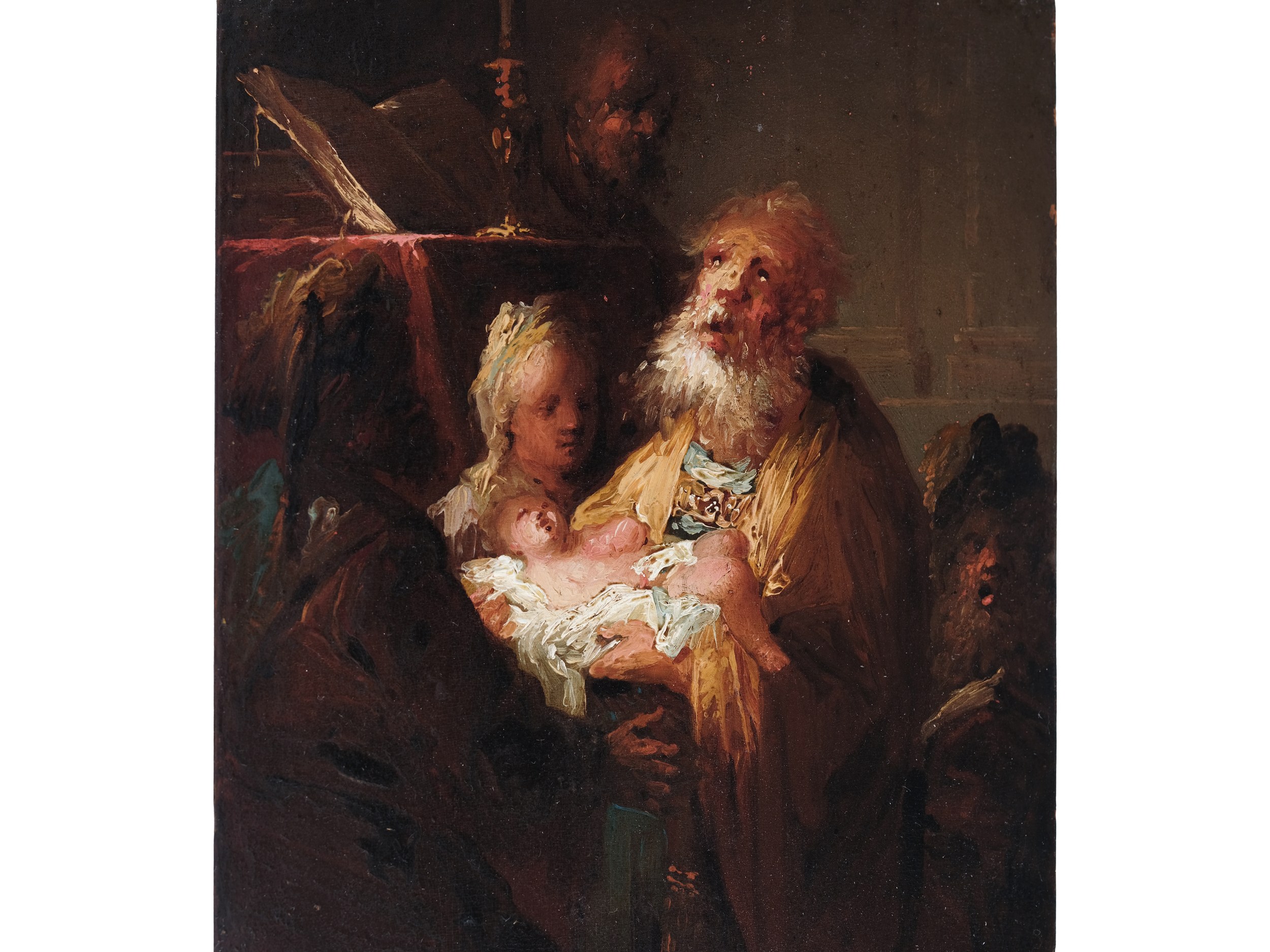
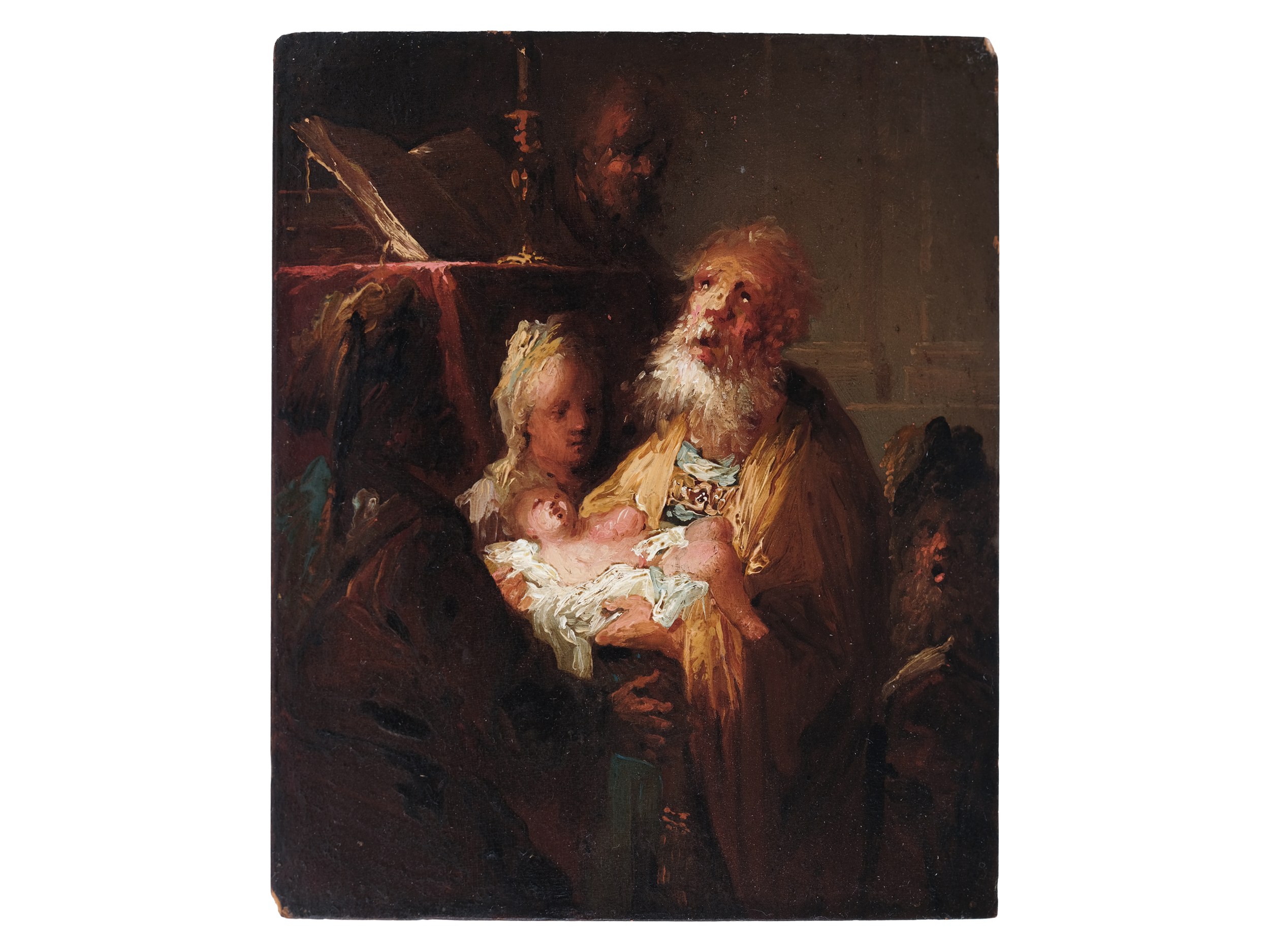
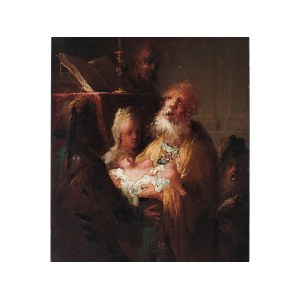
Simeon and the Infant Jesus
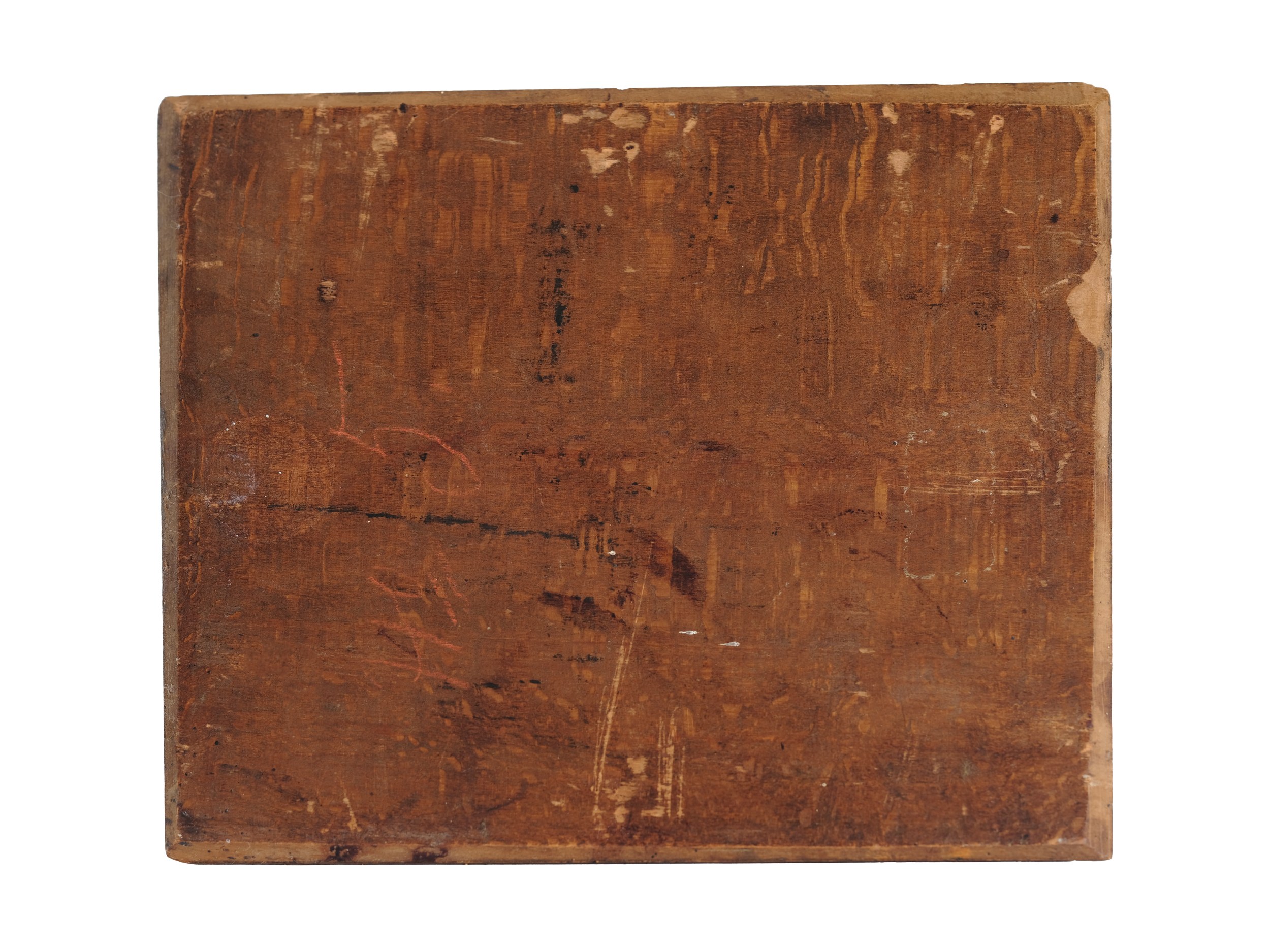
Oil on wood
21.5 x 19 cm
Rembrandt Harmensz van Rijn, one of the most significant painters of the Dutch Baroque, had a lasting impact on 17th - century European art. His work is characterized by extraordinary psychological depth, masterful use of light, and an intense engagement with biblical and historical themes. In particular, his depiction of light—used not only for modeling but also for narrative effect—became a defining style for his numerous students and followers. In the so - called Rembrandt School, artists further developed this characteristic visual language: a dramatic staging through chiaroscuro contrasts, a warm, often earthy color palette, and an emphasized inner life of the depicted figures.
The motif “Simeon and the Infant Jesus” is based on the account in the Gospel of Luke (Luke 2:25 - 35). The elderly Simeon recognizes the newborn Jesus as the promised Messiah in the Temple of Jerusalem and takes him in his arms. At that moment, he utters the famous hymn of praise (“Nunc dimittis”), in which he thanks God that he may now die in peace. The scene is one of the most popular depictions in Christian art, as it addresses both the revelation of Christ and the fulfillment of a divine promise. Simeon is often accompanied by other figures, such as the prophetess Anna or a female attendant.
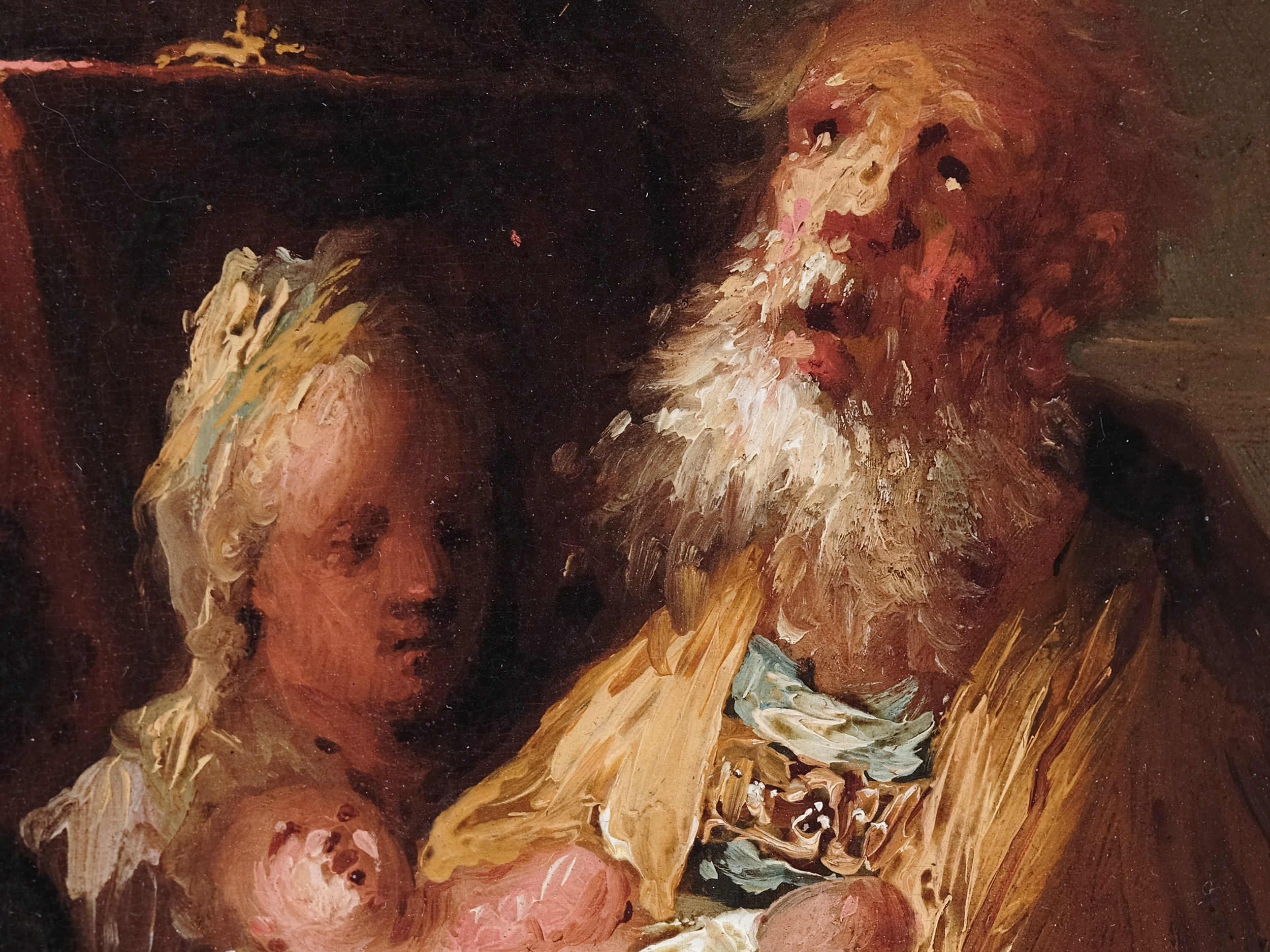
In this small - format painting, the depiction focuses on an intimate moment accentuated by light. A single ray of light falls on the central scene, while the surrounding interior remains largely in darkness. At the center is the infant Jesus, wrapped in a white cloth, being lifted up by Simeon. The old man is depicted with white - gray hair and a beard and wears an ochre - colored cloak. His gesture can be interpreted as the presentation of the child, yet his gaze is directed upward, toward the incoming light, thereby impressively emphasizing the divine dimension of the moment. His moved facial expression—with wide - open eyes and a slightly parted mouth—reveals the moment of realization.
In the background appears a female figure who can be interpreted as a companion. In the upper left half of the picture, a table or desk can be seen on which—behind a single candlestick—lies an open codex that can be interpreted as a reference to the Holy Scriptures. The light sculpts the figures three - dimensionally and makes the child and the protagonist’s face stand out in particular.
Other secondary figures, such as the figure with a hat seen from behind in the left foreground, a figure behind the desk, and a figure in the right part of the picture, remain largely in shadow. Nevertheless, their gestures and facial expressions hint at emotional stirrings: the raised hand of the figure with his back turned suggests a spontaneous reaction, while the wide - open mouth and astonished expression of the figure on the right indicate a state of deep emotion. This lends the scene an inner tension and powerfully conveys the impact of the divine revelation on those present.
Another characteristic feature is the impasto application of paint, in which the brushstrokes emerge from the surface in a relief - like manner and create deliberate accents. Especially in the areas illuminated by light, the painting style intensifies into an almost sculptural presence: Thus, the light glows on the open book, highlights Simeon’s nose and beard, and illuminates the naked Christ Child as well as parts of the accompanying figure. This nuanced treatment of the surface not only enhances the material effect but also contributes significantly to the dramatic lighting by making the interplay of visibility and concealment tangible on a painterly level.
Rembrandt’s school is characterized by a particularly striking use of chiaroscuro, which is employed here in an exemplary manner. The strong contrast between light and shadow creates a dramatic yet contemplative atmosphere. The light seems not only to illuminate the figures but to penetrate them from within, so that they appear in a warm, almost golden glow. This lighting lends the scene a spiritual intensity and underscores the emotional depth of the moment depicted—a central concern of the Rembrandt school, which always imbues the visible with a meaning that points beyond itself.










Nesen skatītās
Piesakies, lai redzētu lotu sarakstu
Iecienītākie
Piesakies, lai redzētu lotu sarakstu