


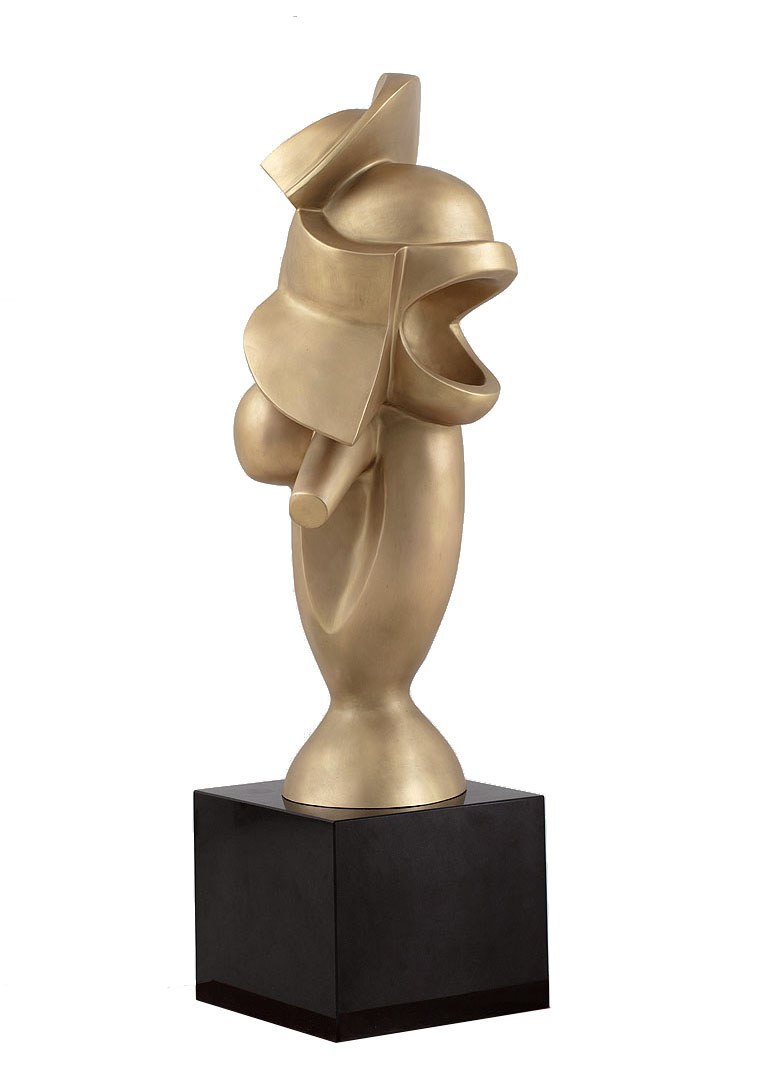


Dimensions: height 105 cm (135 cm with base), ed. 1/3
Signature: signed at the bottom: M. PAPA 1/3
Provenance
Warsaw, collection of the artist’s heirs.
Exhibited
Pietrasanta, Sala delle Grasce, “The Power of Destiny,” June 15–July 13, 2025 (version in white Carrara marble, height 50 cm). Orońsko, Museum of Contemporary Sculpture, “Haptic Resonance of Matter.” Maria Papa Rostkowska and Guest Artists on the Centennial of the Artist’s Birth, March 4–June 4, 2023 (version in white Carrara marble, height 50 cm).
Reproduced
Smolińska, M. [ed.], “The Haptic Resonance of Matter: Maria Papa Rostkowska and Her Guests on the Centennial of the Artist’s Birth” [exhibition catalog], published by the Center for Polish Sculpture in Orońsko, Orońsko, 2023, p. 41 (version in white Carrara marble, height 50 cm). Cortina, S., Riva, V., Maria Papa Rostkowska. The Works, the Friends, the Places [exhibition catalog], Virgilio Guidi Contemporary Art Gallery, San Donato Milanese, 2017, p. 75 (version in white Carrara marble, height 50 cm).
The sculpture “Rigoletto” is a personal commentary on the life of Maria Papa-Rostkowska, embodying her fascination with opera and her deep bond with her father, Bolesław Baranowski. He was a great admirer of Verdi’s work and played the violin himself, which is why the artist grew up with a love for sound and rhythm. She was raised on operas such as “Aida,” “La Traviata,” *The Force of Destiny*, and *Rigoletto*.
One of the key events that left a lasting impression on her was a visit to the Warsaw Opera in November 1933. It was then that her father took his daughter to see “Rigoletto” for the first time. For the young Maria, this was a source of immense pride, and over time, the music became a key interpretive element in her later work.
Inspired by these youthful experiences, the sculptor created a work titled “Rigoletto.” The sculpture on display is a 50-centimeter-tall marble version created in 1995. Its smooth texture and slender form are characterized by a complex arrangement of volumes. This dynamism directly echoes the intricate and satirical story of the titular Rigoletto—a gnarled hunchback hated by the court of Mantua. The tale, with the jester in the lead role, is a drama from beginning to end. It is an opera in three acts, with a libretto written by Francesco Maria Piave based on Victor Hugo’s play *The King Amuses Himself*. The sculpture’s composition is therefore no accident—it captures the spirit of this convoluted tale, whose original title was simply “The Curse.” The figure is stereometric, which means it reveals a different “face” from every angle. Much like the Duke of Mantua, who changes women, the object changes its appearance depending on the perspective from which we view it. This offers ample room for interpretation of the creative act, which is also a tribute to the artist’s father, without whom this work would likely never have been created.










