


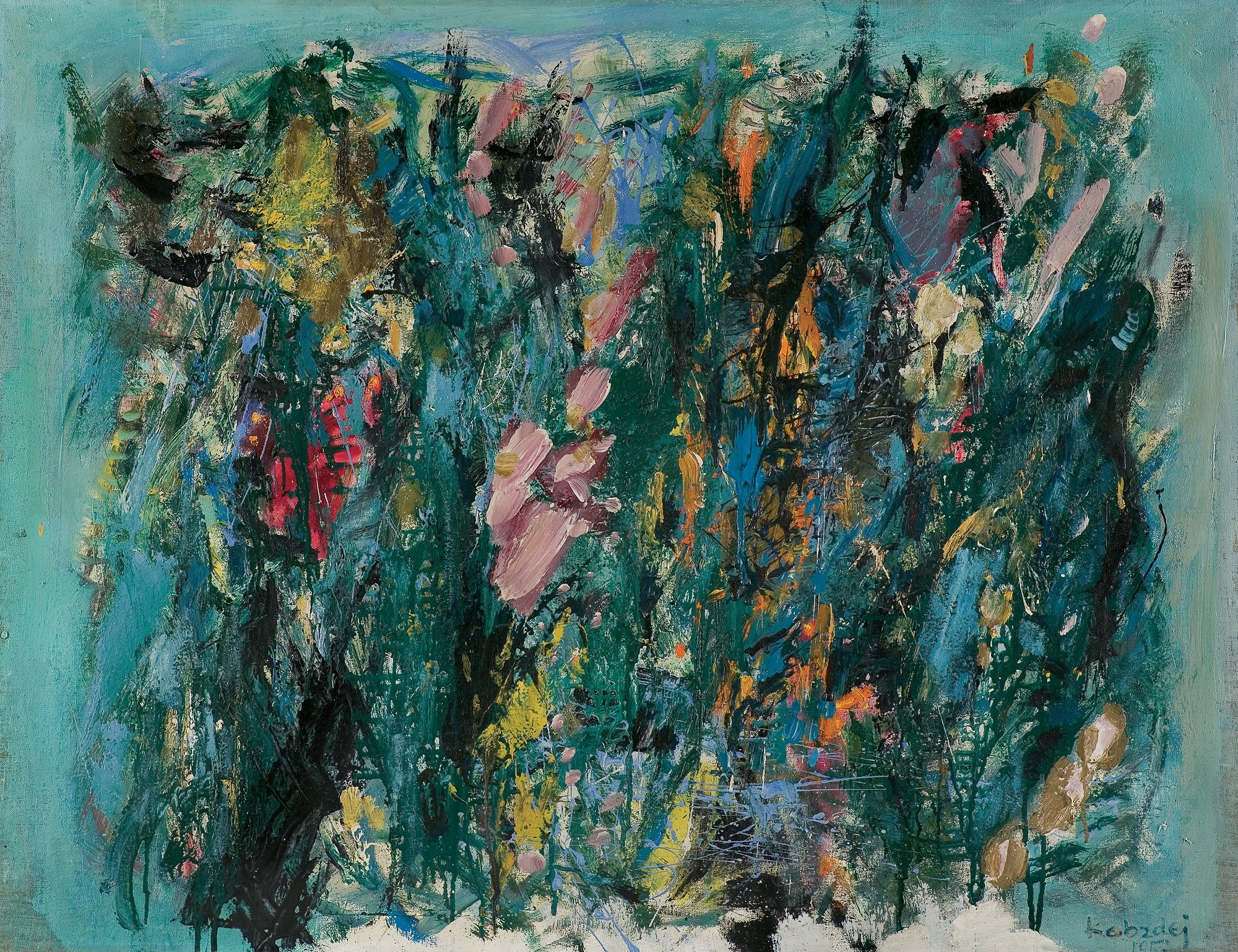
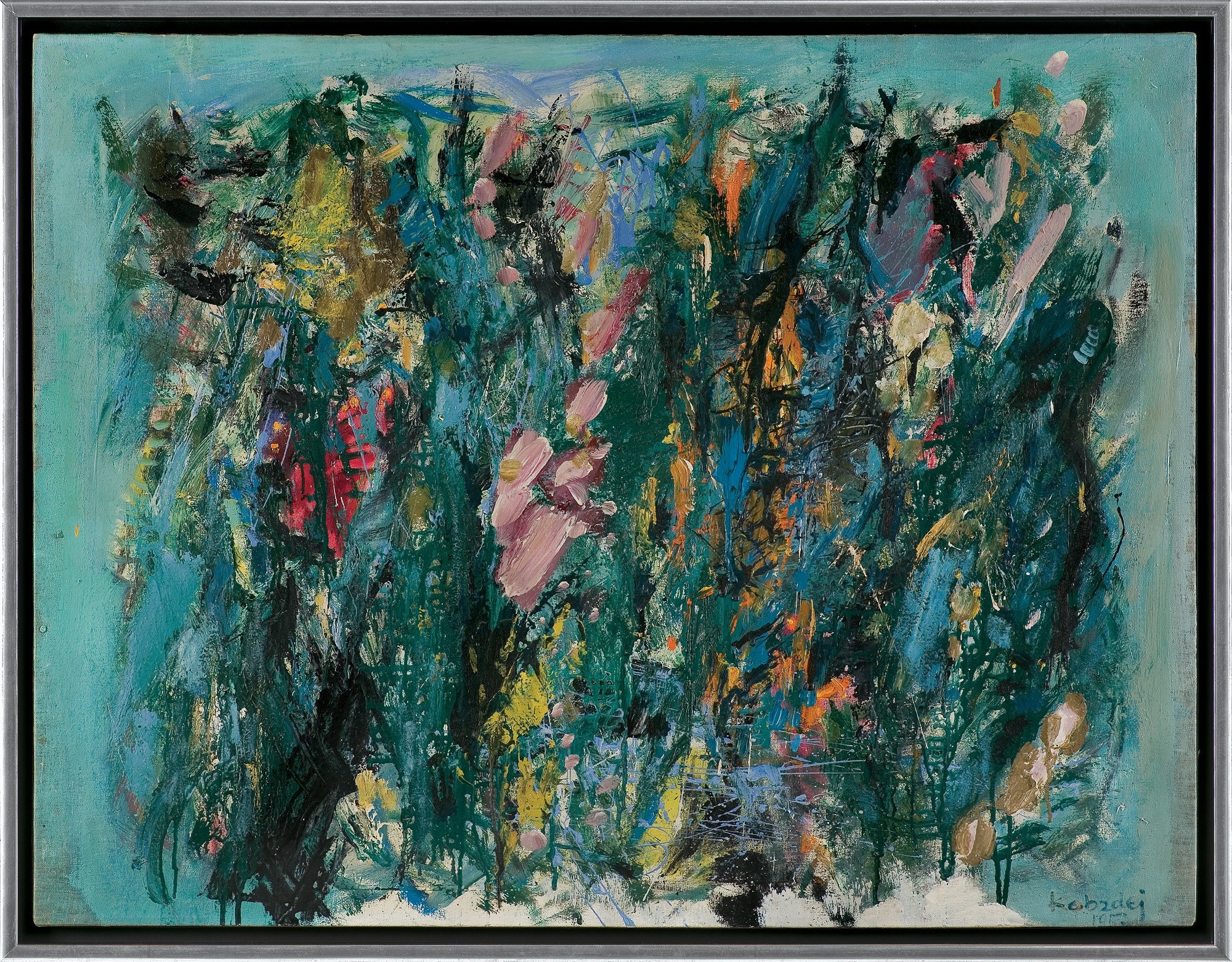
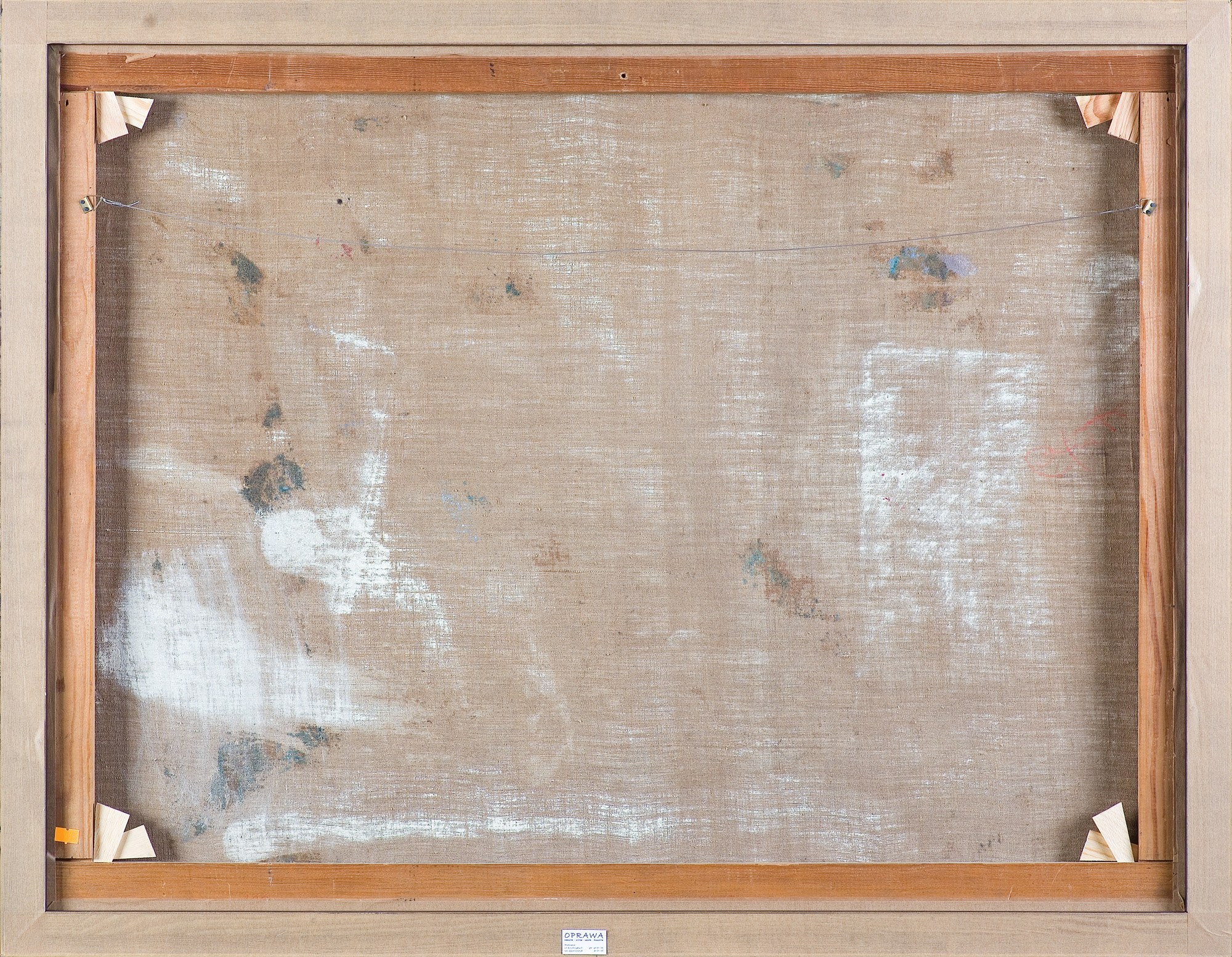
77.0 x 100.0 cm - oil, canvas
signed p.d.: Kobzdej | 1957
Aleksander Kobzdej's painting has undergone one of the most spectacular metamorphoses in Polish contemporary art. The author of the 1950 flagship painting of socialist realism Pod cegłę (Give a Brick), a decade later he was recognized as a leading representative of matter painting not only at home, but also abroad - in 1959 he was awarded 2nd prize at the 5th Biennale in Sao Paulo, and a year later Galerie de L'Ancienne-Comédie in Paris and French and Company in New York organized his monographic exhibitions. The "Pollock" composition presented in the catalog is an extremely rare example of a work documenting - a key moment in the artist's work - the transition from figuration to abstraction. Anna Baranova mentioned it: "The "transformation" lasted quite a long time, took place in stages. (...) The turn to abstract painting occurred only in 1957. Hardly anyone remembers these works. During preparations for the current exhibition, in the artist's studio Maryna Kobzdejova and I discovered wrapped "transitional" paintings in the Informel manner. These are aggressive colorful canvases, on which the artist tried the principles of the language so fashionable at the time, based on the play of free gesture and chance. (A. Baranova, Aleksander Kobzdej - painting as the price of life [in:] Aleksander Kobzdej. Struggles with Matter, ed. J. Grabski, IRSA 2002, p. 16)
In "our" painting, the expansive expression inherent in formless art is toned down by the dominance of cool turquoise, which forms the margin of the canvas space vibrated with colors. The artist has exemplarily assimilated the assumptions of the avant-garde trend, and - despite only a momentary fascination - has left an expressive and technically refined work. It seems that whatever Kobzdej did not touch, he did it perfectly. Many made an accusation against him, unable to believe in the authenticity of the metamorphoses of his paintings," Anna Baranova wrote (ibid., p. 15). His brief adventure with informel marks the beginning of his explorations and experiments in the area of non-figurative painting, which resulted in the later famous series of Cracks or Hors Cadre.
♣ A fee will be added to the auctioned price in addition to other costs, based on the right of the artist and his heirs to receive remuneration in accordance with the Law of February 4, 1994 - on Copyright and Related Rights (droit de suite).
Aleksander Kobzdej (Olesko, Ukraine, September 12, 1920 - Warsaw, September 25, 1972) lived from early childhood in Lviv, where he passed his high school diploma in 1939. In parallel with his high school education, he studied drawing and sculpture privately. In the fall of 1939 he began studying architecture at the Lviv Polytechnic Institute and at the same time began painting under the tutelage of Władysław Lam. Under both occupations, Soviet and Nazi, he took gainful employment while continuing his studies as much as possible. In 1944 he was deported to forced labor in Vienna, from where he escaped to Yugoslavia. In 1945, he returned to the country. He studied briefly at the Academy of Fine Arts in Cracow under Eugeniusz Eibisch, and by the end of 1945 had already taken a position as an assistant to his former teacher, Władysław Lam, at the Faculty of Architecture at the Gdansk University of Technology. While working, he graduated from the polytechnic with an engineering diploma and began teaching at the Academy of Fine Arts in Sopot in 1947. He worked there until 1951, when he moved to the Academy of Fine Arts in Warsaw, where he taught until his death. In the 1940s, he succumbed to the influence of Colorism in his painting attempts, a direction that triumphed both at the Kraków Academy, where he began his studies, and at the "Sopot school", where he himself taught. Kobzdej's colorism, however, was subjected to the discipline of concentrated, synthetic form with an ancestry dating back to Cubism and Expressionism. In the first half of the 1950s, Kobzdej was among the coryphaeus of Socialist Realism. To what extent the artist did not shy away, even at that time, from ironic reflection, is evidenced by a diptych composed of paintings Pod cegłę and Ceglarki, in which he confronted the postulative and real side of the toil of everyday work. In the 1950s, he also developed his talent as a draftsman, creating a series of reportage notes on his travels to China and Vietnam. From 1956 he radically changed his style, henceforth experiencing various varieties of informel and matter painting. Experimenting with texture and space, he arrived at his main motif, m became the great series of "Cracks", created since 1966. Their synthesis became the painting objects called "Hors cadre".













Nesen skatītās
Piesakies, lai redzētu lotu sarakstu
Iecienītākie
Piesakies, lai redzētu lotu sarakstu