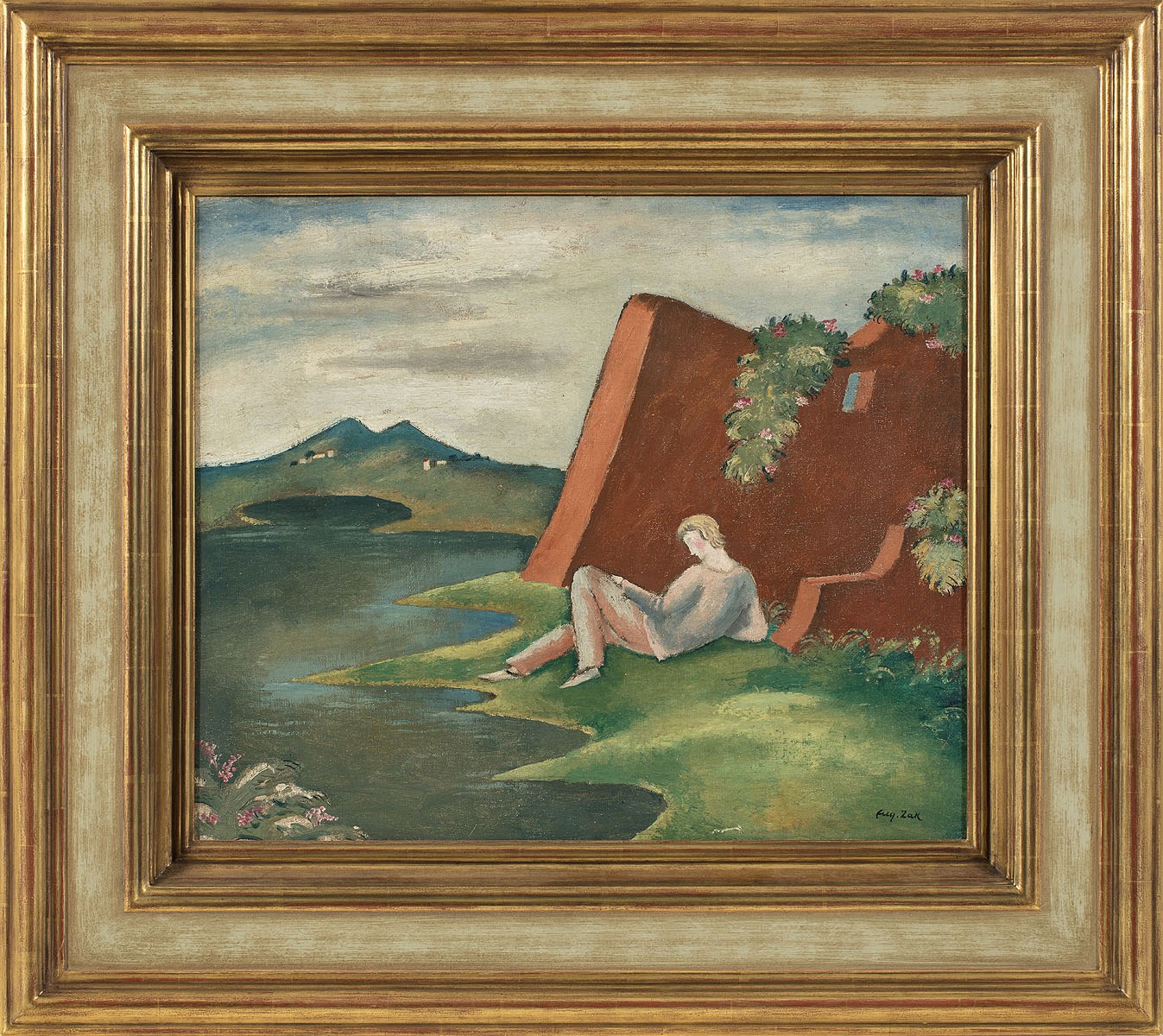

Dimensions: 45 x 54 cm
Signature: signature p.d.: Eug. Zak, on the reverse: Partyka Gallery stamp, National Museum in Warsaw sticker and number: 05999/MR/04
Provenance
Warsaw, private collection Rempex, auction 26.05.2004, item 240 Kraków, Partyka Gallery.
Exhibited
Warsaw, National Museum in Warsaw, Eugeniusz Zak (1884-1926), 12.2003 - 02.2004
Reproduced
B. Brus-Malinowska, Eugeniusz Zak 1884-1926 [exhibition catalog], published by the National Museum in Warsaw, Warsaw 2004, , ill. 49, s. 96.
Literature
Tanikowski A., Eugeniusz Zak, published by the Borderland Foundation, Sejny 2003, item cat 112., p. 112.
Eugeniusz Zak is a name that had a significant impact on the image of Polish art of the interwar period. His work was shaped and matured in the orbit of tradition and contemporary French art. He was called "the most Parisian of Poles" and, along with Kisling and Makowski, became a favorite of collectors and art historians. His artistic attitude was influenced by the art of the Pont-Aven School and the Parisian Nabists, who operated with synthetic form and flexible contours. The artist also succumbed to a rekindled interest in the art of the early Renaissance at the beginning of the century. His fascination with Quattrocento styling intensified in the motifs he developed between 1910 and 1923 of lovers, fishermen and shepherds harmoniously blending into the landscape background. In the second half of the 1920s, images of harlequins and pierrots, representatives of the "artificial" reality of the circus, fair and theater, became a frequent motif in Zak's paintings. Freezing in theatrical poses, the artist inscribed figures of elongated proportions into the shallow spaces of empty interiors.
The idyllic scenes clearly show an interest in Japanese art, but also - or especially - in Chinese painting, and from the most sophisticated period of the late Song era (13th century). In European painting of the time, this type of inspiration was extremely rare. Mieczyslaw Wallis, wishing to characterize the painter's art, wrote: "It is difficult to convey with words the dreamy beauty, the delicate poetic charm of these paintings. We are witnesses to some Arcadian idyll, some dolce far niente and siesta in a land that is not on the map, among flowers and trees not known in botany textbooks. Among the hills with caressing and melodious lines, over the mirrored water, semicircles cutting into the land, they rest in careless, lazy attitudes (...)" (Wallis M., Eugeniusz Zak, "Contemporary Review" 1927, z. X-XI).
The offered painting "Idyll - Landscape with a Lying Young Man, ca. 1915" fits perfectly into the above characteristics. On the background of an idyllic landscape in the Italian or Southern French style is placed a male figure with a typical Zak look, slightly referring to the style of the quattrocento. The melancholy and nostalgia of the performance draws the viewer into a land of timelessness, tranquility and daydreams. This impression is enhanced by the range of subtle tones of greens, blues and browns, as well as the fine, soft contours. Compositions from the idyllic artist's series, as they are usually called, have been among the most valued and sought-after for years.


![Eugeniusz ZAK (1887-1926), Motywa z parku [Paryskiego?], 1904](https://img1.one.bid/img/10307/3219924_1w.webp?1787159737)