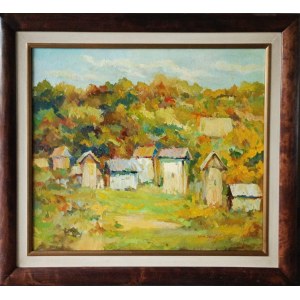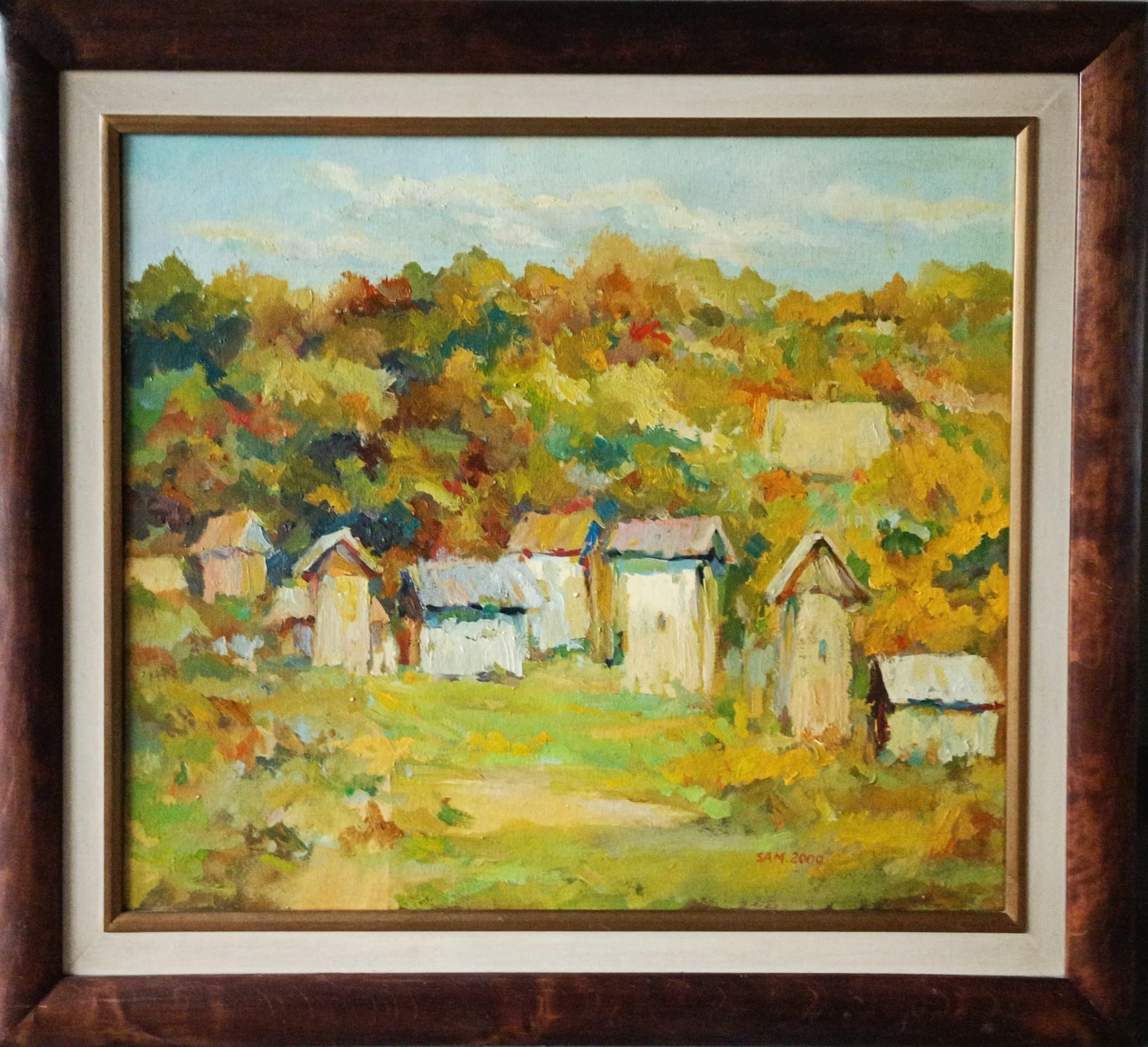
Sławomir Mieleszko (1938, Nowy Świerżeń – 2021, Warsaw), Landscape with Beehives, 2000
Oil on canvas, 70 x 76 cm (frame) / 50 x 59 cm
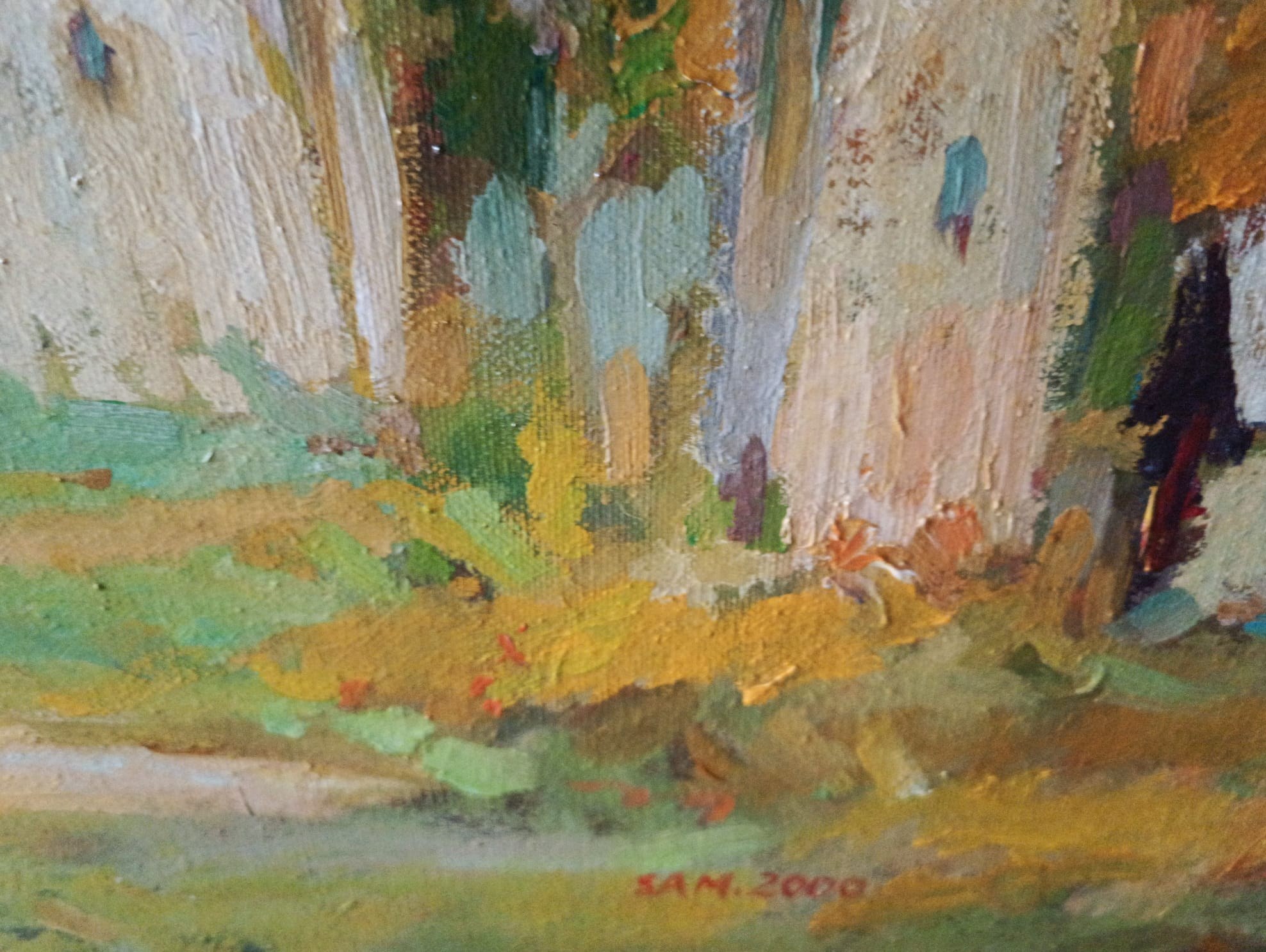
Signed and dated in the lower right corner.
Artist’s details on the reverse.
The painting comes from the collection of the artist’s heirs.
*
Sławomir Andrzej Mieleszko—sculptor, painter, and university professor. He was born on April 30, 1938, in the village of Nowy Świerżeń, in the Nowogódzkie Province (present-day Belarus). He came from a family with an exceptionally long and illustrious history, dating back to before the founding of the Jagiellonian dynasty: one of his ancestors, Jan Mieleszko, was a direct descendant of Gediminas and was part of the retinue that accompanied the matchmakers from Jagiełło to Jadwiga. The family’s subsequent fate was inextricably linked to the history of Poland.
In 1939, the artist’s parents, facing the threat of deportation, managed to flee from the advancing Soviet troops: warned by railroad workers, they left on the last transport bound for Warsaw. They settled in a forester’s lodge near Zambrów, where they hid a Jewish family.
In 1946, the family settled near Lublin. In 1957, Sławomir Mieleszko began his studies at the State Higher School of Fine Arts in Poznań, in the Department of Sculpture. In 1963, he received his diploma from the studio of Prof. Bazyl Wojtowicz.
After graduating, the artist first settled in Świdnik, and later in Lublin. In 1975, he began working at the Institute of Art Education at UMCS, which he co-founded and later served as director for many years. He worked at the university until the year 2000 as a professor in the Department of Monumental Sculpture.
Prof. Sławomir Mieleszko is the creator of several hundred sculptures, including outdoor sculptures and monumental monuments commemorating events in Polish history. These include, among others: the Monument to the Tyszowce Confederation (Tyszowce, 1964), the Partisans Monument (Tomaszów Lubelski, 1966), the Monument to the Children of the Zamość Region (Lublin, 1969), the Victory Monument (Radzyń Podlaski, 1970), the “To the Glory of the Polish Soldier” Monument (Świdnik, 1975), the Monument to the Martyrdom of the Jews of Lublin (Lublin, 1985), and the Tadeusz Kościuszko Monument (Chełm, 1982).
In the 1990s, the artist also turned to painting. His work is dominated, on the one hand, by idyllic landscapes, drawing on the tradition of 19th- and 20th-century Polish painting, and, on the other hand, by portraits of Jewish people. Their origins may lie in the family’s wartime history—perhaps Sławomir, who was only a few years old at the time, retained vague memories of the war years, when the family risked their lives by sheltering Jews. Undoubtedly, stories from that time were recounted many times within the family, especially since, after the war, the artist’s mother was to be awarded the Righteous Among the Nations medal —but she refused to accept it, arguing that she had not helped for the sake of rewards, but out of the goodness of her heart and a sense of decency. Moreover, the family lived in Lublin—a city that had been home to a very significant Jewish community before the war. After the war, a void remained, filled only by the eerie proximity of the site of the former Majdanek concentration camp.
These anonymous portraits of Hasidim, devoid of any anecdotal elements and seemingly suspended in a void, may well be a gallery of those people who no longer exist—the ones who lived in Lublin before the war. In turn, the somber portraits of tragic figures—a weeping child, a woman in rags, a girl with sunken cheeks—unquestionably allude to the tragedies of war. War themes, in fact, serve as a bridge between the artist’s paintings and his sculptural work. We find them not only in monumental sculptures but also in smaller forms, such as the bronze reliefs presented at the auction (No. 29, “War,” and No. 30, “Children of the Warsaw Ghetto”).
Sławomir Mieleszko has exhibited his works in over a dozen solo exhibitions and numerous group exhibitions. He has won numerous awards and honors in sculpture competitions. He was also awarded numerous prizes and honors, including the Minister of Culture and Art Award for his lifetime achievement, the Knight’s Cross of the Order of Polonia Restituta, and a medal from the Minister of National Education. Sławomir Mieleszko died on May 13, 2021, in Warsaw.
[2024/04/AK/9]