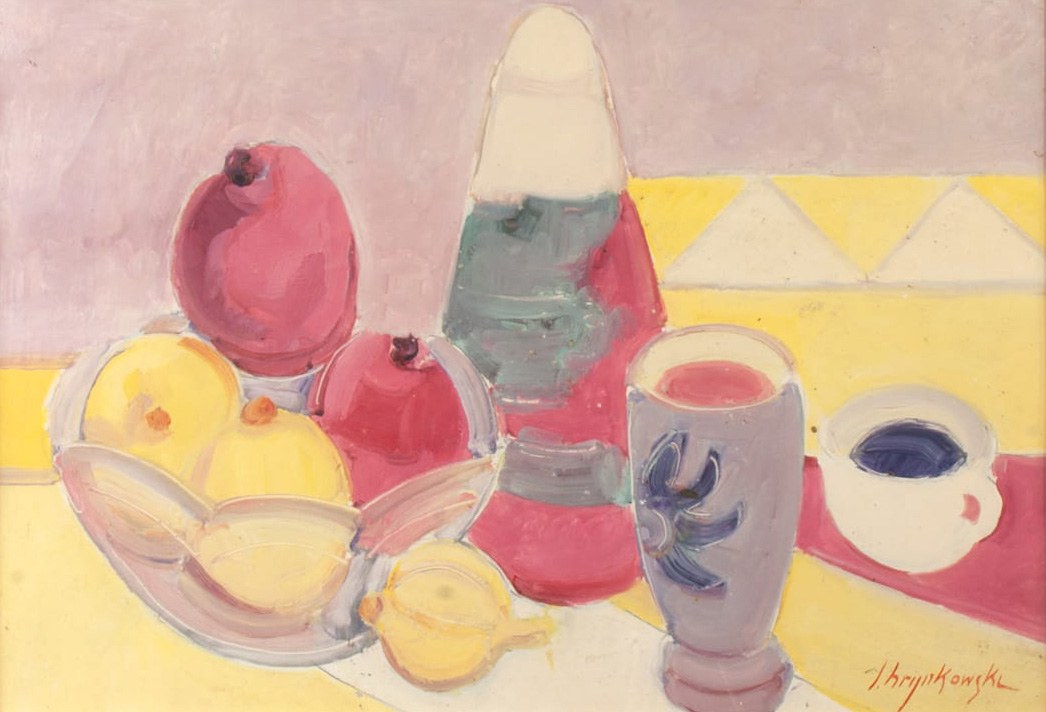
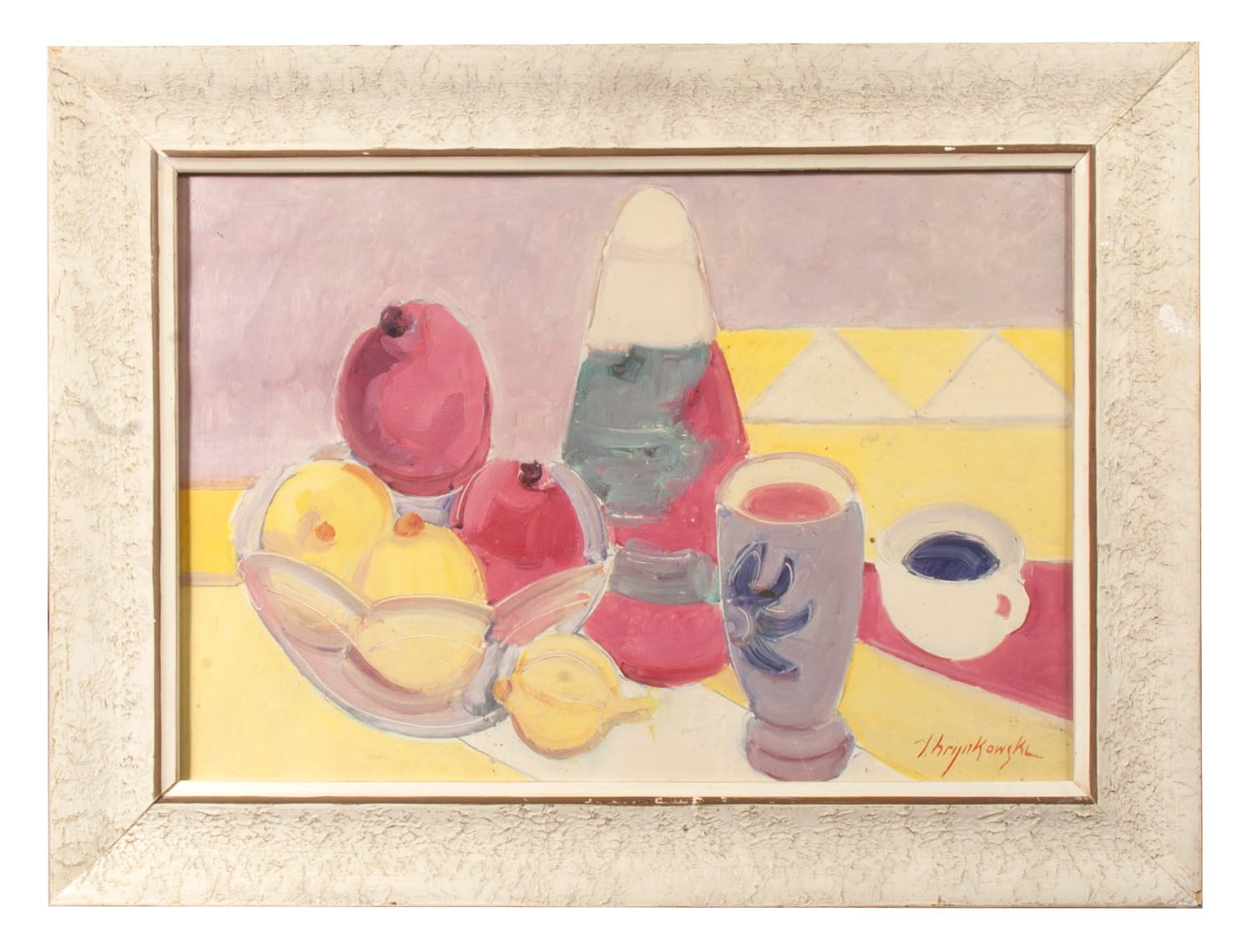
Oil on cardboard, signed p.d. "J.hrynkowski".
Dimensions in frame: 41.5x55.5 cm (31.5x45.5 cm)
Jan Piotr Hrynkowski (Żelechów near Lviv 1891 -1971 Kraków) - Polish painter, graphic artist and stage designer. He studied painting at the Academy of Fine Arts in Cracow under Stanisław Dębicki, Jozef Pankiewicz and Wojciech Weiss, and sculpture under Konstanty Laszczka; he received his diploma in 1918. In 1914 he enlisted in the 1st Brigade of the Polish Legions, was assigned to the 4th Company of the 1st Battalion of the 1st Infantry Regiment, and then in the 1st Artillery Regiment. After going into reserve, he became associated with a group of Cracow Formists, which he co-founded. Until 1921 he participated in most of their exhibitions. From 1921 he stayed in Paris for five years, studying with André Lhote. After returning to Krakow in 1926, together with Felicjan Szczęsny Kowarski, Jan Wacław Zawadowski and Jan Rubczak, he was a co-founder of the Jednoróg grouping and its president throughout the grouping's existence (1925-1935). In June 1926, at an exhibition at the Municipal Art Gallery in Lodz of works by members of this Group, he showed two of his works: Auto(?)portrait and Portrait Study [of a woman reading a newspaper. From 1926 he also worked as a stage designer at the Juliusz Słowacki Theater in Cracow. During the German occupation during World War II, he served as the unofficial president of the Artists' Union in Cracow and was the organizer of the Artists' Café at the Artists' House. There he organized, together with Stefan Zbigniewicz, the open puppet theater "Brzdąc". After 1945, he was a stage designer at the Stanislaw Wyspianski Silesian Theater in Katowice, and from 1955 to 1963 at the Zagłębia Theater in Sosnowiec. He also designed sets for the Old Theater in Cracow. Among others, Hrynkowski presented his work at solo exhibitions in 1946, 1948, 1960 and in 1966, when his monographic exhibition was held at Warsaw's Zachęta Gallery. In November 2019, a major exhibition dedicated to Hrynkowski opened at the National Museum in Krakow: "Jan Hrynkowski. An Artist's Story," curated by Sviatoslav Lenartovich. Hrynkiewicz's painting is a typical example of formist stylistics; it combines cubic deformation, Young Poland decorativism, folklore and grotesque (e.g., Street Juggler, 1919). Over time, he combined his formal interests and realistic subject matter with colorism, which resulted in the development of his own individual style. He painted mainly landscapes, as well as still lifes, nudes, figure and portrait studies. He used techniques such as oil, gouache, watercolor and tempera. A lesser-known part of his oeuvre are his prints, posters, sculptures and literary works.