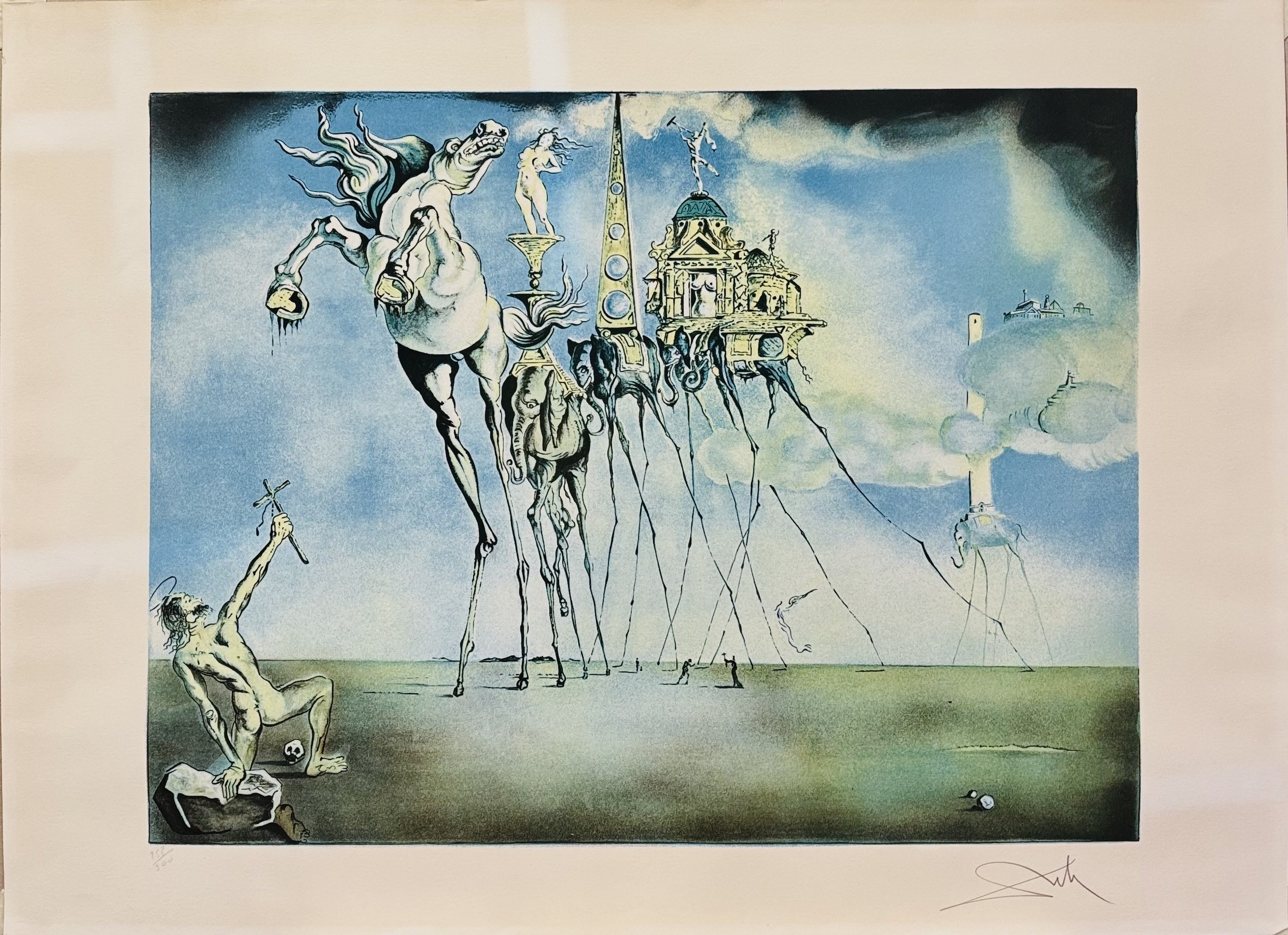
Workshop lithograph, BFK Rives paper, dimensions: 55 x 75 cm.
Signed in pencil by the author p.d. and numbered by the author in pencil 258/300 l.d.
Publisher Atelier Mourlot; edition in an edition of 300 copies. Salvador Dali's lithographs in editions of up to 300 copies were mainly created between 1957 and 1980 at Atelier Mourlot and were supervised and signed personally by Dali.
References:
Catalogue raisonné of the Gala-Salvador Dali Foundation: N° P625.
The work "The Temptation of St. Anthony" is one of Salvador Dali's most famous works, painted in 1946. It is a wonderful example of his mature surrealist style, full of symbolism, fantastic elements and technical mastery.
Dalí created this painting for a competition held in 1946 by the Metro-Goldwyn-Mayer film company to select a work of art depicting the Temptation of St. Anthony for Albert Lewin's The Private Affairs of Bel Ami, based on the novel by Guy de Maupassant. Interestingly, the competition was won by Max Ernst.
The theme of the temptation of St. Anthony has been popular in art for centuries, and Dalí approached it in his own unique way, drawing inspiration from his own obsessions, dreams and psychoanalysis. In the foreground, we see a solitary St. Anthony, kneeling in the act of prayer in the desert. His figure is naked and emaciated, emphasizing his asceticism and spiritual struggle. In his right hand is a cross, a symbol of faith and protection.
A procession of fantastic, misshapen creatures that symbolize temptations emerges and approaches him from behind the horizon: an elephant on long, webbed legs: This is the most characteristic element of the painting. The elephant is a symbol of strength and desire. On its back is an obelisk, which may symbolize phallic power and dominance.
Woman with slender figure: A naked woman on the back of an elephant represents carnal, sensual temptation. Horses with deformed legs: These animals, symbolizing power and impulsiveness, are also depicted in an unnatural way, which heightens the impression of nightmare.
The entire scene is set against a harsh, rocky landscape, typical of Dali's vision. The desert background emphasizes the isolation and loneliness of St. Anthony in his struggle. The sky is dark and stormy, adding to the drama and tension.
Salvador Dalí's painting entitled "The Temptation of St. Anthony" (The Temptation of St. Anthony) is in the Royal Museums of Fine Arts of Belgium (Musées Royaux des Beaux-Arts de Belgique) in Brussels, Belgium.
The fixtures shown in the visualizations are for illustrative purposes only and do not constitute a commercial offer.