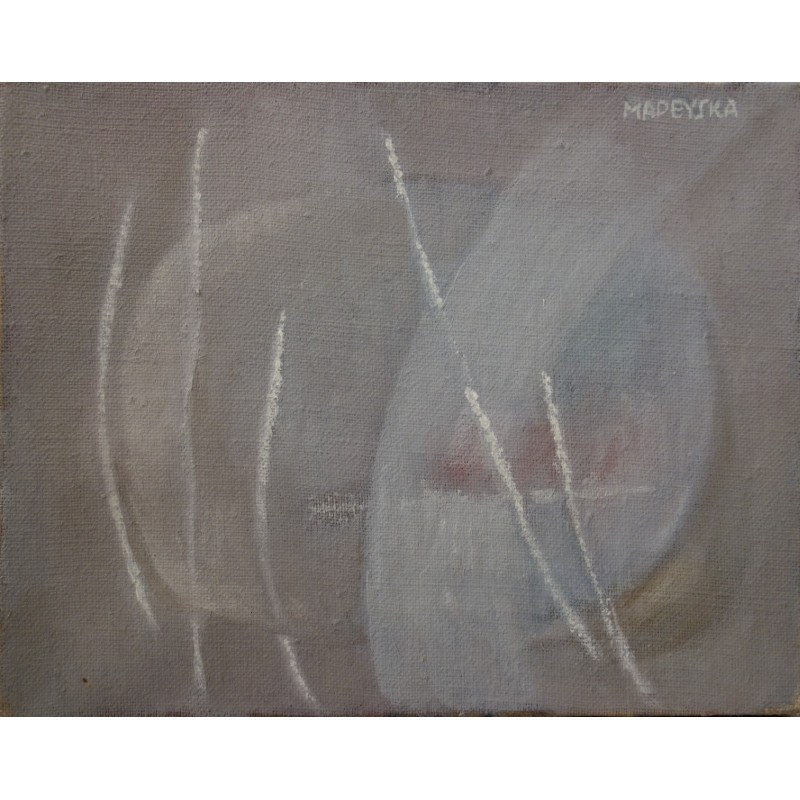
Oil on canvas, 19 x 24 cm,
Signed "MADEYSKA" in the upper right corner.
The work comes from the collection of the artist's heirs.
Arika Madeyska was born in 1920 in Warsaw, to an aristocratic family with intelligentsia and patriotic traditions (her father Władysław Lubicz-Orłowski was an engineer-farmer, and was active in the Home Army during World War II). In 1953 Madeyska graduated from the Academy of Fine Arts in Sopot, where she studied under Artur Nacht-Samborski and Jacek Żuławski. At the academy she met her first husband, Roman Poray-Madeyska, an assistant in the mural painting department. Soon after the artist graduated, the young couple moved to Warsaw, where they quickly became part of the life of the artistic bohemia. It was in the capital that Madeyska began a serious career, and her works won the recognition of the public as well as critics and even official institutions, which awarded her many prizes, despite the fact that the artist rejected the style of socialist realism, using her own unique painting language. Madeyska began exhibiting and winning awards in the late 1950s: her first solo exhibition took place in 1959 on the occasion of the Salon of New Culture in Warsaw. As the artist herself stated : "I worked a lot and painted continuously. I was quite famous. I was invited to all exhibitions, I won awards, museums bought my paintings and even some people bought too. I was promoted without trying for it at all, it happened by itself."
However, despite her successes - and due in part to personal problems - Madeyska decided to finally leave for Paris in 1963. During her first years in the French capital, she suffered immense poverty, but after a while her situation improved, on the one hand thanks to the help of other Poles present in France - be it the Polish artistic bohemia or the "Kultura" circle - and on the other hand thanks to her artistic talents. For Madeyska learned the profession of art restorer and practiced it first in the studio of Joanna Wierusz-Kowalska (through her, she participated, among other things, in the restoration of frescoes in Fontainebleau), and later on her own account. Beginning in 1972. - when she married Jacob Carlo and gained the freedom of movement she did not have before, as the Communist authorities deprived her of a passport - she traveled extensively around the world. It was during this time that she began exhibiting again; previously, her painting career had suffered due to her difficult living situation and the need for gainful employment, making it impossible to concentrate on her art.
In 1991 Madeyska renewed her contacts with the country and began to exhibit her works in Poland again. The artist died in Paris in 2004.
Arika Madeyska's style underwent many transformations: the artist evolved from figurative cityscapes to abstraction with geometric elements, where at first lines reminiscent of some of Mondrian's works dominated, then increasingly rounded forms and finally circles. However, throughout her life the artist preferred small formats and delicate, subdued colors. Her works were exhibited in numerous exhibitions in galleries around the world, including Japan, Switzerland, Brazil, Slovenia and the United States. She has won numerous national and international awards.