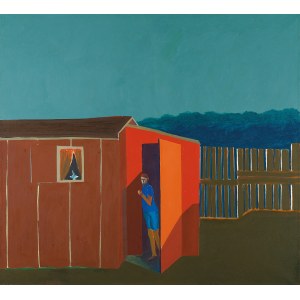
signed, dated and described on the reverse: Jaroslaw Modzelewski 1995 (in circle) / "Barak" / 136 x 150 cm, oil
Malgorzata Kurzac, Inventory of paintings 1977-2004, in Jaroslaw Modzelewski paintings 1977-2006, Krakow 2006, p. 187, color ill. (Painting entitled Barak, 1995) cat. no. 251,
including bibliography: Jaroslaw Modzelewski (cat.), 1996, il.
Jaroslaw Modzelewski began his artistic path in the 1980s. Initially he was associated with the current of "new expression". He took part in exhibitions organized at the former Norblin plant, or participated in the artistic life centered around the Dziekanka Studio. He was one of the founders of the Gruppa art formation (1982), which, in addition to Modzelewski, consisted of Paweł Kowalewski, Włodzimierz Pawlak, Marek Sobczyk, Ryszard Grzyb and Ryszard Woźniak. In 1984-1989 they published the magazine "Oj dobrze już". Despite the expressive tendencies prevalent in the art of the 1980s, Modzelewski's painting is at the same time an example of realism in the painting of the era. His early defined figuration, realism with a distinctive plane of colors, often devoid of structures, made it possible, in effect, to describe him as a "painter of icons of everyday life." The themes taken up by the artist in his paintings center around human beings, existential or political themes. In a conversation with Elżbieta Dzikowska on his own order, rhythm, the artist tells how he sees the real world. "I simplify it, synthesize it, work with a sign, but I have an increasing desire to take into account the structure of reality, the detail." Modzelewski also does not shy away from landscape. Until 1997, the artist uses oil paint, then yolk tempera, which enhances the effect of matte planes in the painting. The offered canvas is an analogy to the painter's paintings from the 1990s, which are characterized by a kind of simplification and schematicity of figures, often repeated many times on the canvas surrounded by an artistically unresolved background or developed completely separately from the figurative part of the composition, sometimes abstractly. According to Jan Michalski, these paintings can be called "painted judgments."