


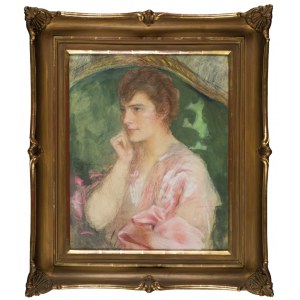
Pastel, watercolor, cardboard, 58 x 47 cm,
Signed: T. Axentowicz.
Teodor AXENTOWICZ (1859-1938)
Painter, pastelist, lithographer. He was in his time one of the most famous and respected Polish artists. He was educated at the Academy of Fine Arts in Munich, and then supplemented his studies in Paris, where he stayed for several years. He took part in the Paris Salons. In 1890 he became a member of the Société Nationale des Beaux-Arts. He also made numerous trips to London. In 1895 he returned to Poland and settled permanently in Cracow, appointed professor at the local School of Fine Arts (from 1900 the Academy). He taught continuously at the academy until 1934, serving twice as rector. He was one of the founding members of the Society of Polish Artists "Art", a member of the Vienna "Secession" and a contributor to its magazine "Ver Sacrum". He was especially successful with idealized images of refined ladies and graceful children's portraits. He also painted genre paintings. He was one of the first painters of the Hutsul region and the Hutsul people. He painted with oil paints and watercolor, and after 1890, primarily with his masterful pastel technique.
"Exquisiteness - this word best describes the dominant feature of Axentowicz's work. There is nothing bright, screaming, pulling out of space here. Measure puts its stamp on everything, not putting up with too bold accents of color, nor decisive, strong contours of shape, a measure that harmonizes details into a gentle harmony that works with focus and calm. Axentowicz does not draw his strongest impressions from nature, he is struck by the shape of the human body and the human figure - the head above all, namely the head of a woman. his proper kind are those, so well known, heads saddened, pensive, dreaming, quiet, sweet, anemic heads of boudoir women, blossoming in a greenhouse, away from the harsh blast of wind and the scorching rays of the sun, women whose complete passivity is the secret of grace, who are adored like flowers, who are cuddled like silks and lace, who have only this in common with life, that they are alive..." wrote Antoni Chołoniewski in the pages of "World" in 1906.










Nesen skatītās
Piesakies, lai redzētu lotu sarakstu
Iecienītākie
Piesakies, lai redzētu lotu sarakstu