


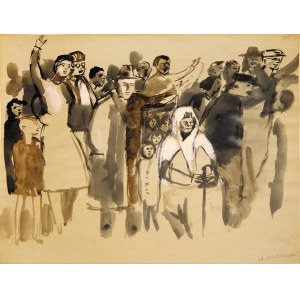
ink, gouache/paper, 36 x 44 cm
described and numbered in pencil. (handwritten by Krystyna Wróblewska),
p.d.: A.Wróblewski, p.g.: 325
on the back topographic map (ozalid)
LITERATURE:
- Avoiding Intermediate States. Andrzej Wróblewski (1927-1957), edited and scholarly concept by Magdalena Ziolkowska and Wojciech Grzybala, Warsaw 2014, Andrzej Wróblewski Foundation, Adam Mickiewicz Institute, Hatje Cantz Verlag, Warsaw - Ostfildern 2014, cat. p. 138, p. 166.
Painter, graphic artist, illustrator, author of theoretical and critical texts. From 1944 to 1946 he was engaged in printmaking under the direction of his graphic designer mother Krystyna Wróblewska. In 1945-1952 he studied at the Academy of Fine Arts in Cracow. He participated in the First Exhibition of Modern Art in Cracow in 1948, where he exhibited abstract compositions and spatial forms. Also in 1948, he established the Self-Study Group at the academy in opposition to the colorism that dominated the academy. At the time, he supported the doctrine of Socialist Realism. From the end of the 1940s come "Shootings," in which the traumatic events of the war are depicted in a surrealist convention - they are characterized by a high degree of deformation and an unreal, symbolic color scheme. The artist strived for "direct realism," which he understood as art that was "legible, thematic and calculated for wide social reach." Since the mid-1950s, his work has been characterized by stylistic diversity, balancing between figuration and abstraction. Wróblewski's work became an inspiration for the next generation of artists in Poland - especially the artists of the new figuration (Cracow's Wprost group, from 1966) and the New Wild (Warsaw's Gruppa, 1980s). In addition to texts on art history and art criticism, Wróblewski also left behind scripts - these refer to real, observed or invented situations. The presented drawing, gives the impression of a film stop-frame. We see a group of figures, focused on what is outside the frame: are they standing on the platform and greeting loved ones? Are they greeting them or saying goodbye? The impossibility of an unambiguous reading of the representation allows for poetic interpretations, but always with an existential meaning, which imposes itself on this and other works by Wróblewski.
"To put the matter in a thorough manner, I would present the purpose and working method of the exhibited drawings as follows: fleeting associations that constantly arise in everyday life, I try to capture and express in a form that would best express each of them. Avoiding any personal aesthetics bent on different content, I give such an artistic abbreviation and such a form as would best suit a given content idea. Hence, the degree of reproduction of a motif varies, depending on how much its subject matter, sometimes secondary features, play a role in the association used or the literal translation of the poetic text. Sometimes I feel the need to refer to any associations of a conceptual or literary nature that a motif evokes - then I reproduce the motif almost photographically. Sometimes, conversely, I look for expression in breaking down the logic of the subject, or in breaking down the logic of space and light. I try to find ways of formal interpretation in such a way that in the situational recreation of motifs, I accentuate their emotional importance at will" Andrzej Wróblewski (A. Wróblewski, Introduction to the catalog of my drawings (1956), [in:] Andrzej Wróblewski unknown, Zderzak Gallery, ed. Jan Michalski [texts: Jarosław Modzelewski, Marek Sobczyk, Marta Tarabuła], Cracow 1993, p. 101.





Nesen skatītās
Piesakies, lai redzētu lotu sarakstu
Iecienītākie
Piesakies, lai redzētu lotu sarakstu