


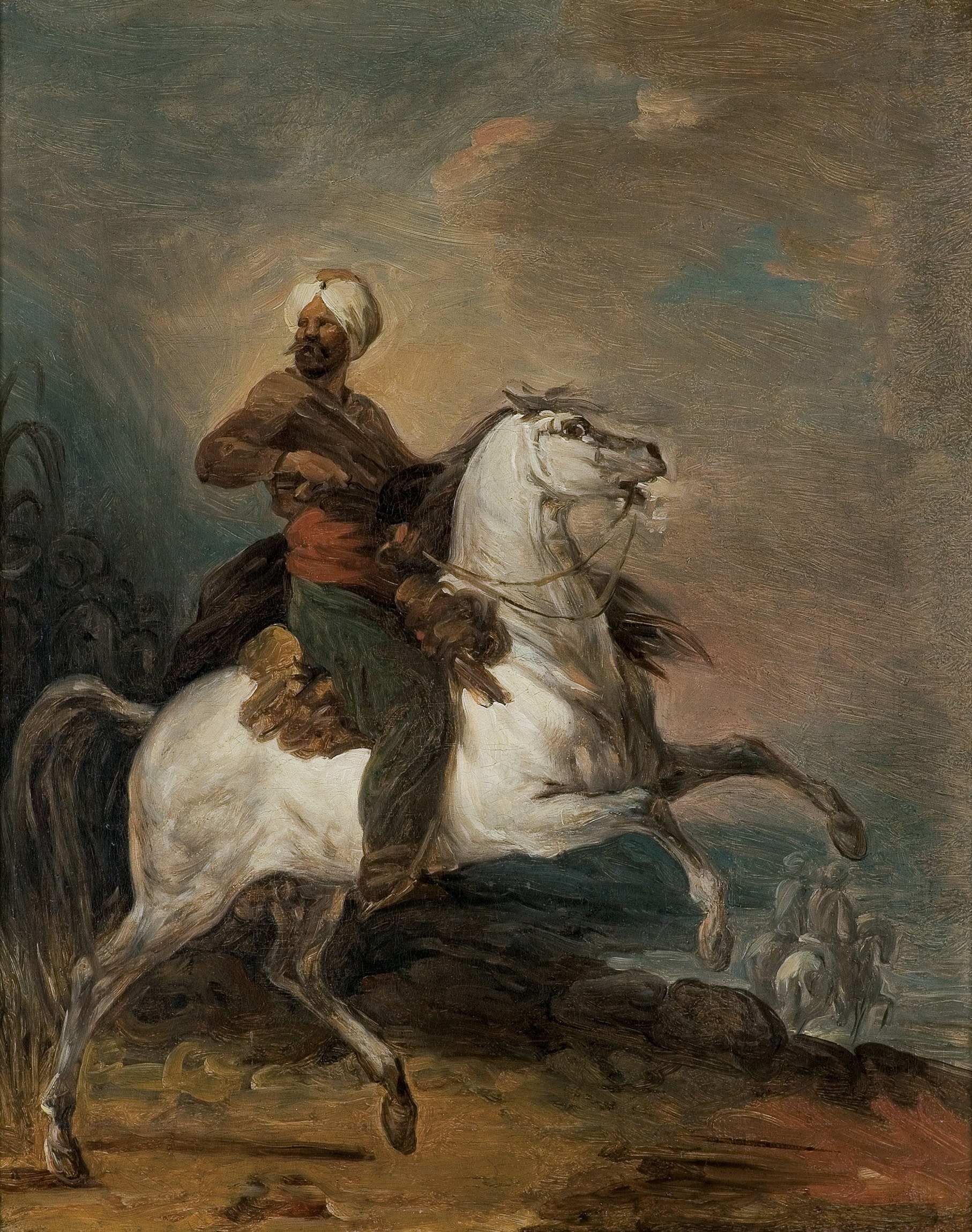
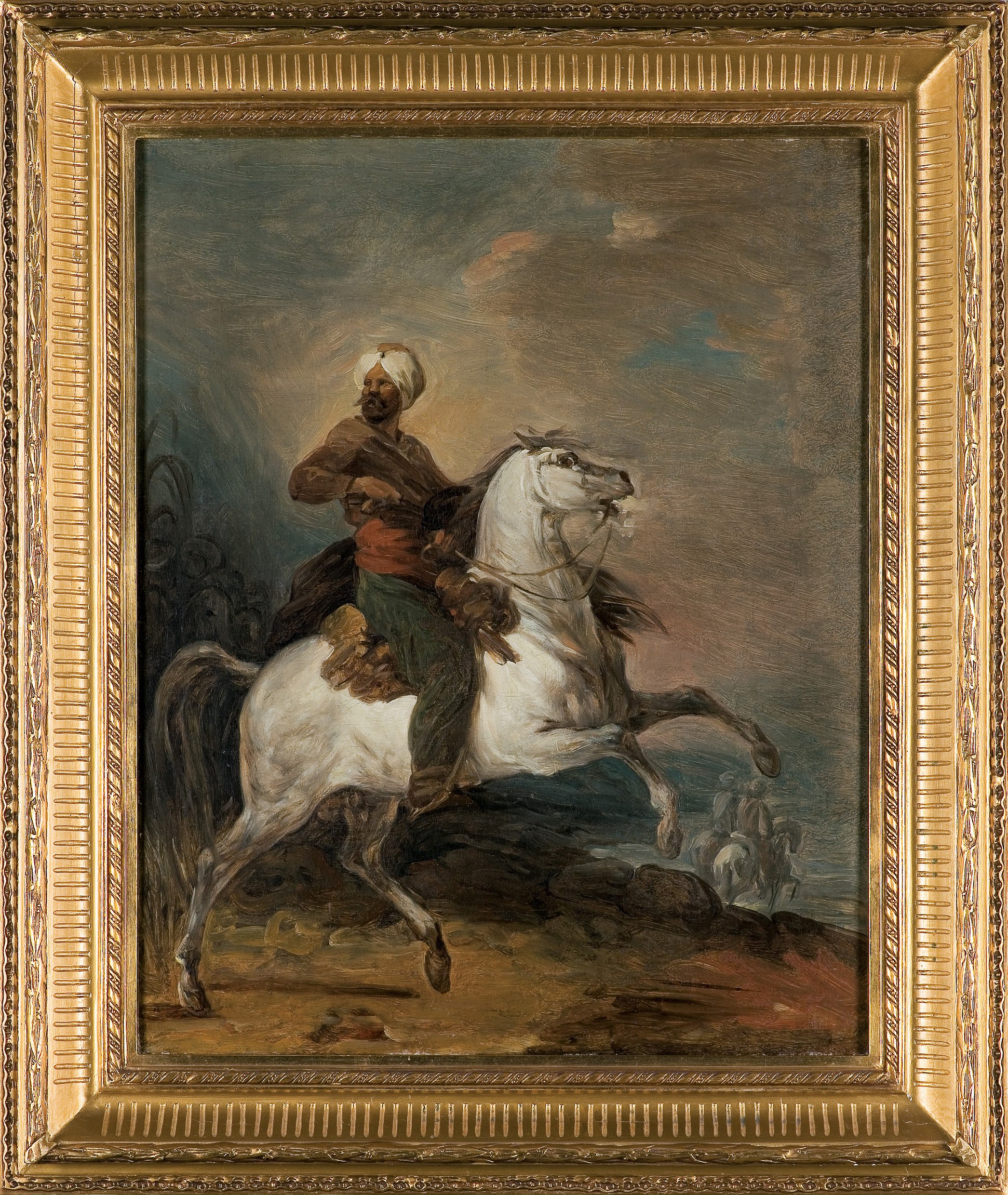
67.00 x 54.50 cm - oil, duplicated canvas
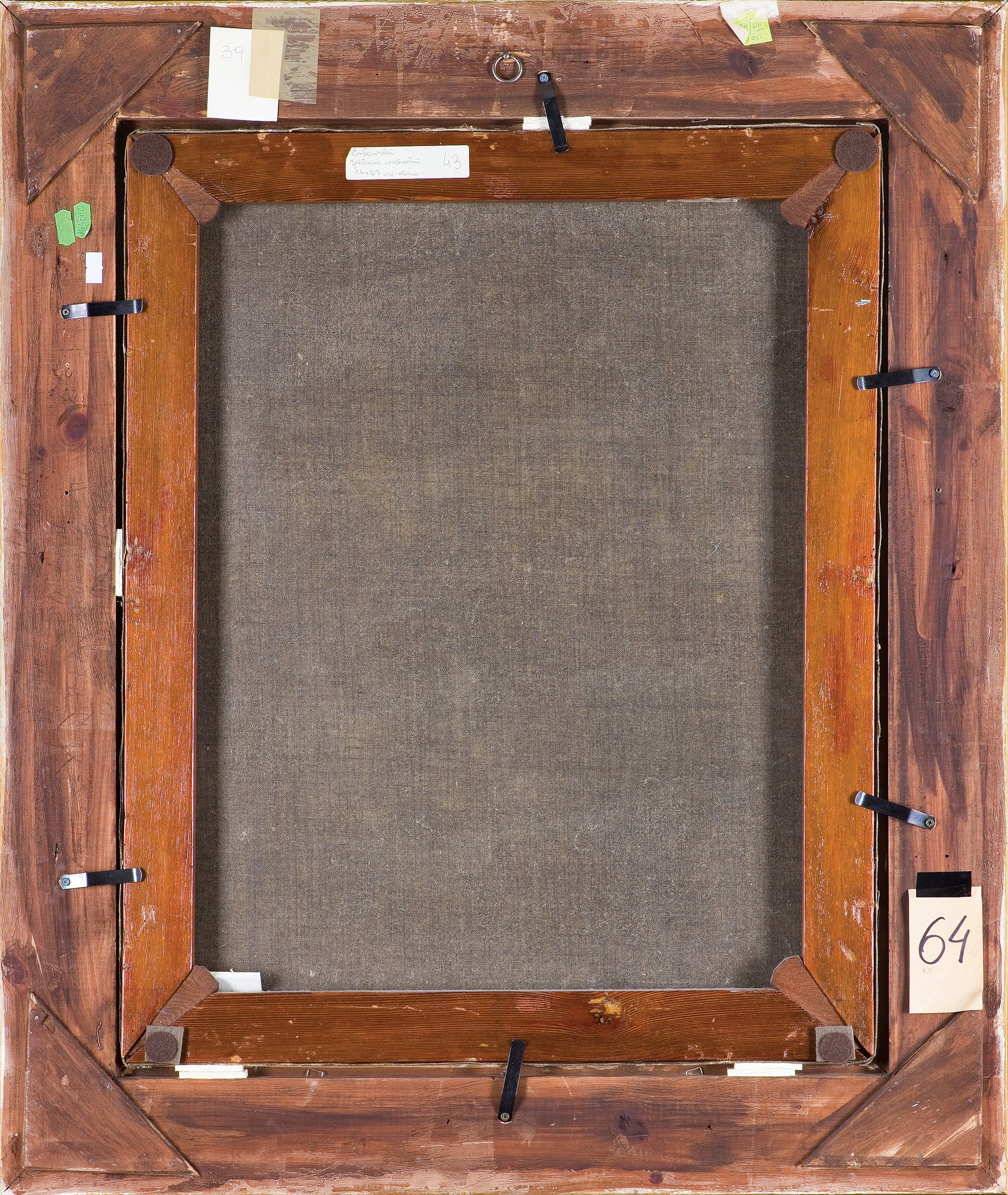
On the upper strip of the painting loom a paper sticker (black pen): Orłowski | Eastern Rider | 54 x 67 | oil-canvas | 43; on the upper frame bar a paper sticker (blue pen): 39, right - 1124/VIII | 210 Eagle; on right rail (black marker pen): 64; on left strip (black pen): D 49538
- Agra Auction House auction, 11 X 1992, item 39.
- P. Sarzyński, Guide to the Market of Painting, published by Iskry, Warsaw 1999, p. 204, il.
Orlowski's merit, achieved, moreover, with Norblin's help, was his break with classicism, his retreat from the official style and his early move to the side of Romanticism, and, above all, his take on realist subjects, first Polish, then Russian.
T. Dobrowolski, Nowoczesne malarstwo polskie, vol. I, Warsaw 1957, p. 146.
Aleksander Orłowski, a pupil of Norblin and Marcello Bacciarelli in the "painting room" at the Castle, left Warsaw in 1802 for St. Petersburg, where he settled permanently. Here he very quickly developed a brilliant career. He became court painter to Grand Duke Konstantin Pavlovich, and later began working for Tsar Alexander I. On the Neva River, as Andrzej Dzięciołowski wrote: he could sate to his heart's content with the picturesque view of exotic Caucasian and Asian auxiliary troops of cavalry, pulling to the West - to come to the succor of the Empire in its military struggles with France, at the tsar's call (Orientalism in painting, drawing and graphics in Poland in the 19th and first half of the 20th centuries. [cat. exhibition], National Museum in Warsaw, Warsaw 2008, p. 326). Fascinating to the artist, colorful groups of horsemen from the East began to appear in St. Petersburg in late 1806, when, after the defeat at Austerlitz, Tsar Alexander I issued a manifesto convening a mass movement. It was to include the nomadic steppe peoples of the Asian part of the empire and the nations of the Caucasus: In incomparably greater numbers, exotic allies flowed into the European part of Russia in 1812, with their return after Napoleon's abdication; in 1814 and the following year, the widespread fashion for their images slowly began to fade, and Orlovsky was forced - again with great success - to turn to caricature and genre humorous scenes (Orientalism..., op. cit., p. 328).
The motif of a horseback rider placed against a landscape is a theme Orlovsky was particularly fond of. One can point to analogies such as Kyrgyz on horseback in the National Museum in Cracow, Cossack in the Art Museum in Lodz, Horseman in the Gallery in Odesa (cf. Aleksander Orłowski (1777-1832): exhibition of works from Soviet and Polish collections, XII 1957 - II 1958, National Museum in Warsaw, National Museum in Cracow, published by Arkady, Warsaw, 1957).
Aleksander Orłowski (Warsaw 1777 - St. Petersburg 1832) - painter, draughtsman and graphic artist. A protégé of Princess Izabella Czartoryska, in 1793-1801 he studied in the atelier of J. P. Norblin, who had a major influence on all his later work. He also studied on a casual basis in the castle's "paint shop" of M. Bacciarelli, the miniaturist W. de Lesseur and the engraver B. Folino. He took part in the Kosciuszko uprising. He periodically worked for Rev. Józef Poniatowski and for Rev. Helena Radziwiłł. In 1802 he went to Lithuania and from there to St. Petersburg, where he settled permanently, soon gaining great popularity. He became court draughtsman to Grand Duke Constantine, and also worked for Emperor Alexander I. In 1809 he was made an academician of the St. Petersburg Academy of Fine Arts. He was primarily a draughtsman, but also enjoyed painting in pastels and oils. The subject matter of his works was diverse: he created battle scenes, drew and painted eastern horsemen, characteristic folk types, scenes of village life, landscapes, portraits and caricatures. From 1816 he was involved in lithography, popularizing the technique in Russia. He was a prominent figure of the Polish art colony in St. Petersburg. Alexander Pushkin wrote admiringly about Orlovsky, finding in his art features close to his own romantic ideals, and Adam Mickiewicz, who befriended him in "Pan Tadeusz", dedicated several poems to "our painter Orlovsky", who, despite, that "his life was consumed in Peterburg | A famous painter (I have a few of his sketches in my desk),| He lived right next to the emperor, at the court, as if in paradise,| And the Count will not believe how he longed for the country,| He liked to constantly recall his youthful days,| He praised everything in Poland: land, sky, forests..."












