


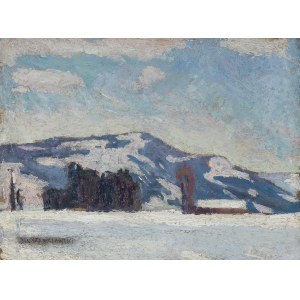
17,6 x 23,7cm - oil, cardboard
two-sided painting
signed l.d. (recto): JAN STANISŁAWSKI
Jan Stanislawski was not only an outstanding landscape painter, but also an excellent and distinguished educator. Brought to the School of Fine Arts in Krakow by Julian Fałat, he headed the chair of landscape for 10 years. It was thanks to him that Polish landscape painting was revived.
Stanislawski broke with academic practices and led his students out of the studios. With their easels, they initially set off for Krakow's Planty, parks and the Botanical Garden. In time, the artist managed to arrange funding that enabled the young painters to go on plein-air trips for several weeks. Plenaries were held in Zakopane in the fall of 1905 and winter of 1906. It is therefore likely that the work on display was created during the artist's winter stay with his students in the Tatra capital. As cited by Urszula Kozakowska-Zaucha in Jan Stanislawski - the great painter of tiny landscapes - they traveled with incessant singing on their lips with pride, as the chosen ones of the Academy (...) The master came every few days. The first day went down to nailing canvases and priming them and finding motifs, and then the young painters spread out like this herd of rams, along the stream stood easel by easel. One painted from breakfast until lunch, and then in the afternoon until evening dusk. As Tadeusz Makowski recalled, the trips [to Zakopane were] full of the harvest of painting and laughing together. We spent time together working, singing, laughing and touring. Happiness radiated from us all around, so that various people like Wladyslaw Slewinski freshly arrived from Paris, Reymont, Witkiewicz, Zeromski and others garnered attention.
Jan Stanislawski (Olshana in Ukraine 1860 - Krakow 1907) - an outstanding landscape painter, printmaker, educator - was one of the most colorful figures in the Krakow artistic milieu of the Young Poland era.
Initially in Warsaw and St. Petersburg, he studied mathematics, then painting under Wojciech Gerson in Warsaw, Władysław Łuszczkiewicz at the Cracow School of Fine Arts, and in 1885-1888 under Carolus Duran in Paris. He traveled extensively in Europe - he went to France, Italy, Spain, Switzerland, Germany, Austria, the Czech Republic, and traveled to Ukraine many times. In 1895 he was in Berlin, where he collaborated with W. Kossak and J. Fałat in painting the Berezina panorama. In 1897 he became a professor of landscape painting at the Cracow School of Fine Arts, the creator of the so-called Cracow School of Landscape. He educated nearly 60 students, including S. Kamocki, H. Szczygliński, S. Filipkiewicz, I. Trusz and S. Galek. He was one of the founders of the Society of Polish Artists Art (1897), a member of the Society of Polish Applied Art (1901). He participated in many exhibitions.
Initially, he painted realistic landscapes based on preparatory studies from nature (numerous surviving sketchbooks). His later fascination with Impressionism led to experiments with light in landscapes and an increasing desire to synthesize color forms. During his travels, he created hundreds, mostly miniature landscapes painted directly in the open air. He worked in printmaking, illustration, and designed posters and theater decorations.







![JAN STANISŁAWSKI (1860 - 1907), Pejzaż z Podola [Krajobraz podolski], około 1905](https://img1.one.bid/img/9723/3007524_1w.webp?1775668397)








Nesen skatītās
Piesakies, lai redzētu lotu sarakstu
Iecienītākie
Piesakies, lai redzētu lotu sarakstu